Get Full Government Meeting Transcripts, Videos, & Alerts Forever!
Get email alerts on the Veterans Homes Admissions Fees topic
No spam. Unsubscribe anytime.
Senate committee backs bill letting Department of Veterans’ Affairs set admissions, collect co‑pays at state veterans homes
Summary
The Family and Veterans’ Services Committee gave Senate Bill 218 a favorable report after the Department of Veterans’ Affairs explained it needs statutory authority to set admissions/discharge rules, collect existing co‑pays and receive federal benefits for the state veterans home enterprise.
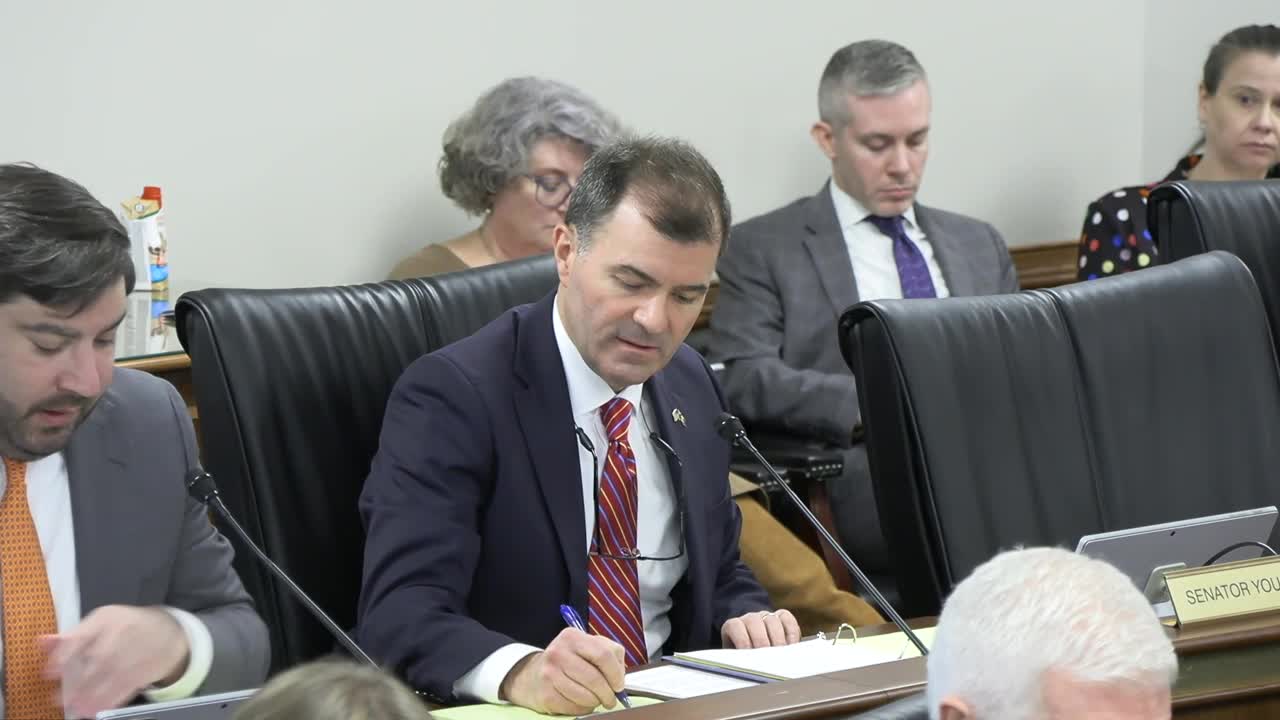
The South Carolina Senate Family and Veterans’ Services Committee voted to give a favorable report to Senate Bill 218, which would authorize the Department of Veterans’ Affairs to set admissions and discharge criteria for state veterans homes, collect resident co‑payments and receive assignments of federal and state benefits to operate the veterans home enterprise.
Committee members heard detailed testimony from the Secretary of the Department of Veterans’ Affairs, who said the bill provides procedural authorities the department needs following the 2023 General Assembly legislation that transferred oversight of the state veterans homes from the Department of Mental Health to the Department of Veterans’ Affairs. The secretary said the last facility in the transfer, Stone Pavilion in Columbia, is scheduled to transfer on July 1, 2025, and that the enterprise now includes six homes (one still transitioning).
The secretary described the co‑payment structure that the department plans to continue: veterans with a U.S. Department of Veterans Affairs (USDVA) disability rating of 70% or higher currently have their full resident cost covered by the USDVA; veterans rated below 70% pay nominal daily co‑pays. The secretary said co‑pays now typically range from $41 to $68 per day depending on the home, while the fully burdened cost per resident ranges roughly from $393 to $500 per day. “Those co‑pays offset the total cost of the enterprise,” the secretary said.
Committee members asked about several operational details. A senator from Richland asked whether probate court commitment orders would still affect admissions; the secretary replied that the veterans homes accept voluntary admissions only and are not receiving involuntary mental‑health commitments. Committee members asked whether National Guard members are eligible; the secretary explained eligibility follows federal veteran status rules and therefore generally requires federal activation or reserve mobilization at some point in the service member’s career.
The secretary also reported on facility status and capacity. The Florence home is operating and almost fully occupied at 104 beds with a waiting list around 60 individuals, the secretary said. The Sumter facility (also 104 beds) has completed construction and was expected to finish licensure and USDVA recognition in late February or early March so residents can begin to be admitted. The secretary said most homes in the enterprise are operated under third‑party vendor contracts administered under state procurement rules; Stone Pavilion remains operated by the state until its transfer.
A motion for a favorable report was moved and seconded; the committee approved the bill by voice vote with no opposition. The record notes a proxy vote from Senator Kimbrell in favor.