Get Full Government Meeting Transcripts, Videos, & Alerts Forever!
Get email alerts on the Education Curriculum Controversy topic
No spam. Unsubscribe anytime.
MTA president defends member-only Israel/Palestine resource list as commissioners criticize one-sided content
Summary
Max Page, president of the Massachusetts Teachers Association, told the Special Commission on Combatting Antisemitism that a members‑only set of Israel/Palestine resources was intended as optional material for educators, as commissioners pressed him over images and worksheets they said were one‑sided or antisemitic.
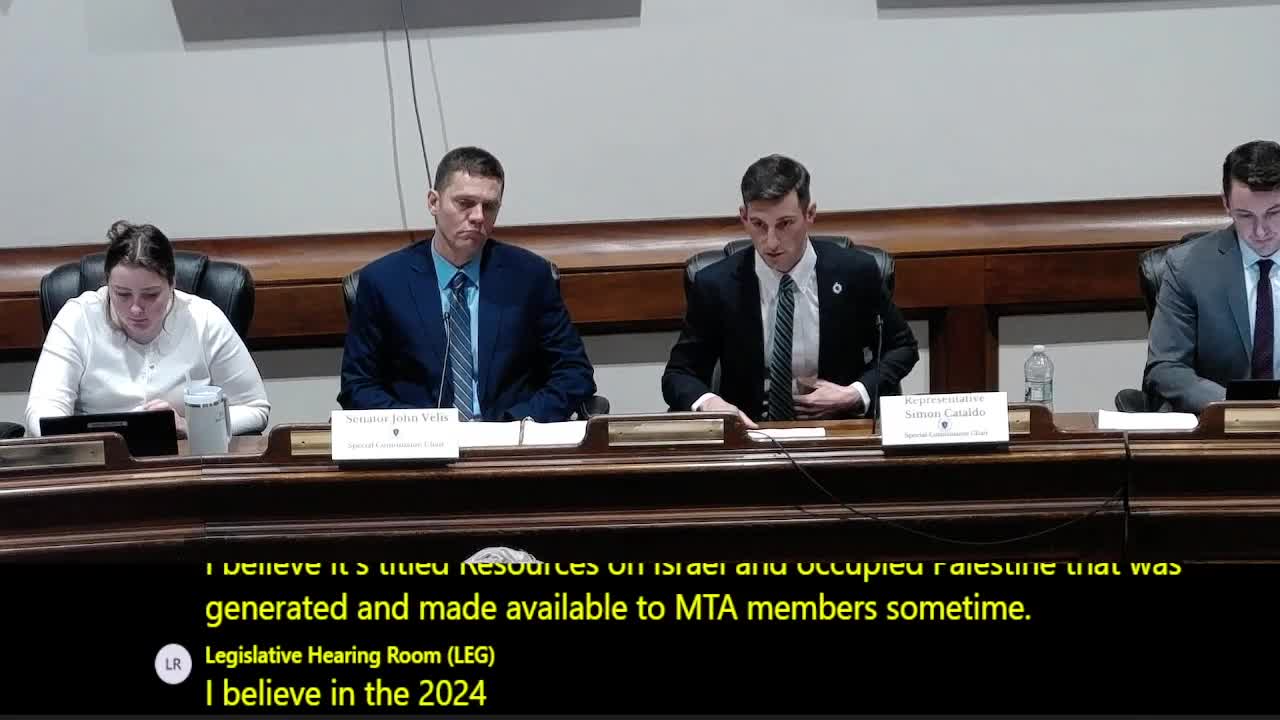
Max Page, president of the Massachusetts Teachers Association, told the Special Commission on Combatting Antisemitism on Feb. 27 that a resource packet titled "Resources on Israel and Occupied Palestine" was created by the MTA professional staff as optional materials for members and was not intended as an official curriculum for classrooms.
"These are resources provided for our members to think about and learn about as educators and as citizens, and they were done thoughtfully and professionally," Page said as commissioners displayed exhibits from the packet and questioned whether images and worksheets were appropriate for K‑12 classrooms.
The commission focused on multiple items from the packet that commissioners and several witnesses described as one‑sided or potentially antisemitic: posters and visuals labeled "Visualizing Palestine," a children's workbook featuring the cartoon figure Handala and references to the Nakba, and other images shown during the hearing including a folded dollar in a Star of David and protest posters. Commissioner questions repeatedly asked whether the materials included parallel Jewish or Israeli perspectives and which of the documents had been used in classrooms.
Jessica Antoline, a social studies teacher at Lexington High School who testified after Page, said she had used some of the materials in her teaching but that she provided context and framing for students. "Teachers absolutely teach controversial materials that they themselves do not necessarily agree with," Antoline said. She added that educators often lack time to build deep curricular units and sometimes rely on outside materials while they develop their own sources and context.
Page told the commission the packet was posted in a members‑only area of the MTA website and was intended to present a wide range of materials for teachers to evaluate, not to mandate what should be taught. "They were not intended as here, use this in a classroom," he said. Page defended his staff and the democratic process in the union, and said the board and professional staff had discussed the materials over months.
Commissioners and several speakers pressed Page on specific items. Representative Cataldo displayed a worksheet contrasting a fictional "Jewish American" teenager and a "Palestinian refugee" and asked whether the materials explain the risks a visitor would face in Gaza; Page replied that the worksheet did not make such claims and repeated that the resources were for professional edification rather than classroom directives. Commissioners also pointed at images they described as explicitly antisemitic and asked whether the MTA had evaluated them for appropriateness.
Witnesses and panelists at the hearing included Jewish, Palestinian, and other community members who urged the commission to protect students from antisemitic material while preserving academic inquiry. Some speakers argued the resource list was needed to broaden the range of voices available to teachers; others said the list was unbalanced and risked encouraging prejudice if teachers lacking subject expertise used items without sufficient context.
The hearing included multiple references to broader standards and definitions of antisemitism. Commissioner testimony noted the International Holocaust Remembrance Alliance (IHRA) working definition of antisemitism and the Jerusalem Declaration on Antisemitism as frameworks commonly discussed by institutions and advocacy groups; commission members debated how those definitions should be used, and whether their adoption should be treated as policy at the state level.
The MTA and witnesses told the commission they would consider board feedback. Page said materials would remain available to members while the union continues to review and respond to concerns raised by Jewish and non‑Jewish educators. Antoline urged the commission to support professional development and classroom safeguards, saying that teachers need time, training and community support to present complex, contested histories responsibly.
The commission did not adopt policy at the hearing. Members said they will continue to collect testimony and consider next steps, including how state guidance, professional development and local curriculum choices interact with union resources.