Get Full Government Meeting Transcripts, Videos, & Alerts Forever!
Get email alerts on the Finance topic
No spam. Unsubscribe anytime.
Alex Partners: $1.8 billion accounting discrepancy traced to conversion errors; recommends independent monitor
Summary
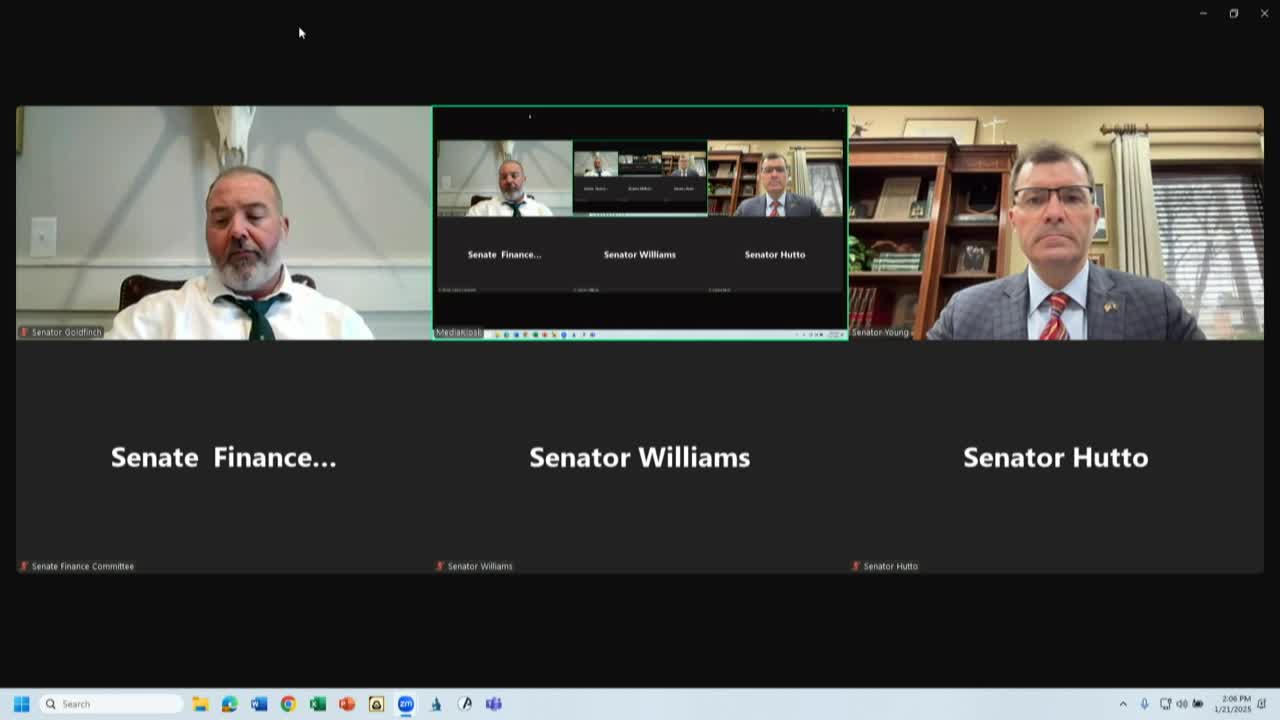
The Senate Finance Committee on Tuesday heard a forensic accounting report that traced $1.8 billion in unreconciled balances to errors made during the state's multi-year conversion from STARS to the SKI(S) accounting system.
The Senate Finance Committee on Tuesday heard a forensic accounting report from Alex Partners that traced $1.8 billion in unreconciled balances within the state's accounting system to errors made during a multi-year conversion from the old STARS ledger to the current SKI(S) system.
Alex Partners' Susan Markle, a managing director, told senators the firm was hired after responding to an RFP from the Department of Administration under proviso 93.19 and was asked to investigate the $1.8 billion matter and a $3.5 billion restatement in the 2022 Annual Comprehensive Financial Report (ACFR). "We responded to an RFP that the admin department put out earlier in the summer, in response to a proviso 93.19," Markle said.
The firm said its scope included tracing cash and investments in the state treasury, reconciling SKI(S) general ledger accounts, and reviewing historical ACFR presentations. "The $1,800,000,000 that we talk about ... it wasn't something that came about as a result of a particular organization," Alex Partners' David Bly said, describing the discrepancy as the product of multiple offices and conversion activities rather than a single actor.
Why it matters
Alex Partners told the committee its work indicates roughly $1.607 billion of the $1.8 billion balance does not represent actual cash balances in treasurer-controlled bank accounts; instead, those amounts resulted from accounting entries tied to the conversion process and to how certain accounts were classified in the ACFR restatement. The firm said about $245 million does represent cash that remains to be properly classified.
Key findings and recommended fixes
- Conversion mechanics: The report traces the problem to two conversion phases: migration from STARS to SKI(S) beginning in 2007 and a bank account re-mapping completed in phases through 2017. In the re-mapping phase, transactions that could not be tied to a specific bank were parked in a conversion fund, recorded as Fund 30350993, and were later excluded from ACFR reporting. Alex Partners said both the Comptroller General's Office and the State Treasurer's Office were aware that the fund was being used for conversion reconciliation.
- Nature of the $1.8 billion: Alex Partners said much of the $1.8 billion was created by accounting entries that do not change underlying bank balances; their tests in a SKI(S) test environment showed reversing those conversion entries leaves bank-account balances unchanged, which the consultants interpret as evidence that roughly $1.6 billion never represented cash the treasurer could "touch." The firm told the committee that, while about $245 million is cash that should be reclassified to the ACFR general fund, the $1.6 billion portion should be removed from the accounting ledger entries produced by the conversion.
- Restatement complexity: The 2022 ACFR restatement reported a $3.5 billion adjustment; Alex Partners said that presentation aggregates multiple underlying misstatements, including a roughly $5.9 billion overstatement and the offsetting $1.8 billion understatement, and that the historical allocation of the restatement in the ACFR's statistical tables may need further review.
- Documentation and controls: The report criticized weak documentation for key tax and cash adjustments, missing support for some journal entries, the use of SKI(S) batch entries that obscure who posted transactions, and limited contemporaneous rationale for "topside" adjustments that changed the ACFR presentation without clear source documentation.
- Governance and staffing: Alex Partners recommended improving the relationship and information flows between the Comptroller General's Office and the State Treasurer's Office, strengthening audit independence practices, and assessing staffing and technical needs in the Comptroller General's Office to support accurate ACFR preparation.
Recommendations presented to the committee
Alex Partners offered multiple recommendations; the firm emphasized two priority actions: (1) hire an independent compliance monitor (described in testimony as an "independent compliance consultant" or "monitor") to oversee implementation of corrective steps and ensure recommendations are executed, and (2) correct SKI(S) entries by reversing conversion-related entries and reclassifying the remaining $245 million into the general fund in the ACFR after appropriate analyses.
On procedure and oversight, the consultants said that an independent monitor could also demonstrate to any external regulator, including the Securities and Exchange Commission if it were to inquire, that the state is addressing issues proactively.
What the committee did and next steps
No formal votes were held. The subcommittee recommended a favorable report on a joint resolution to re-obligate $1.2 million appropriated last year to fund the independent oversight work Alex Partners recommended; the committee chair announced the matter and the Alex Partners presentation will continue at a future session and asked staff to prepare draft edits to the joint resolution ahead of floor consideration. Committee members signaled they will reconvene the matter next week for further discussion.
Quotes from the meeting
"We responded to an RFP that the admin department put out earlier in the summer, in response to a proviso 93.19," Susan Markle, managing director at Alex Partners, told the committee.
"We believe there was a mistake that happened as part of that process, that contributed to the $1,800,000,000," David Bly, a CPA with Alex Partners, told senators.
"If it was based on 1.8 as the principal balance, then the answer would be no," Bly said when asked whether the treasurer's office could have legitimately earned the investment earnings figures previously cited in public testimony.
Context and limits
Alex Partners said much of its work relied on documents produced by the Department of Administration and email records provided by state offices, plus a SKI(S) test environment provided by the Comptroller General's Office. The consultants said some former employees could not be reached; the consultants also said they reviewed auditors' work papers provided by the joint auditors. The report does not allege criminal activity; Alex Partners told the committee it found no definitive evidence of an intent to conceal but cited a pattern of weak documentation, limited ownership of the problem across offices, and years of inadequate follow-up.
Ending
Committee leaders and Alex Partners agreed to continue the matter at the next Finance Committee meeting to consider draft bill language and the subcommittee's recommendation to obligate funds for independent oversight. The consultants told senators they stand ready to assist in implementing the corrective steps they laid out in the report.