Get Full Government Meeting Transcripts, Videos, & Alerts Forever!
Get email alerts on the Wastewater Infrastructure topic
No spam. Unsubscribe anytime.
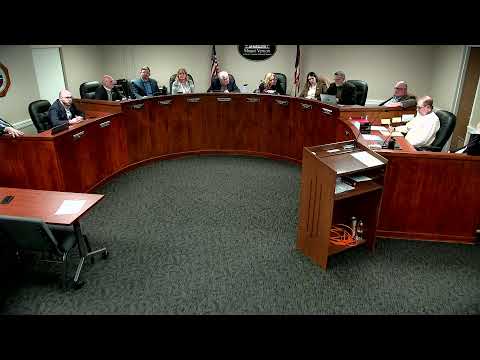
Mount Vernon council approves step to seek WPCLF loan for $45M wastewater upgrades
Summary
City council voted 6–1 to authorize staff to apply for a Water Pollution Control Loan Fund (WPCLF) loan as the city advances design and funding work for a roughly $45 million wastewater treatment plant upgrade aimed at phosphorus removal and replacement of aging equipment.
Mount Vernon City Council voted to authorize the Safety-Service Director to apply for a Water Pollution Control Loan Fund (WPCLF) agreement with the Ohio Environmental Protection Agency, a step officials said is needed to advance design and seek low-interest financing for a comprehensive wastewater treatment plant upgrade.
Council approved Resolution 2025‑02 in a 6–1 vote on Feb. 10. The measure does not obligate the city to accept a construction loan or begin construction; it clears the way to pursue WPCLF design funding and retain a construction manager, officials said.
The project team and city staff told council the work addresses aging equipment and new regulatory requirements. Joe Jacobs of Arcadis, the project consultant, said many plant structures have not been upgraded since the 1970s and 1990s and that the Ohio EPA is moving toward phosphorus limits that the plant must meet. “This project is really intended to address a lot of the facilities that have aged and have deteriorated over time and are in need of upgrade,” Jacobs said.
City and consultant materials estimate about $45 million for the full set of improvements. The timeline presented shows design work in 2025, a construction-loan decision targeted for late 2025, construction start as early as January 2026 and about 30 months of construction — putting substantial completion in mid‑2028, assuming all later approvals and funding are secured.
Project elements described by consultants include replacement or rehabilitation of preliminary screens and grit systems, primary settling and grit removal, major secondary treatment basin upgrades, upgraded disinfection and chlorine handling, improved solids thickening and dewatering, and anaerobic digestion upgrades. Consultants said some equipment is at or beyond recommended service life and that construction-cost escalation and broader scope growth since an earlier, smaller plan account for much of the increased estimate.
Arcadis and city staff stressed the WPCLF is a loan program. “It is a loan. They have to pay the loan back, but they offer discounts on the interest rate,” Jacobs said, noting the WPCLF can reduce financing costs versus a typical bond. The city will pursue other grants and funding opportunities, but officials cautioned grant availability is competitive and not guaranteed.
Council members pressed the administration on how the scope grew since the 2021 plan and on the project’s likely effect on sewer rates. City staff said they will run a rate study to quantify revenue and rate impacts before asking council to accept any construction loan. As a working example presented in committee, a purely hypothetical $45 million financed at 0% over 20 years, spread across 7,209 active wastewater accounts, would equate to about $26.01 per account per month; staff said that was an illustrative calculation and not a proposed rate.
Several council members said they supported moving forward with design and funding steps while retaining questions about long-term costs and project scope. Councilman Miller said he was supportive of addressing plant needs but remained “questioning how the scope grew so much in four years” and urged careful financial planning before committing to construction.
Council voted to adopt Resolution 2025‑02; staff said subsequent steps will include issuing an RFQ for a construction manager-at-risk (CMAR), finishing design, securing a guaranteed maximum price, and then returning to council for contract approvals and any loan acceptance.
The city also noted enterprise-funded loans for wastewater do not count against the city’s general-purpose debt limits under state rules because their repayment is sourced to the utility enterprise rather than general property-tax-backed debt. City staff said they will return with a rate-study-based funding plan before any construction borrowing is finalized.