Get Full Government Meeting Transcripts, Videos, & Alerts Forever!
Get email alerts on the Clean Energy Transition topic
No spam. Unsubscribe anytime.
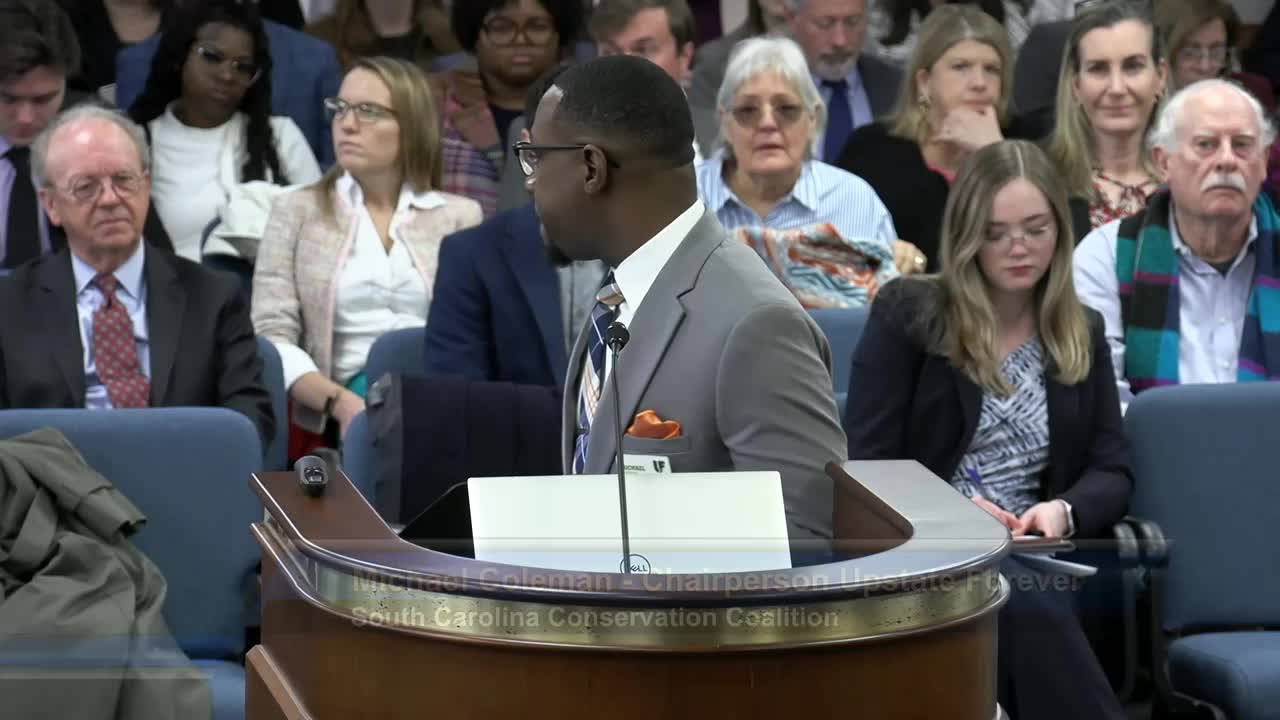
Conservation coalition urges careful clean-energy transition and expanded efficiency programs
Summary
Conservation groups told the Senate Fish, Game and Forestry committee that South Carolina must pair a clean-energy transition with stronger oversight, better load forecasting and expanded energy-efficiency programs to protect ratepayers, habitats and economic competitiveness.
Conservation advocates told the Senate Fish, Game and Forestry annual briefing that South Carolina’s transition to cleaner energy must be managed with improved utility forecasting, stronger oversight and broader efficiency programs to avoid cost-shifts to long-time ratepayers and to capture economic benefits from clean-energy jobs.
The coalition asked lawmakers to require utilities to adopt industry best practices for load forecasting, to guard against unexpected rate impacts, and to expand weatherization and efficiency programs that lower household energy burden.
Taylor Allred, energy and climate program director at the Coastal Conservation League, said rapid industrial load growth — in part from proposed data centers — creates new forecasting challenges. “This new kind of electrical load growth calls for new approaches to load forecasting to make sure that we have as clear a picture as possible before making sweeping policy changes or committing ratepayers to billions of dollars worth of investments,” Allred said. He urged lawmakers to consider recommendations from the Applied Economics Clinic’s white paper on load-forecasting best practices.
Allred also warned of two broad risks: that inadequate accountability could allow costs to “skyrocket” and that private property rights and wildlife habitat could be harmed if oversight is rolled back. He cited the Energy Freedom Act (2019) and the earlier repeal of the Base Load Review Act as examples of major statutory steps the General Assembly has taken in recent years.
Stacy Washington, clean energy and equity director at the Southern Alliance for Clean Energy (SACE), told senators that energy burden remains acute in parts of the state and that existing federal and utility programs reach a small fraction of households that could benefit. Using the U.S. Department of Energy’s definition, Washington said a household has an energy burden when electricity costs reach 6% or more of income; she noted that Allendale County is at about a 6% energy burden while surrounding counties are at about 5%.
Washington described two existing federal programs administered in South Carolina — the Weatherization Assistance Program (WAP) and the Low Income Home Energy Assistance Program (LIHEAP) — and said local community action agencies use those funds to weatherize several hundred homes a year. She said state and utility programs are inconsistent geographically and that South Carolina ranked near the bottom in the American Council for an Energy-Efficient Economy state scorecard.
Both presenters tied workforce and economic opportunity to clean-energy policy. Allred cited an E2 industry report saying South Carolina has nearly 50,000 clean-energy jobs and argued that states without policies to ensure affordable, reliable clean power risk losing job and investment opportunities.
The coalition asked lawmakers to consult with the groups as bills affecting permitting, economic development and energy policy move through the legislature, and to weigh impacts on ratepayers and natural resources before voting.
The presenters answered senators’ questions about specific proposals and offered to provide reports and models to staff. Washington agreed to deliver the SACE report cited during testimony to committee staff on request.