Get Full Government Meeting Transcripts, Videos, & Alerts Forever!
Get email alerts on the Water And Infrastructure topic
No spam. Unsubscribe anytime.
Senate water committee adopts rules, hears agency briefings on $1 billion fund, SWIFT demand and flood needs
Summary
At an organizational hearing in Austin, the Senate Water, Agriculture and Rural Affairs Committee adopted its rules and received overview briefings from state agencies that outlined large unmet needs for water infrastructure, flood projects and staffing to process permits and grants.
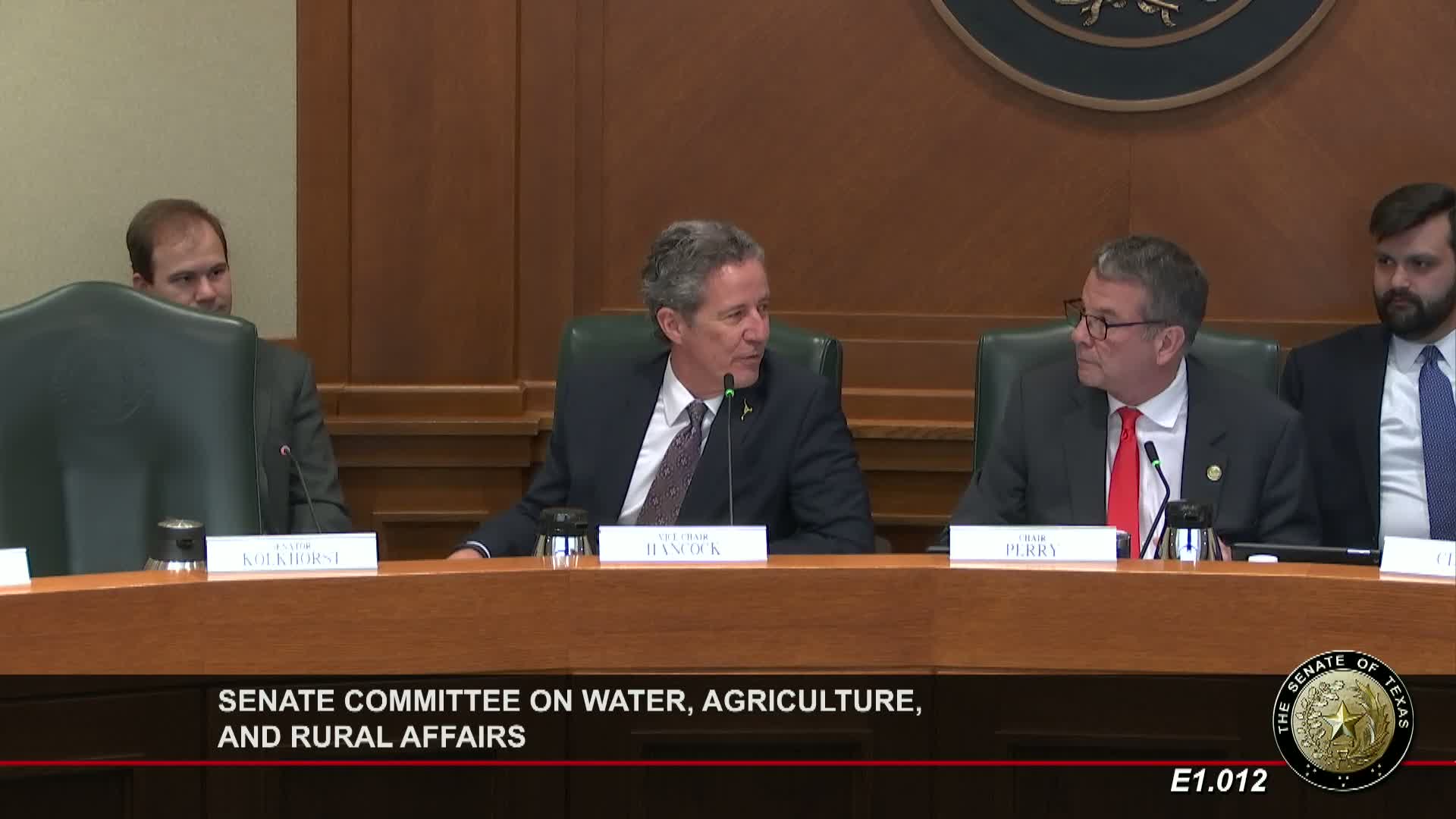
The Senate Water, Agriculture and Rural Affairs Committee on Monday adopted its committee rules and heard invited testimony from seven state agencies on water supply, flood planning, infrastructure funding and related regulatory work.
Senator Perry, chairman of the panel, opened the organizational hearing, which included presentations from the Texas Water Development Board (TWDB); the Texas Commission on Environmental Quality (TCEQ); the Texas State Soil and Water Conservation Board; the Public Utility Commission (PUC); the Texas Animal Health Commission (TAHC); the Texas Department of Agriculture (TDA); and Texas Parks and Wildlife Department (TPWD).
L’Oreal Stepney, chairwoman of the Texas Water Development Board, told senators the agency manages science, planning and finance for state water work and has grown sharply as a lender and grantor. “We are a small agency with big responsibilities,” Stepney said, noting SWIFT (the State Water Implementation Fund for Texas) has funded about $11.5 billion in projects to date and that the board recently received roughly $5.1 billion in abridged applications in the latest SWIFT solicitation. She said the state’s Clean Water and Drinking Water revolving funds together show roughly $8 billion in current need ($4.2 billion drinking water, $4.1 billion clean water) and that the 2018 state water plan estimated roughly $80 billion in water and wastewater infrastructure costs, while the newly adopted flood plan identified about $54.5 billion in needs.
Brian McMath, executive administrator at TWDB, summarized how the $1 billion Texas Water Fund adopted by the legislature has been allocated. McMath said roughly $750 million of the fund was treated as discretionary and $250 million was set aside for the new Water Supply Fund for Texas; portions were used to reactivate smaller programs such as the Rural Water Assistance Fund (RWAF) and the Water Loss Assistance Fund (WALAF) to assist communities of varying sizes. He also described a statewide water awareness campaign and agency requests to add staff and to provide matching funds for federal state revolving fund grants.
TCEQ Chairwoman Brooke Popp and Executive Director Kelly Kiel told the committee the agency enforces water quality and water-rights authorities, oversees drinking-water primacy for public systems, and responds to boil-water notices and major system outages. Patrolling and technical assistance teams, Kiel said, helped 110 systems in 2023–24 through multiweek emergencies and the agency logged more than 7,600 boil-water notices over the past two years; she added 95 percent of those events were tied to low distribution pressure or outages. Kiel said permit applications have increased (about 900 over the last two years compared with a 20‑year annual average near 700) and flagged produced-water permitting as a growing workload; TCEQ pressed the need for additional FTEs, including a request for 39 FTEs tied specifically to produced-water reviews.
Agency witnesses and members discussed dam safety and flood-delivery readiness. Stepney and TWDB staff said flood planning and engineering work is largely complete in many regions but that funding is the primary barrier to moving projects to construction; TWDB noted the agency has an initial $2 billion of flood projects with applications ready to proceed if funding becomes available. The Texas State Soil and Water Conservation Board and TPWD staff highlighted aging dam and levee infrastructure: the soil-and-water board said Texas relies on roughly 2,038 flood-control dams, with 752 now classified high hazard and an estimated $3.8 billion cost to address long‑term repair and rehabilitation needs; the board requested further state funding to accelerate repairs.
Other agency highlights included the PUC’s work to streamline utility consolidations and system improvement charges for utilities, the TAHC’s ongoing surveillance and response to animal diseases (including high‑path avian influenza, cattle‑fever tick control, and surveillance for new‑world screwworm and invasive ticks), and TDA’s agricultural export, school‑meals and biosecurity programs. TPWD described recent conservation actions including translocation of bighorn sheep into Franklin Mountain State Park and recent rulemaking on chronic wasting disease (CWD) designed to balance breeder and wild‑herd protections.
Senators pressed agency officials on staffing and process: members repeatedly asked for more FTEs to keep permitting and emergency response from becoming bottlenecks as population and project demand rise. Committee members also discussed municipal utility districts (MUDs), with TCEQ staff describing the agency’s review and avenues for affected parties to seek administrative hearings when MUD creation is contested.
The committee adopted its rules as presented; the chair said there were “no substantive differences” from the draft members had received. The hearing was organizational in nature and included agency updates and requests the committee will carry forward into bill drafting and budget deliberations.
Looking ahead, TWDB and TCEQ said they plan to press for budget and staffing increases during the legislative session, and the committee indicated it will continue hearings that focus on SB 7/SJR funding mechanisms and implementation details before advancing major statutory changes.