Get Full Government Meeting Transcripts, Videos, & Alerts Forever!
Get email alerts on the School Facilities topic
No spam. Unsubscribe anytime.
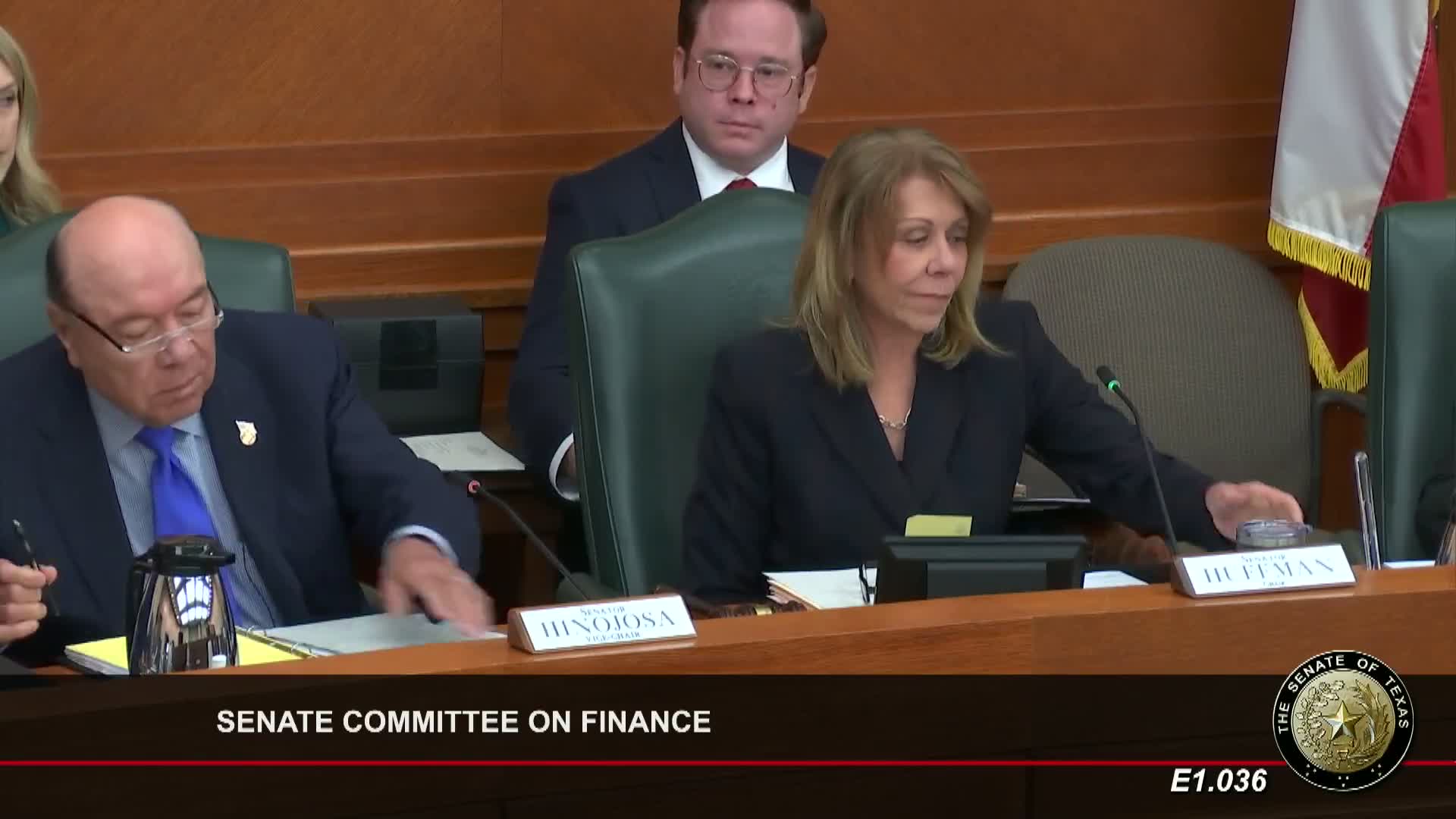
Texas School for the Deaf asks Senate Finance for $35.3M central‑plant funding; LBB recommends smaller biennial increases
Summary
The Texas School for the Deaf (TSD) presented budget recommendations to the Senate Finance Committee, seeking a $35.3 million exceptional item to upgrade the central utility plant. LBB recommended maintenance funding and smaller targeted increases for salaries, special education services and transportation in 2026–27.
The Texas School for the Deaf told the Senate Finance Committee it needs a major capital appropriation to replace and expand its central utility plant and asked lawmakers to consider a $35.3 million exceptional item for campus master plan phase 3B.
LBB presenter Antonio Najera summarized recommendations and noted the board did not include TSD’s $35.3 million exceptional item in the baseline but recommended other targeted increases for the TSD 2026–27 biennium. Najera said recommendations include a roughly $84.9 million all‑funds biennial recommendation for TSD — a modest increase from the 2024–25 base driven by required educator salary biannualization, increased general‑revenue support for federally mandated special education services, and higher transportation costs.
Nut graf: TSD officials told the committee the campus central utility plant — which supplies heating, chilled water and HVAC to most occupied spaces including dormitories — is nearing end of life and currently operates at roughly 90 percent capacity. The school said the $35.3 million would expand chilled and heating water systems to support future master‑plan growth and reduce recurring reliability risk.
During committee questions, senators pressed school leaders about staffing and recruitment, bilingual stipends, transportation for residential students, and the voluntary residency and teacher compensation environment for deaf‑education teachers. TSD superintendent Peter Bailey described recruitment challenges: the pool of certificated deaf‑education teachers nationally is very small — the school competes with other Texas districts and out‑of‑state cost‑of‑living barriers and relies on bilingual stipends to attract some staff.
TSD CFO Justin Woodell told the committee the school requested salary increases tied to the statewide educator salary initiative (Austin ISD parity) and sought roughly $3.5 million in general revenue to maintain federally mandated special education program staffing (about 30.7 FTEs). Transportation costs for residential ‘‘homegoing’’ services were cited at about $2 million annually; LBB recommended $7.6 million for transportation in the 2026–27 biennium to reflect both daily local and weekly homegoing charter/airline transports.
Ending: The committee left the request on the record; LBB included the school’s finance details in their Article 3 packet and recommended the exceptional central‑plant item remain on the agency’s request list for future consideration. If approved by legislators, the capital upgrade would be a one‑time appropriation and would not be part of TEA’s baseline funding included in SB1.