Get Full Government Meeting Transcripts, Videos, & Alerts Forever!
Get email alerts on the Special Education Inclusion topic
No spam. Unsubscribe anytime.
Highline presents inclusion push; reports rise in students with IEPs spending more time in general education
Summary
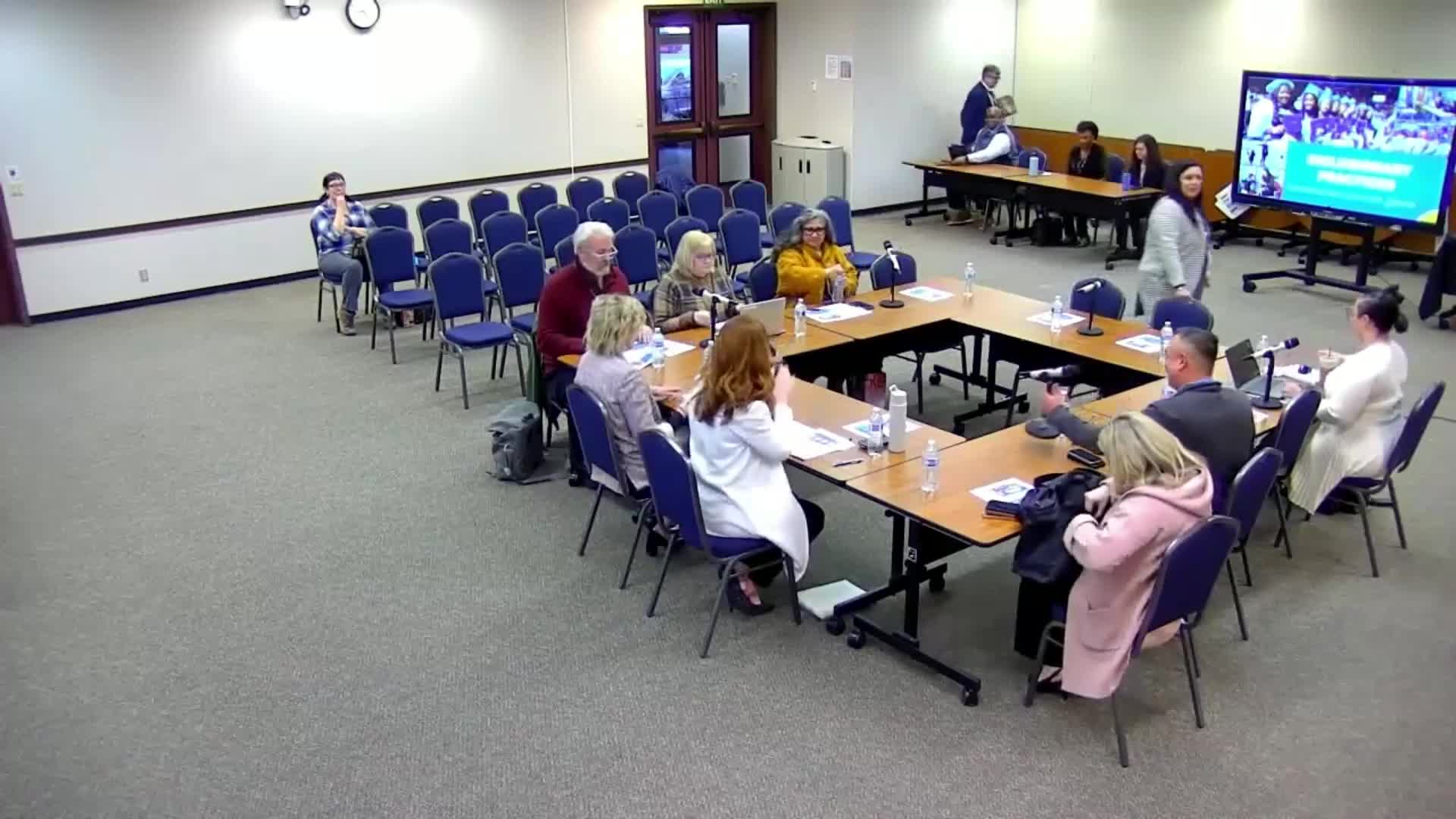
Highline School District staff told the board on Jan. 22 that the district is expanding inclusionary practices districtwide and reported measurable gains in student participation: the share of students with Individualized Education Programs (IEPs) who spend at least 40% of the school day in general-education settings rose from 85% at the start of the 2023–24 year to about 88.5% most recently, with the district's first cohort of schools at roughly 93%.
Highline School District staff told the board on Jan. 22 that the district is expanding inclusionary practices districtwide and reported measurable gains in student participation: the share of students with Individualized Education Programs (IEPs) who spend at least 40% of the school day in general-education settings rose from 85% at the start of the 2023–24 year to about 88.5% most recently, with the district's first cohort of schools at roughly 93%.
The presentation matters because the shift affects how students with disabilities receive services, shapes staffing and training priorities, and carries budgetary implications if the state does not increase special-education funding. District leaders described a cohort model, a negotiated letter of agreement for elementary schools, targeted trainings for staff and paraeducators, and ongoing work to scale supports at secondary schools.
At the session, Adrianna (staff member, session facilitator) framed the district’s strategic priorities and said the inclusion work is linked to the district’s promise that “we are committed to ensuring that every student in High Line Public Schools is known by name, strength, and need and graduates prepared for the future.” Janet Parker, executive director in student learning, said plainly: “Special education is a service, not a place.”
What the district presented
Gabe Bunkart and Darren Spencer, the district’s directors of special education for elementary and secondary levels respectively, and Janet Parker detailed the district’s multi-year inclusion effort, which began in earlier phases at select buildings and moved into a formal Inclusive Practices Project in 2019 with Highline joining in 2020. The district uses a cohort model: cohort 1 began earliest and has the most advanced practices; cohort 2 and cohort 3 followed; the district plans to bring a fourth cohort of schools on in the spring and a fifth cohort to cover remaining secondary schools.
District staff said the cohort approach pairs building-level coaching from four inclusion specialists with local school leadership, special-education and general-education teachers, related services staff (speech-language pathologists, psychologists, occupational therapists) and union partners. The district described a letter of agreement (LOA) already implemented in participating elementary cohort schools (11 elementary schools were identified as part of the LOA) that allows schools flexibility to individualize how services are delivered while keeping the same special-education services.
Data and examples
District staff reported the following measures and examples during the presentation: - Baseline (fall 2023): 85% of students with IEPs were included for at least 40% of the day. - Goal: increase that share by 3 percentage points within three years (target 88%); the district reported reaching 88% by spring 2024 and 88.5% in the most recent review. - Cohort 1 schools collectively average about 93% of students included at the 40% threshold. - Four inclusion specialists currently work across cohort schools.
Presenters offered school-level examples: Sylvester Middle School reported academic gains and social integration after moving students from self-contained settings into inclusive classes; Gregory Heights Elementary accepted students with more complex needs previously served in more restrictive placements and reported rising least-restrictive-environment (LRE) percentages; Camp Waskowitz (camp name as discussed at the meeting) expanded access for students with complex needs this year, with families reporting positive experiences.
Training and supports
The district described trainings for paraeducators (ParaBytes), behavior supports led by district Board Certified Behavior Analysts (BCBAs) covering de-escalation, Functional Behavioral Assessments and Behavior Intervention Plans, and an onboarding/phasing plan that specifies what inclusion supports schools receive and how in-building coaching is faded toward a consultation model when appropriate. Staff emphasized that general-education teachers receive professional learning so inclusion is not only a special-education initiative.
Budget, sustainability and state funding
District leaders said they are conscious of budget constraints and that special education remains underfunded at the state level. Staff described efforts to align existing staffing allocations with inclusive practices rather than requiring large, immediate staffing increases. The presentation noted active advocacy in Olympia: two Senate bills by Senator Wellman and Senator Peterson (discussed at a hearing the day prior) were described in the meeting as proposals that together total more than $1.5 billion to increase special-education funding statewide.
Board questions and district responses
Directors asked about how the district determines when a cohort’s on-site support is reduced to a consultative model, staff turnover and the need to build systemwide capacity, and whether the district will delay moving on to new cohorts until earlier cohorts are stable. Staff said cohort schools vary in readiness and that inclusion specialists and principals collaborate to decide when to sustain or withdraw on-site coaching. The district repeatedly stressed that services to students have not been reduced; they are now provided in inclusive settings rather than primarily in pull-out or self-contained placements.
Formal actions
No programmatic motions or votes on policy or budget were taken at the work session. A procedural motion to adjourn was made, seconded and adopted by voice vote.
Why this matters going forward
Staff framed the work as long-term and iterative: the district intends to continue the cohort rollout through spring and beyond, integrate the inclusion work with upcoming multi-tiered systems-of-support (MTSS) and literacy initiatives, and continue bargaining and operational partnerships with HEA (the union) and OSPI (the state education agency). District leaders said sustaining the work will depend in part on state funding outcomes and on building durable practices that survive leadership and staff changes.
The board did not take binding action at the session; staff committed to return with implementation updates and continued collaboration with school leaders, union representatives and state partners.