Get Full Government Meeting Transcripts, Videos, & Alerts Forever!
Get email alerts on the Program Changes topic
No spam. Unsubscribe anytime.
Superintendent announces shift to classroom-based services for highly capable students and in-school elementary instrumental instruction
Summary
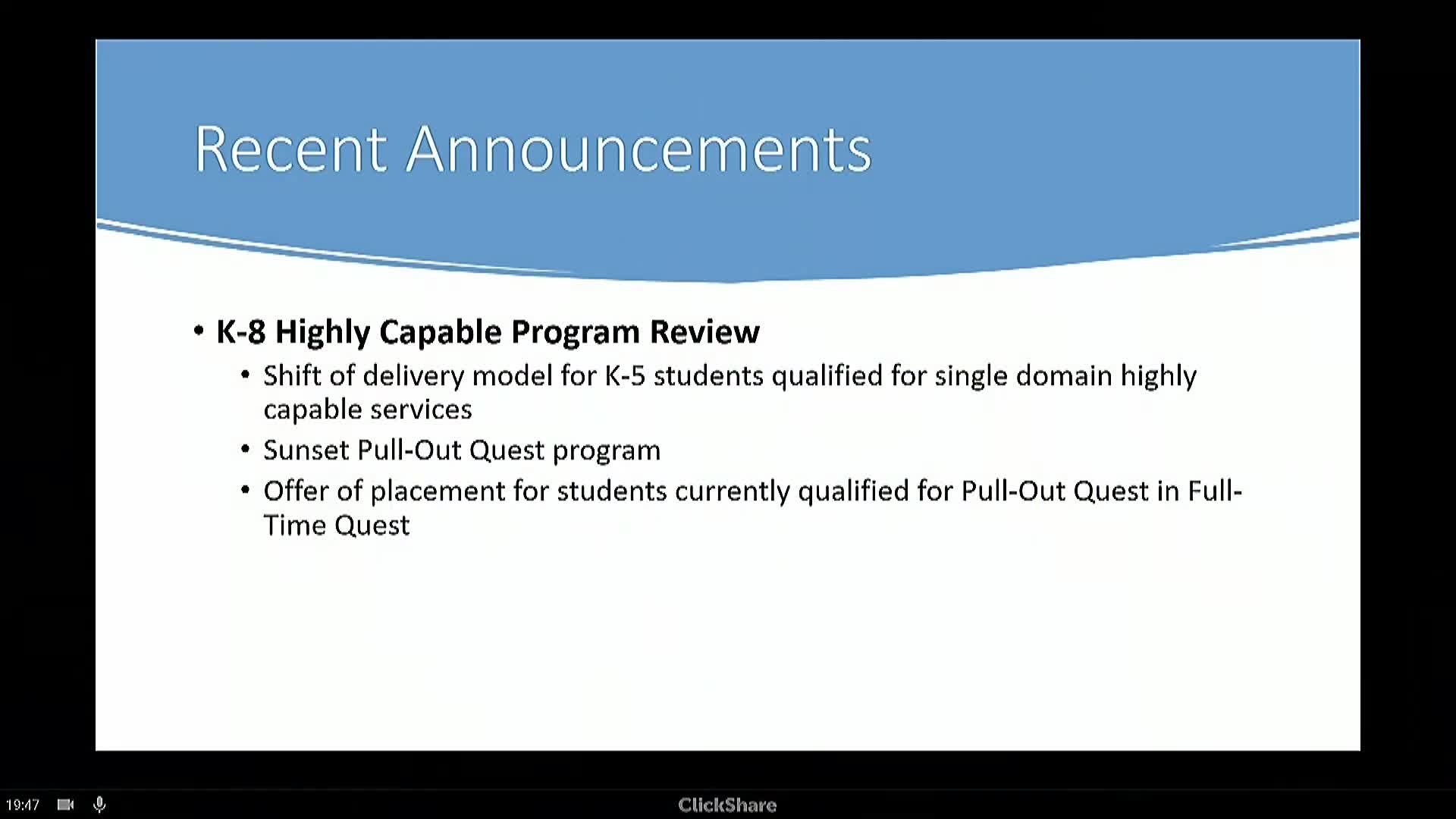
Lake Washington School District Superintendent Dr. Holman announced Jan. 27 that the district will end the K–5 pull-out Quest program for most students and will replace before-school elementary band and orchestra with in-school instrumental instruction for grades 4–5 beginning in 2025–26.
Lake Washington School District Superintendent Dr. Holman told the board on Jan. 27 that the district will change how it delivers services to highly capable (HC) elementary students and will shift the elementary band and orchestra model from before-school offerings to in-school instrumental instruction.
Dr. Holman described the outcome of a multiyear review of the K–8 Highly Capable program and said the district will "sunset the pull-out Quest program" for most K–5 students who are qualified in a single domain and instead provide classroom-based services. He said families of currently participating pull-out students will be offered full-time Quest where requested. The superintendent framed the change as a reinvestment of staffing into earlier elementary supports and teacher professional learning.
Dr. Holman quantified the financial changes the district expects: "Overall, this is a change of about $2,200,000 worth of staffing. We're going to reinvest about a million and a half of those staffing dollars back into primary, elementary staffing," he said. He added the net ongoing budget reduction attributable to the highly capable staffing change is about $700,000 and that reinvestment resources will fund additional classroom supports, professional development, MTSS coaching, and materials for differentiated instruction.
On elementary music, Dr. Holman announced that 2024–25 will be the last year for the district's before-school elementary band and orchestra program; beginning 2025–26 the district will shift to instrumental instruction during the school day for fourth- and fifth-graders. He said that shift will require a one-time instrument purchase estimated at about $300,000, and that the ongoing budget reduction from ending the before-school program is estimated at about $800,000 per year. He emphasized district pilots in some schools this year and said staff will work with secondary music leads to ensure continuity into middle and high school programs.
Associate Superintendent Dr. Rose and other staff described planned details: classroom-based supports for K–5 HC students, professional learning for general education teachers and MTSS coaches, illustrative mathematics and literacy extension materials, and a plan to make instrument kits and lesson plans available for schools to begin 2025–26.
Board members asked for implementation details. Director Guthrie and others sought assurances about preserving high-quality secondary music programs and asked how many students might benefit; staff said the number of students who would use the competency-credit pathway or the HC/classroom model would be provided in a later brief. The superintendent emphasized the district's use of an equity analysis tool to guide communication, stakeholder engagement, and mitigation for those who may be burdened by the change.
Public comment at the meeting touched these topics. Fourth grader Mariana Hanson urged the board not to cancel the elementary band program, describing personal academic and social benefits she receives from before-school band. Parent commenter Anaya Mitros raised concerns about transparency in the district's K–5 Highly Capable process and cited specific test scores in her daughter's case; Dr. Holman and staff referenced the district's equity-analysis and engagement steps in response to concerns.
The announcements were presented as administrative decisions and program shifts that will be reflected in forthcoming budget documents and implementation procedures. The board did not record a formal vote at the Jan. 27 meeting to approve these specific program changes; staff said they are working on timelines, communications, and supports for affected students and teachers.