BCS discloses $509,981.71 past-due bill for Apple device management; district and vendor outline fixes
Loading...
Summary
Birmingham City Schools officials reported a past-due mobile device management (MDM) balance of $509,981.71 to Mozzle (MDM vendor) covering Jan. 2021–Sept. 2024, described steps taken to reconcile device counts and to align future licensing, and discussed gaps in prior contract oversight.
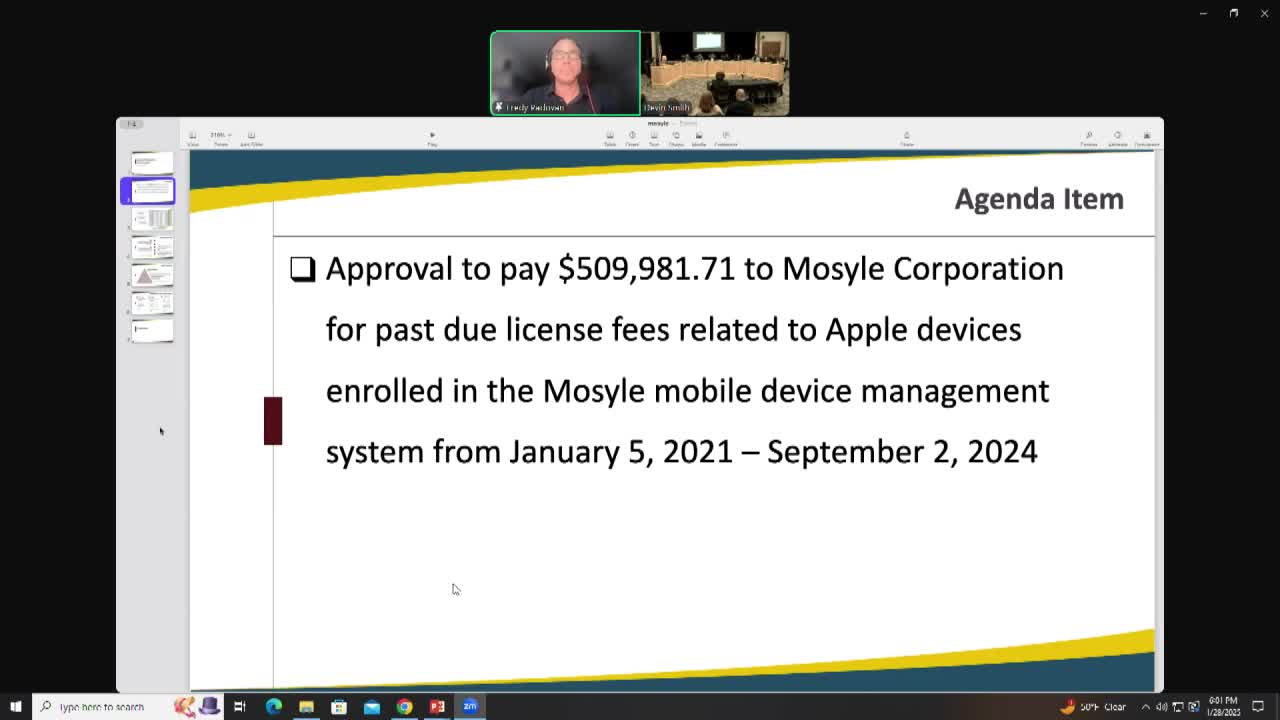
Birmingham City Schools officials told the board they will seek approval to pay $509,981.71 to Mozzle Corporation for past-due mobile device management (MDM) license fees covering January 2021 through September 2024.
The matter surfaced during a work-session presentation on how the district manages Apple-device licenses. Freddie Padavan, Mozzle’s head of relationships, said Mozzle and the district jointly counted devices and reduced an initial $600,000 figure to the $509,981.71 total. “We will be asking for approval to pay $509,981.71 to Mozzle Corporation for past due license fees related to our Apple devices…from January 2021 to September 2024,” Padavan said during the presentation.
District staff and Mozzle representatives described how the billing grew as the district expanded its Apple deployment, especially during the pandemic. Doctor Stevens (district technology staff member) said the district initially used a free tier beginning in 2016 and later purchased multiyear Apple licensing as device counts rose, but that invoices and renewal notices were sent to outdated or generic email addresses and were not escalated internally. Stevens said the district had to perform a three-month, school-by-school reconciliation to identify devices actually on the network and to remove replacements and retired units from Mozzle’s license pool.
Padavan told the board Mozzle’s practice—sending invoices to the email on record and showing a past-due pop-up inside the MDM platform—reflects an effort to avoid sudden account freezes that could disrupt student devices. “We never want to have a scenario where all of a sudden we freeze an account, which then could impact student learning,” he said.
Board members pressed district staff on why the delinquency was not flagged sooner and how the invoices reached former or generic inboxes. Doctor Stevens said the district lacked a single, centralized contract-management process for the MDM until recent efforts to align licensing across Google, Microsoft and Apple. She said Mozzle allowed the district to de-register devices no longer in use, which reduced the total by several thousand licenses; the district and Mozzle reported a reconciled device count of 27,179 active Mozzle licenses.
Board members asked for additional documentation on how the past-due total was calculated and how future renewals will be tracked. Several board members urged stronger internal controls, including consolidated district-level purchasing and a single contract-management system to avoid similar gaps. Mozzle and district staff said they will put a one-year licensing cadence in place to avoid staggered multi‑year expirations and will prepare a timeline for competitive procurement before the co-terminus period ends in 2028.
The presentation did not include a final board vote at the work session; the item was discussed in depth and identified as requiring follow-up materials, including a detailed invoice timeline and the reconciled device list.