Get Full Government Meeting Transcripts, Videos, & Alerts Forever!
Get email alerts on the Zoning Code Updates topic
No spam. Unsubscribe anytime.
Reynoldsburg planning board opens broad zoning-code review covering EV chargers, signage, parking and innovation-district rules
Summary
At a Feb. 6 zoning-code workshop the Reynoldsburg Planning and Zoning Board heard staff identify multiple areas for rewrite or clarification — from EV charger rules and signage to parking, lighting and rules for the Innovation District — and asked staff to return with draft code language in May.
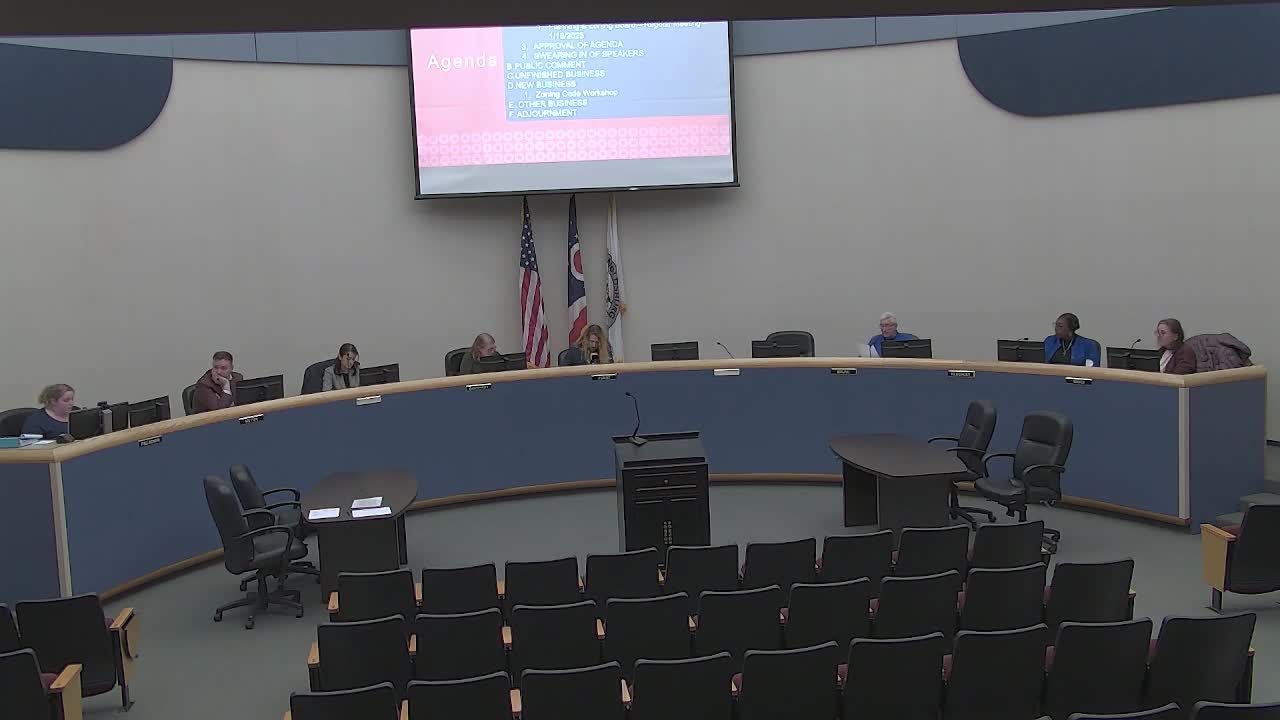
Board Chair called the Reynoldsburg Planning and Zoning Board to order at 6:02 p.m. Feb. 6 and opened a workshop on proposed zoning-code updates that staff say are intended to clarify ambiguous provisions and address issues that repeatedly required variances.
Director Felix Meyer, leading the presentation for planning staff, told the board that staff reviewed variance applications from 2023 and 2024 and found 29 cases that commonly raised questions for the code—15 related to wall signs, three to taller or larger monument signs and six to building setback requests. "This is just a number of variances. This isn't what was approved. This is just what was applied for that actually made it to the board," Meyer said.
The workshop grouped proposed revisions into topic areas. Meyer said staff’s goal is to return in May with concrete draft language so the board and public can review formal amendments.
Why it matters: The changes aim to reduce repeat variance requests, give clearer guidance to applicants, and modernize the code in areas not anticipated in the 2019 rewrite — including electric-vehicle (EV) charging, commercial signage, parking and design standards for larger, higher-tech sites in the city’s Innovation District.
Key topics and staff proposals
- EV chargers: "the city of Columbus passed an EV ordinance, I think it was about a year ago," Meyer said while noting Reynoldsburg’s code currently lacks consistent standards for how chargers are classified, screened or regulated. Staff will research other cities’ thresholds for mandatory chargers on multifamily or large commercial sites and return with options. A board member suggested exploring parking reductions tied to EV installations; Meyer said staff will include that in their review.
- Signage and rebranding: Staff flagged signage as the most frequent source of variances and said code language around wall signs, monument signs, temporary signs and pickup-window identification is vague. Staff pointed to problems for small commercial clusters and for areas where buildings are required to orient to the street but practical access or parking is at the rear (Old Reynoldsburg examples). Miss Barnhart, a board member, urged a business-friendly approach on rebranding: "I just I think that we don't need to be difficult," she said, noting businesses rebrand periodically. Board members asked staff to propose language that permits reasonable rebranding without creating a "precedential blank check."
- Large sites, setbacks and phased development: Staff said the code's intent to place buildings close to streets does not work well on very large parcels or business parks. They plan to explore acreage or site-specific triggers and other tools (but said they are cautious about reintroducing planned-unit developments). Board members raised concerns about phased projects and the risk that later phases might never be built; staff noted that current project approvals typically require building permits within a limited period (staff described the timing as involving a 12-month term plus a commonly granted 6-month extension, and also referenced an 18-month figure in discussion) and said they will clarify time limits and protections.
- Townhomes/condos and residential accessory standards: Staff proposed clearer, separate standards for townhomes and condominiums (rather than treating them exactly like single-family detached homes), including minimum unit widths and accessory-structure design guidelines. A board member said some townhome units appear too narrow and asked staff to research typical widths.
- Innovation District and large-format industrial/tech sites: Staff argued existing rules (setbacks, lot coverage, parking ratios and maximum setbacks) may prevent the kind of large, varied uses the Innovation District aims to attract. They cited examples from Marysville and said the city may need differentiated parking and setback rules for large or specialized uses.
- Parking and lighting: Staff said parking tables are often one-size-fits-all and suggested tiered or use-based parking standards (for example, lower parking ratios for very large buildings or certain office/amenity uses). The code currently lacks a requirement for parking-lot lighting; staff proposed a lighting requirement for new parking areas while maintaining foot-candle limits where developments abut residences.
- Land-locked parcels, small commercial lots (Bryce Road/East Livingston) and East Main Street easements: Staff noted several parcels zoned commercial or mixed-use that are physically constrained by lot size, right-of-way easements, underground irrigation or other city-owned infrastructure. Those constraints can make compliance with setbacks and other standards effectively impossible without a variance; staff said they will study overlays or tailored standards for limited areas so routine business changes do not require repeated variances.
- Accessory structures, shipping containers, storage containers and fish ponds: Staff want clearer definitions and design standards for porches, decks and accessory structures and said they intend to restrict long-term use of shipping containers as storage or living units except for temporary construction uses. Staff also proposed removing fish ponds and water gardens from supplemental uses because they receive few applications and staff believe the code already distinguishes pools from small decorative ponds.
- Uses and definitions: Staff proposed breaking out certain activities from generic retail categories — for example, vape or smoke shops and certain rental/vehicle uses — so the board can decide appropriate siting rules for those uses. Staff also recommended a comprehensive review of definitions to reduce ambiguity (daycare vs. educational uses, directional signage, etc.). Director Meyer and staff emphasized that many topics are clarifications rather than wholesale policy shifts, but that some areas (for example, minimum townhome widths or Innovation District standards) will require more detailed research.
Board feedback and next steps
Board members generally supported staff research and asked for draft code language in May. Miss Barnhart emphasized business-friendliness on rebranding; another member cautioned against returning to broad planned-unit-development tools without careful limits. Meyer encouraged board members to email additional topics or meet with staff outside meetings. "We have a giant memo on our desk that our engineering team is dissecting that we are gonna provide comments on," Meyer said regarding coordination with COTA on transit and right-of-way questions tied to zoning.
Staff said they will return in May with proposed text for many items and further discussion sessions will follow before formal amendment and public-notice steps. There were no formal motions or votes on code changes at the workshop.
Ending: The board adjourned at 7:22 p.m. Staff will continue research and expects to present draft zoning-code language at a future meeting in May.