Get Full Government Meeting Transcripts, Videos, & Alerts Forever!
Get email alerts on the State Budget And Policy topic
No spam. Unsubscribe anytime.
Maryland governor outlines plan to close $3 billion gap with tax reform, port and education investments
Summary
At a joint session in Annapolis, the governor described a $3 billion budget shortfall and proposed tax changes, major port and transportation investments, a $550 million K-12 increase and measures to expand expungement eligibility.
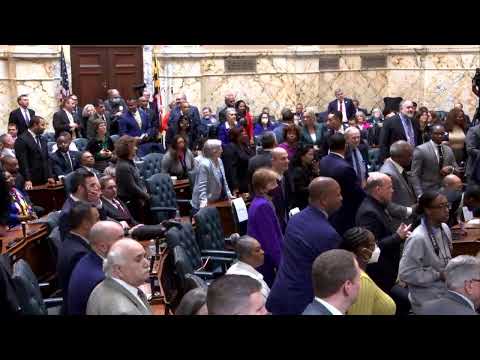
At a joint session of the General Assembly in Annapolis, the governor said Maryland faces a roughly $3 billion budget gap and urged a mix of tax reform, targeted investments and program changes to close it without raising sales or property taxes.
The governor opened by asking lawmakers to “confront this moment” after recent federal policy shifts and an aerial collision over the Potomac, and praised first responders who aided victims. He said a new freeze on federal grants and uncertainty in Washington contributed to the state’s fiscal challenge.
"We must close this $3,000,000,000 budget gap," the governor said. "We only have difficult decisions ahead." He described a budget proposal that he said includes more than $750,000,000 for economic competitiveness and workforce development and more than $21,000,000,000 for transportation projects.
Why it matters: the governor framed the package as balancing fiscal restraint with investments intended to grow jobs and diversify the economy. He tied the measures to specific initiatives — notable among them an expansion at TradePoint Atlantic and the Port of Baltimore — and large increases in education and workforce funding.
Economic and port investments
The governor highlighted TradePoint Atlantic and the Port of Baltimore as cornerstones of his economic plan, saying the proposal would increase the port’s container capacity by about 70 percent, create more than 8,000 jobs and attract about $1,000,000,000 in private investment. He said the state’s transportation plan totals "more than $21,000,000,000" and covers highway, bridge and transit investments statewide.
Education and workforce
Addressing schools, the governor said Maryland is "tens of thousands" of licensed teachers short of need and proposed a national recruitment campaign, debt-free pathways to teaching and a $550,000,000 increase in K-12 funding, which he called the largest investment in public education in the state’s history. He also proposed steps to expand apprenticeships and add employers and registered public apprenticeship agencies.
Tax reform and household relief
The governor proposed a package of tax changes he said would simplify the code, close corporate loopholes, lower the corporate tax rate, double the standard deduction and expand the child tax credit. He said under the plan two-thirds of Marylanders would receive a tax cut and that "82% of Marylanders will either see a tax cut, or no changes in their taxes at all." He also asserted Maryland is currently the only state with both an inheritance tax and an estate tax; that claim was presented as part of his argument for reform.
Criminal justice, housing and social policy
The governor said he will seek legislation to expand expungement eligibility to allow people who violated parole or probation to petition to have records wiped, building on prior cannabis pardons he signed. He also reiterated commitments to housing affordability, saying the administration plans to press for more measures following last year’s housing legislation.
Nominations and recognitions
The governor announced the nomination of Harry Coker to lead the Maryland Department of Commerce and noted it was Coker’s first day in office. He also recognized business owners, teachers and individuals affected by criminal records, and asked the room to stand for first responders who responded to recent disasters.
What is and isn't decided
The governor presented a budget proposal and legislative priorities; none of the spending proposals, tax-law changes or nominations he outlined were enacted during the address. His remarks signaled the administration’s priorities for negotiation with the General Assembly.
Ending note
He closed by urging bipartisan cooperation to meet the fiscal challenge, asking lawmakers to choose "the tough thing instead of the simple thing" and to work together to protect services and invest in growth.