Get Full Government Meeting Transcripts, Videos, & Alerts Forever!
Get email alerts on the Transportation Infrastructure And Disaster Response topic
No spam. Unsubscribe anytime.
GDOT details storm response, damage and amended‑FY25 requests; estimates $200 million in storm costs
Summary
The Georgia Department of Transportation told the Senate subcommittee it has spent months responding to Hurricane Helene and earlier storms, estimating nearly $200 million in non‑labor infrastructure and contracting costs and requesting supplemental state funding in the amended FY25 budget.
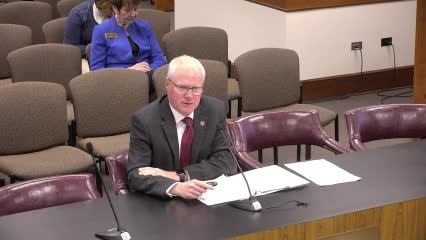
The Georgia Department of Transportation on Monday described extensive storm and winter‑event damage, emergency response efforts and supplemental budget items in the agency’s amended FY25 request, telling the Senate subcommittee the total non‑labor infrastructure and contracting cost related to recent storms is approaching $200 million.
Commissioner’s summary: The agency said it staged staff and equipment ahead of Hurricane Helene, executed large‑scale bridge and road inspections after flooding from Hurricane Debbie and instituted an extensive debris‑removal and infrastructure repair effort after Helene. The presenter said crews inspected roughly 120 bridges after flooding in the Debbie event and that at State Route 169 in Tattnall County a culvert was washed away, a new bridge design was completed within seven days and a contractor began work within 13 days; the contractor completed a replacement bridge within about two months.
Traffic signals, signs and debris: The department reported major impacts to traffic‑signal systems: roughly 719 traffic signals sustained damage ranging from minor to total loss, and some individual cities (Augusta was cited) saw dozens of signals down. The department said it exhausted its traffic‑signal inventory, borrowed parts from local jurisdictions and used contractors and bucket trucks to restore signals. The agency also described heavy sign loss and noted that critical regulatory signs — stops and wrong‑way signs — were among the worst damaged.
Debris and costs: The agency reported an ongoing debris removal tally of approximately 3,700,000 cubic yards and said debris operations could continue into March or April. The commissioner estimated that non‑labor infrastructure and contracting storm costs related to Helene and Debbie are approaching $200,000,000. The agency also reported two winter storms earlier in the season that cost approximately $23,000,000 to clear.
Amended FY25 highlights: The agency outlined key additions the governor recommended and the House considered for the amended FY25 budget, including a roughly $1.032 billion net state general‑fund add and multiple program increases such as $250,000,000 in state funds for local roads (LMIG/local roads administration), $530,000,000 for a freight program and sizable capital construction and maintenance allocations. The presenter emphasized that advancing projects now can avoid higher future construction costs and cited large percentage increases in materials pricing since FY21 (asphalt and other construction inputs) as justification for moving projects forward.
Reimbursement and timing: Senators asked whether FEMA or other federal sources might reimburse storm costs. The commissioner said the state has submitted requests and expects federal reimbursement in many cases but that timing is uncertain; FEMA reimbursements can take from 12–18 months up to two years.
Ending: The department did not record a committee vote in the hearing excerpt. The commissioner thanked committee members for prior appropriations that aided quick deployment and asked for continued support to accelerate project delivery and respond to infrastructure needs created by extreme weather.