Get Full Government Meeting Transcripts, Videos, & Alerts Forever!
Get email alerts on the Driver Services Technology topic
No spam. Unsubscribe anytime.
Georgia DDS asks state to fund identity-verification tech, AI call agent and case management system
Summary
The Georgia Department of Driver Services told the Senate subcommittee it seeks $1.022 million in one-time state funds to expand address-verification and biometric checks, upgrade its chatbot to a conversational AI and replace an investigations case-management system that is at end-of-life.
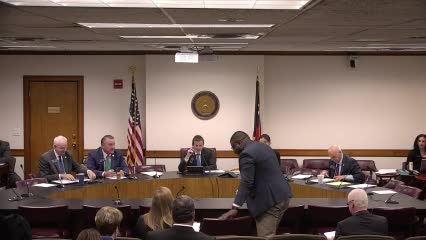
The Georgia Department of Driver Services on Monday asked the Senate Subcommittee on Appropriations for Transportation to approve $1,022,000 in one-time state funding to bolster online identity verification, expand an automated voice/chat agent and replace an aging investigations case-management system.
The request comes as the agency reported that 99.91% of Georgia credential holders are Real ID-compliant and said it manages roughly 8.87 million valid driver’s licenses and about 416,000 commercial driver licenses. “We are asking, again, for $250,000” for an address-verification technology, the department’s commissioner said, to guard against fraud in online transactions and to confirm that credential mailings are sent to legitimate addresses.
Why it matters: Department officials told the committee they are seeing more online transactions — including address changes — and want to add layers of authentication to reduce identity theft, identity-based fraud and downstream harms such as fraudulent credit applications. The upgrades also respond to an earlier state audit recommendation to modernize contact-center and customer-service technology.
What the agency told senators: The department described three requests on the committee’s tracking sheet: $250,000 for enhanced address verification and identity-fraud detection; $452,000 for “chatbot phase 3,” a conversational AI voice agent the agency calls “George;” and $320,000 to replace an investigator case-management system that does not support a required transition to a government (gov) cloud environment. The presenter said the three requests total $1,022,000.
On the address-verification item, the commissioner explained the typical fraud scenario: someone with stolen personal information logs into an online account, changes a mailing address and obtains a replacement credential. “What we now have is the ability for if you are doing an online transaction, not only are we getting your information and requiring you to do multi factor authentication, but we have a biometric solution that if you're doing it on a device, it requires you to show us your face,” the commissioner said. He said the agency can compare that face against images on record to verify identity.
On the chatbot, the department said the contact-center technology already answers a large share of incoming customer contacts and that the conversational-AI upgrade would reduce the need for staff to manually record and upload scripted answers. The agency said the existing bot fielded about 2,000,000 conversations in fiscal 2023 and that live contact-center staff answered about 754,437 calls in the same period; the presenter said roughly 62% of bot contacts do not transfer to a human agent.
On the investigations case-management replacement, the department said it operates a small sworn-investigator unit (13 investigators when fully staffed; two vacancies were reported) that uses a case system currently at end of life. The agency said the replacement system would be CJIS-capable and run in an AWS gov-cloud environment so it can better exchange information with local and state prosecutors.
Questions from senators focused on how the chatbot is priced and whether the AI product uses an enterprise license or per-unit charges; the agency described the upgrade as a one-time enterprise enhancement and said there are maintenance costs going forward. A senator also asked whether the chatbot records customer satisfaction; the presenter said the unit currently measures transfers to live agents and that the conversational-AI phase would reduce the need to manually curate scripted answers.
The department did not seek recurring operating funds on these three items and described them as enhancements to systems the agency already uses. No formal vote or committee action was recorded in the transcript excerpt provided.
Ending: The subcommittee did not take a final vote during the hearing segment; staff said they would follow up on any licensing or maintenance-cost detail senators asked for.