Get Full Government Meeting Transcripts, Videos, & Alerts Forever!
Get email alerts on the Education Governance topic
No spam. Unsubscribe anytime.
Bill would require more school board members to be elected from geographic director districts; OSPI and advocates differ on best approach
Summary
House Education Committee heard House Bill 1683, which would require larger school districts to elect a minimum number of directors by geographic director districts rather than at‑large; witnesses discussed representation tradeoffs, recruitment challenges and alternatives such as multi‑winner proportional methods.
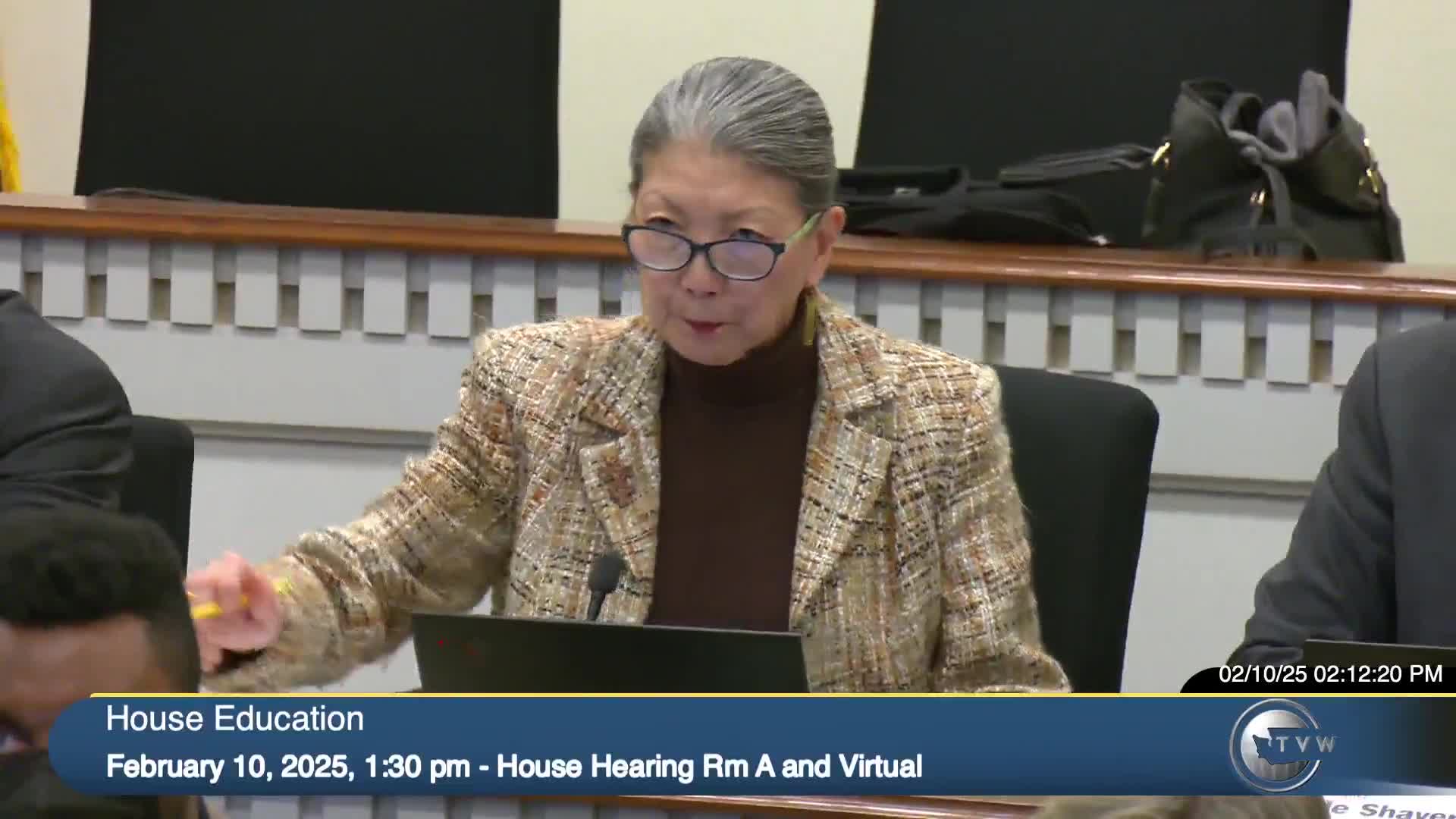
The House Education Committee heard House Bill 1683 on Tuesday, a measure that would require larger Washington school districts to elect a minimum number of school board directors by designated member director districts rather than solely at large. The change would take effect by calendar year 2027.
Under the bill briefed by nonpartisan staff, districts with headcount enrollments of 3,001 to 5,000 would have to elect at least three directors by designated member districts; districts with more than 5,000 students would have to elect at least four directors by such districts. Districts with 3,000 or fewer students are exempt. The bill does not change the total number of board members but sets a minimum that must be elected by geographic director districts.
Ethan Moreno, nonpartisan committee staff, said director district boundaries are already subject to revision after the federal decennial census and explained how the bill would affect primary and general election procedures. Representative Lillian Ortiz‑Self, the bill’s sponsor, said the aim is to improve local representation: “I want to make sure that everybody gets represented and that people have a voice,” she told the committee.
Tyler Munch, speaking for OSPI, framed the bill as a tool to improve candidate diversity and parent participation, citing research that “Studies have consistently demonstrated that proportional representation voting produces more balanced representation by encouraging a wider pool of candidates to seek office.” Munch said the bill exempts small districts to preserve flexibility; OSPI estimated about 32 districts would not comply as drafted.
Supporters included community groups that told the committee some school boards do not reflect neighborhoods. Nina Martinez of Latino Civic Alliance said the bill would encourage neighbors to run without competing against better‑resourced, district‑wide candidates. Several witnesses urged safeguards or legislative options to ensure the policy does not produce unintended vacancies.
Local school‑board leaders and the Washington State School Directors Association raised concerns about a one‑size‑fits‑all mandate and about practical recruitment problems in some districts. Dr. Karen Bolton of WSSDA said districts need flexibility to tailor recruitment and that rigid designations could complicate filling board positions in areas with low candidate interest. Researchers from Sightline Institute and FairVote Washington supported the objective of broader representation but warned single‑member districts do not guarantee proportional outcomes and suggested multi‑winner or ranked‑choice approaches as effective alternatives.
The committee did not vote on the bill. Staff and witnesses recommended additional technical work on definitions, a possible local option for multi‑winner districts, and a list of districts that would be affected; OSPI said it would provide a list of the 32 districts it identified as out of compliance.
Why it matters: the bill seeks to change how school board seats are elected in larger districts to make boards more geographically representative. Supporters argued it will diversify candidate pools and improve local accountability; opponents said it may reduce local flexibility and create recruitment or implementation challenges.