Get Full Government Meeting Transcripts, Videos, & Alerts Forever!
Get email alerts on the Curriculum Portfolio topic
No spam. Unsubscribe anytime.
Stevenson teachers pilot cultural-comparison portfolio in capstone Spanish course
Summary
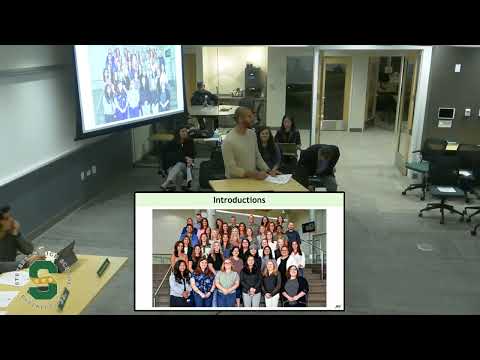
Sam Figueroa and Christina Mueller, teachers in the district’s multilingual learning division, presented the Advanced Conversation and Culture course to the Adlai E. Stevenson HSD 125 Board of Education, describing a new cultural-comparison portfolio that gives students repeated presentational writing opportunities and structured peer feedback.
Sam Figueroa and Christina Mueller, teachers in the district’s multilingual learning division, presented the Advanced Conversation and Culture course to the Adlai E. Stevenson HSD 125 Board of Education, describing a new cultural-comparison portfolio that gives students repeated presentational writing opportunities and structured peer feedback.
The teachers said the portfolio model spreads assessment across four opportunities in a six-week unit so students revise and reflect. "It all really comes down to student agency," Sam Figueroa said, arguing the approach increases student ownership of learning and peer engagement.
Christina Mueller described the portfolio as a persistent classroom resource: "This is a learning resource. This is their bank of everything that we've learned," she said, explaining the portfolio holds prompts, peer-feedback sheets and evidence students can use to track growth across the year.
Why it matters: the presenters told the board the change is intended to strengthen students’ presentational skills while deepening intercultural understanding. The teachers said the portfolio requires students to identify cultural products, practices and perspectives of the target culture and to compare those with their own communities. That work, they said, has produced classroom-level gains the teachers measured: a 12% increase in both classroom learning strategies and classroom belonging in the cohort they reported.
Details from the classroom: the presenters showed unit-level examples from a Caribbean-themed unit. One lesson used a recent news clip about a Taino cultural center in the Dominican Republic and a virtual tour of a Taino exhibit at the Met Museum; students were then asked to name a place in their community where they felt represented and to tie that example to cultural preservation. A student response the teachers shared connected participation in Sports Analytics Club with pride expressed at the museum exhibit, which the presenters said illustrated how students build bridges between cultures.
Another sample asked students to compare Puerto Rican dishes such as mofongo and pasteles to foods in their own families; one student wrote that baklava in his family reflected parallel histories of migration and adaptation. The teachers said those kinds of cross-cultural connections were exactly the portfolio’s goal.
Course context and next steps: Figueroa said the course can be taken after Spanish 3–4, Spanish 4, or AP Spanish Language and Culture; the teachers reported two sections are running at present. They also said many students in the course pursue the Seal of Biliteracy and that the team plans to refine the portfolio model and share it with other language teams. Justin (multilingual learning division staff) introduced the presenters and framed the work as part of a broader push for communicative and intercultural competence.
Board reaction and follow-up: board members asked whether teams across disciplines were sharing the approach; presenters said different teams have experimented with portfolios and the division has produced guiding principles. The teachers said they hope to help other teams adapt the model and to build vertical continuity so culture remains central as students progress through the language program.
Ending: the teachers recommended continuing data collection and iteration; they described the portfolio as both an assessment tool and a long-term record of cultural learning students can carry through the program.