Get Full Government Meeting Transcripts, Videos, & Alerts Forever!
Get email alerts on the Zoning Code Update topic
No spam. Unsubscribe anytime.
Planning director updates commission on near-final zoning and subdivision code rewrite
Summary
Millcreek planning staff outlined near-final zoning and subdivision code updates after a 2.5-year process, summarized outreach results and proposed policy questions for the commission (lighting, impervious coverage, step-backs, accessory buildings, legacy zones). Public hearing scheduled for Feb. 19; City Council review targeted for March.
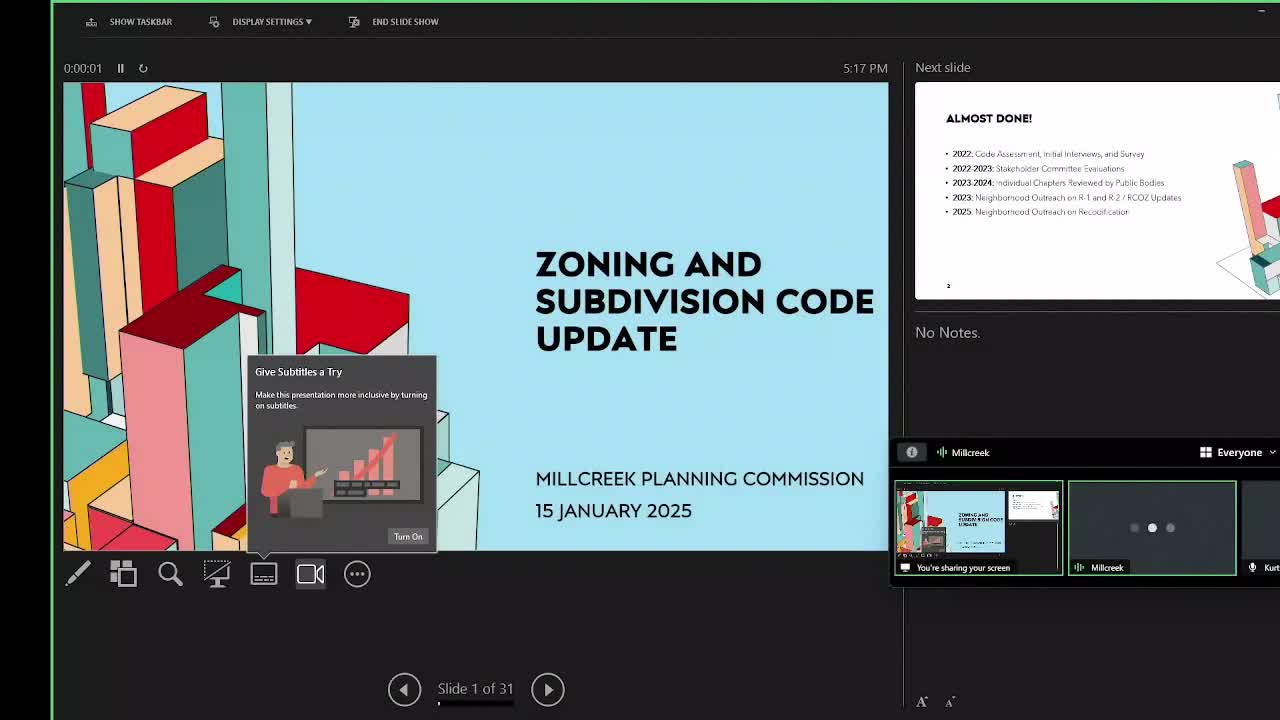
Francis, Millcreek’s planning director, told the Planning Commission the city will bring a final draft of the consolidated zoning and subdivision code to the commission next month after more than two years of review and public outreach.
Francis said the rewrite reduced the number of zones, added clearer definitions and graphics, and consolidated scattered rules (animal regulations, temporary uses, nonconformities) into single chapters. "By the end of business tomorrow I'm gonna send out a document that summarizes for each chapter the recommendations of all the 4 community councils, the recommendations of the planning commission, and where you can find kind of that reference in the new code," Francis said, noting the update represents about a 2.5-year effort that began in late 2022.
Staff highlighted public outreach metrics and changes: staff said they mailed roughly 43,000 notices related to the code update, posted chapter drafts to a live website, and ran five "chat with a planner" sessions attended by roughly 80 people total. Francis said the existing code contained about 70,000 words and the proposed code is lighter and reorganized with more diagrams and clearer tables.
Key policy questions Francis asked the commission to consider before the Feb. 19 public hearing included: - Whether updated outdoor lighting standards should apply to single-family dwellings that undergo additions or instead be limited to commercial and industrial projects; Francis said City Council may be hesitant to require single-family dwellings to retrofit lighting when they alter homes. - Whether to adopt a maximum impervious-surface coverage for residential lots (staff sought the commission’s view). - Whether step-back requirements in the City Center overlay should be relaxed at specific locations where existing development demonstrates alternatives; Francis asked commissioners to review local examples (Mill House, Cottonwood projects) to judge whether tweaks could provide flexibility without undermining design goals. - Accessory building sizes: the current draft ties accessory structures to lot-coverage limits, which could allow accessory buildings larger than primary residences on small lots; Francis flagged this as a policy choice for commissioners. - Status of "legacy" zones (C1 and R4): staff recommended that, with newly added design standards, the city consider removing the policy barrier to rezoning into those districts and instead encourage targeted use where appropriate.
Commissioners raised a number of clarifying questions. Commissioner Reed asked whether the proposed occupancy limit language in a separate item meant 40 psychiatric patients or 40 total patients; that exchange led to clarifying language in the CU motion (see separate article). Commissioner Jacob asked whether C1 and R4 would remain in the code: Francis said the zones would remain but staff proposed dropping the practice of blocking rezones into them now that design standards have been added.
Francis outlined schedule and next steps: the planning commission has a noticed public hearing set for Feb. 19 (the body may continue the hearing if more time is desired), City Council review is anticipated in March, and staff hopes to have the recodified zoning and subdivision code adopted in April along with updated checklists and a consolidated fee schedule. Title 14 (engineering standards) will be aligned with the new code but is not directly adopted by the commission.
Francis invited commissioners to send written feedback and said staff will compile recommendations and present them at the Feb. 19 hearing. Several commissioners indicated they will provide e-mail comments; Francis said he would summarize them for the commission prior to the hearing.