Get Full Government Meeting Transcripts, Videos, & Alerts Forever!
Get email alerts on the Program Design And Funding topic
No spam. Unsubscribe anytime.
Millcreek renewable-energy board reallocates communications funds to cover program design work as utility filings advance
Summary
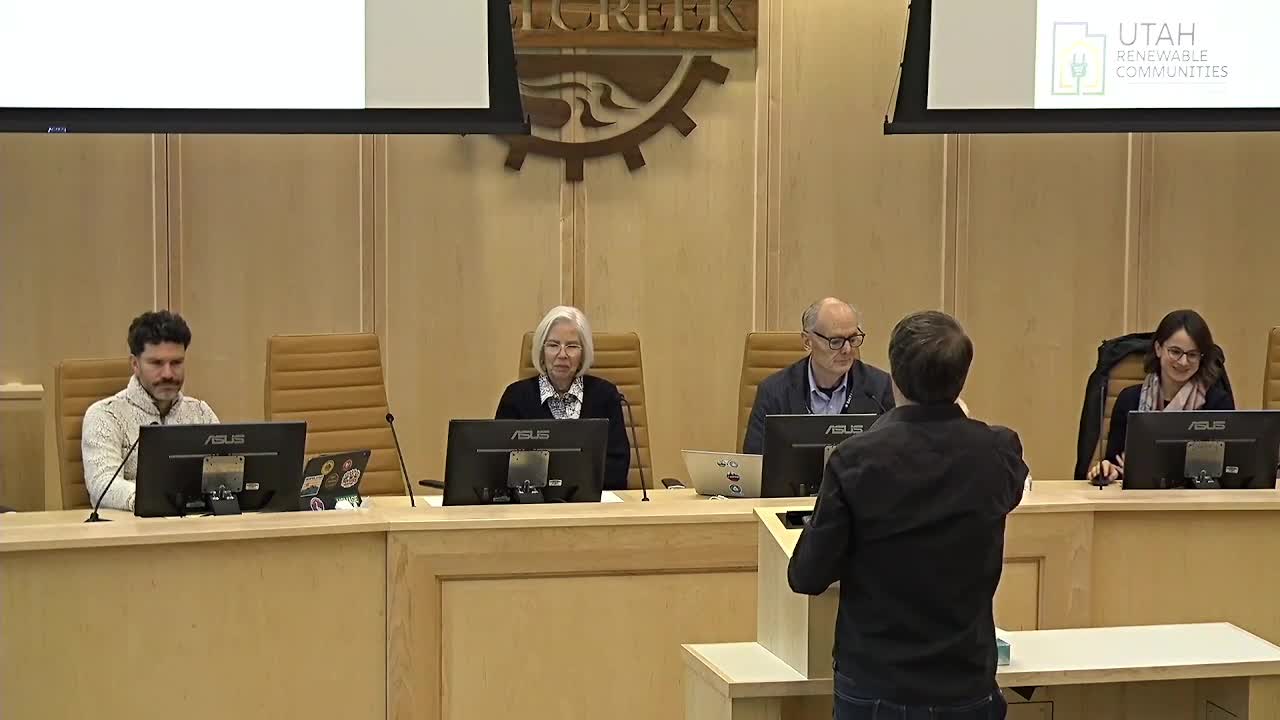
The Millcreek City Community Renewable Energy Agency Board voted unanimously to reallocate roughly $27,500 from its communications budget to program design work to cover legal and solicitation costs as Rocky Mountain Power files program applications with the Utah Public Service Commission.
The Millcreek City Community Renewable Energy Agency Board voted unanimously to reallocate communications funds and existing new-party payments to bolster program-design work necessary to carry its program application and solicitation through the Utah Public Service Commission process.
The funding move, approved as Resolution 2053 (program design funding changes), shifts about $27,500 previously budgeted for outside communications work and $11,142 from new-party payments into the agency's program design budget. Christopher Thomas, who convenes the agency's Program Design Committee, said the reallocation will help pay for legal, technical and solicitation-related expenses as the agency advances two dockets filed with the Utah Public Service Commission. "Rocky Mountain Power filed the program application this last month, opening docket '20 five-thirty five-six," Thomas said.
The board adopted the resolution after a motion by Drew Quinn (Holiday) and a second from Councilman Rod Armstrong; the motion passed unanimously. Earlier in the meeting the board also approved the Jan. 6, 2025 meeting minutes by voice vote.
Why it matters: the agency is moving from planning into regulatory filings and an expected developer solicitation. Thomas told the board that the agency faces an estimated $110,000 in near-term program-design expenses: about $60,000 for legal and technical support (outside counsel and expert testimony) and roughly $50,000 to prepare and publish the solicitation platform and process for bids. He said those figures are estimates and that the board may seek voluntary additional contributions from member communities if costs exceed projections.
Key budget figures discussed at the meeting included: $30,400 remaining in the current program-design allocation, $27,500 proposed to be reallocated from communications, $11,142 in new-party payments (primarily a Midvale initial payment), an estimated $60,000 cap for commission-related legal and expert costs, and an estimated $50,000 cost to publish and run the resource solicitation. Thomas also said an outside environmental organization has offered a donation of up to $50,000 to support the agency's program-application legal and technical work; the board will consider steps to formalize that gift in March if Millcreek City's treasury policies permit it.
Communications budget and contractor: Christopher Cawley, who presented the communications committee update, said the committee proposes to retain a small contingency in the communications budget for key press releases while reallocating the bulk of the remaining communications contract to program design. "We have about $30,000 remaining in our communications budget which is all allocated to our Pennant Powers contract," Cawley said, and the resolution would reallocate roughly $27,500 of that to program design while keeping a few thousand dollars available for future press support.
Regulatory schedule and outstanding filing items: Thomas reviewed the two open dockets. The solicitation filing appears in Docket 2403555; the agency and Rocky Mountain Power filed a second set of program-application materials under Docket 2503506 on Jan. 24. Thomas said Rocky Mountain Power submitted the filing but left several items incomplete: Rocky Mountain Power did not sign the joint utility agreement before filing (the company, Thomas said, indicated it intends to sign only if the commission approves the program), the tariff filing lacks a proposed program rate, projected program rates were not included, and the company plans to file additional testimony later on periodic rate adjustments and on how costs would be prevented from shifting to nonparticipating customers. The agency plans to file reply and parallel testimony addressing areas of agreement and items where parties disagree.
Procurement and bidder fees: The draft solicitation calls for a $15,000 bid fee per proposal to help recoup solicitation development costs; Thomas said the number of bids the agency receives will materially affect the program's financial outcome. The board's spending forecast assumes, for modeling purposes, eight bids (about $120,000 in bid fees) and an estimated $100,000 in additional evaluation and solicitation expenses handled by their contracted consultant. Thomas emphasized the many estimates and unknowns, including the number and size of bids and potential additional costs.
External factors and legislative risk: Thomas briefed the board on several Utah legislative proposals that could reduce the pool of in-state projects eligible for the agency's solicitation or increase project costs. He highlighted House Bill 241 (solar power plant amendments), which would limit project size to about 1.2 miles in diameter (roughly 922 acres by his conversion) and prohibit solar on agricultural land; Senate Bill 192 (commercial wind and solar incentives amendments), which would require co-located storage (a six-hour requirement in substitute text); and House Bill 378, which would impose a new tax on wind and solar generation. "Collectively," Thomas said, "my read of these bills is that they will make Utah clean energy options less available and more expensive," and that could reduce the number of Utah-based bids into the solicitation. Thomas noted resources outside Utah (Wyoming, Idaho) could still be eligible under the agency's draft rules.
Next regulatory steps: reply comments in the solicitation docket were due Feb. 13, and a virtual hearing is scheduled for Feb. 28 in Docket 2403555, Thomas said. The agency will prepare follow-up testimony for Docket 2503506 and work with outside counsel Phil Russell and consultant Energy Strategies on scheduling and testimony.
What the vote did and did not do: the resolution reallocates the specified amounts and authorizes staff to use those funds for program-design work; it does not by itself obligate the agency to expend more than the amounts authorized, nor does it finalize any contracts beyond existing contract provisions. Board members repeatedly cautioned that the dollar figures are estimates and that the agency may seek voluntary additional contributions if costs exceed projections.
Board comments and next meeting: speakers thanked outgoing Low-Income Plan Committee lead Samantha DeCielhorst for her work; Thomas and others said they hope to present a formal acceptance of a proposed donation and a governance step on that matter at the March meeting. The chair adjourned the meeting after member comments.
Ending note: the agency is moving from planning and stakeholder engagement into active regulatory procedure and procurement readiness; the funding reallocation is intended to keep those regulatory and technical tasks on schedule as the commission process proceeds.