Get Full Government Meeting Transcripts, Videos, & Alerts Forever!
Get email alerts on the Criminal Justice Reentry topic
No spam. Unsubscribe anytime.
Committee amends and advances several reentry and corrections bills; mixed votes and procedural referrals follow
Summary
The House Judiciary Committee considered three related reentry bills—House Bills 1425, 1417 and 1549—adopted multiple amendments and split on final recommendations. HB 1425 (pretrial diversion and prosecution-led diversion pilot) passed as amended to appropriations; HB 1417 (supervision/indigent defense changes) was sent out without committees
The House Judiciary Committee spent a substantial portion of the hearing on a trio of bills intended to affect reentry, supervision and fees for justice-involved individuals. Committee members debated amendments, fiscal impacts and whether the three bills should advance together as a package.
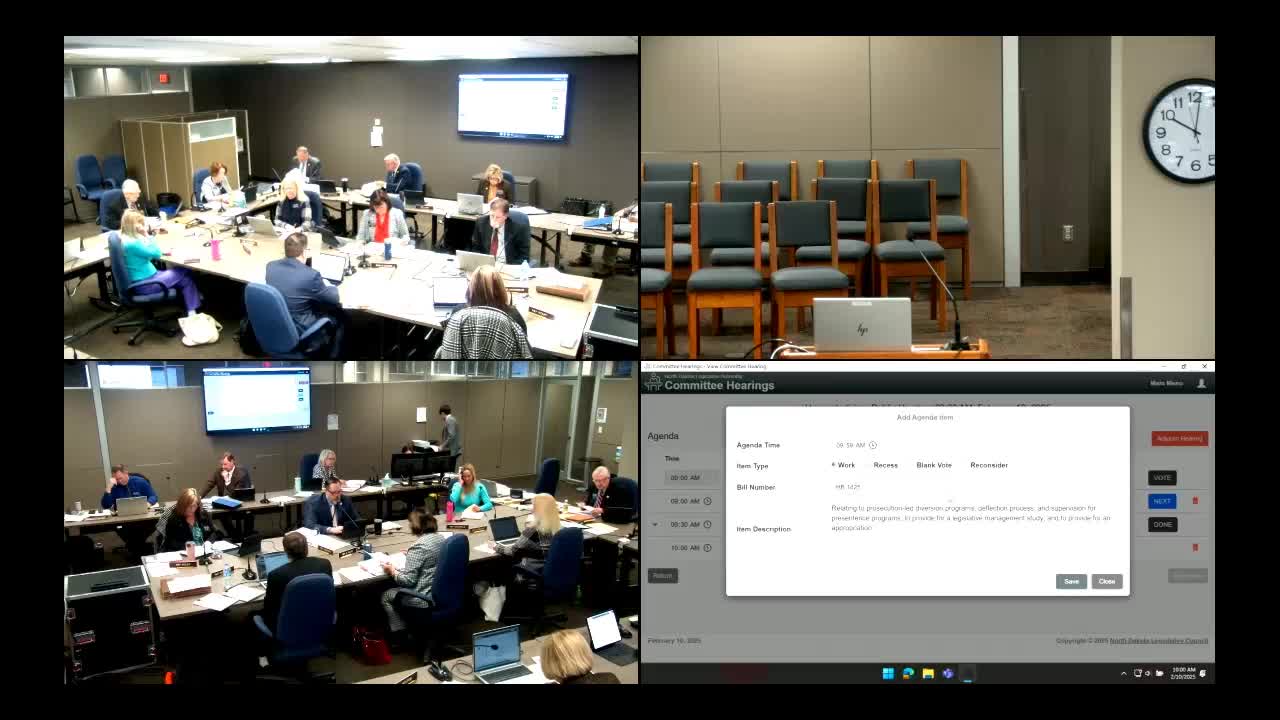
HB 1425 — pretrial diversion and prosecution-led supervision pilot: The committee adopted sponsor amendments clarifying definitions of behavioral health conditions, narrowing implementation and setting the start date. The amendment reduced the intended staffing in the pilot from seven FTEs to a single FTE with third-party contracts for supervision. After committee discussion, the committee voted to give HB 1425 a due-pass recommendation as amended and re-refer it to Appropriations; the committee roll call recorded 9 yes and 5 no.
HB 1417 — supervision, revocation and indigent defense funding: Members adopted an amendment that added an appropriation to the Commission on Legal Counsel for Indigence (a $350,000 appropriation tied to a $3.50 fee proposal in the amendment). Committee debate produced a tied roll call (7-7) on a motion to give a due-pass recommendation; subsequent procedural moves produced a committee decision to send HB 1417 to the next stage without a committee recommendation (vote to send without recommendation carried 10-4). Committee discussion highlighted differing views on technical violations and the financial impediments fines and fees pose for people trying to comply with supervision conditions.
HB 1549 — grants to support reentry and data studies: The bill provides for grant funding to support reentry services at discharge (IDs, Medicaid enrollment, housing coordination) and tasks for studying racial disparities and housing barriers. Committee members adopted two amendments: one to express legislative intent that the Department of Corrections apply for federal Justice Department grants, and another to remove an original requirement that would have directed the Supreme Court’s committee to provide certain reports; the committee instead deleted that reporting section. After amendment the committee gave HB 1549 a due-pass recommendation as twice amended; the committee vote was 8 yes to 6 no. Representative Will (name from transcript) was noted as the bill carrier in committee remarks.
Context and fiscal questions: Committee members repeatedly asked for updated fiscal notes for the package. Sponsors and supporters said the bills are intended to reduce imprisonment, cut recidivism and lower pressure on prison capacity by addressing technical violations, improving pretrial diversion and funding reentry services. Opponents and some members raised concerns about fiscal impacts and urged Appropriations to weigh cost details.
Votes at a glance - HB 1425 (pretrial diversion/prosecution-led diversion pilot): Amendments adopted 14-0; due pass as amended and referred to Appropriations, 9 yes, 5 no. - HB 1417 (supervision/indigent defense): Amendments adopted 12-2 (appropriation amendment); final committee action: sent out without committee recommendation after tied floor votes and procedural motions (final procedural vote 10 yes, 4 no to send without recommendation). - HB 1549 (reentry grants, discharge services, studies): Two amendments adopted (including deletion of original section 3); due pass as twice amended and referred to Appropriations 8 yes, 6 no.
Ending: Committee members instructed sponsors to seek revised fiscal notes and noted Appropriations will review budgetary effects. Several members urged treating the three bills as a package while others said each can stand alone; the committee ultimately advanced the three measures under differing committee recommendations for fiscal review.