Get Full Government Meeting Transcripts, Videos, & Alerts Forever!
Get email alerts on the Gaming Regulation topic
No spam. Unsubscribe anytime.
House bill would reshape gaming oversight, shift sanction authority from AG to a larger commission
Summary
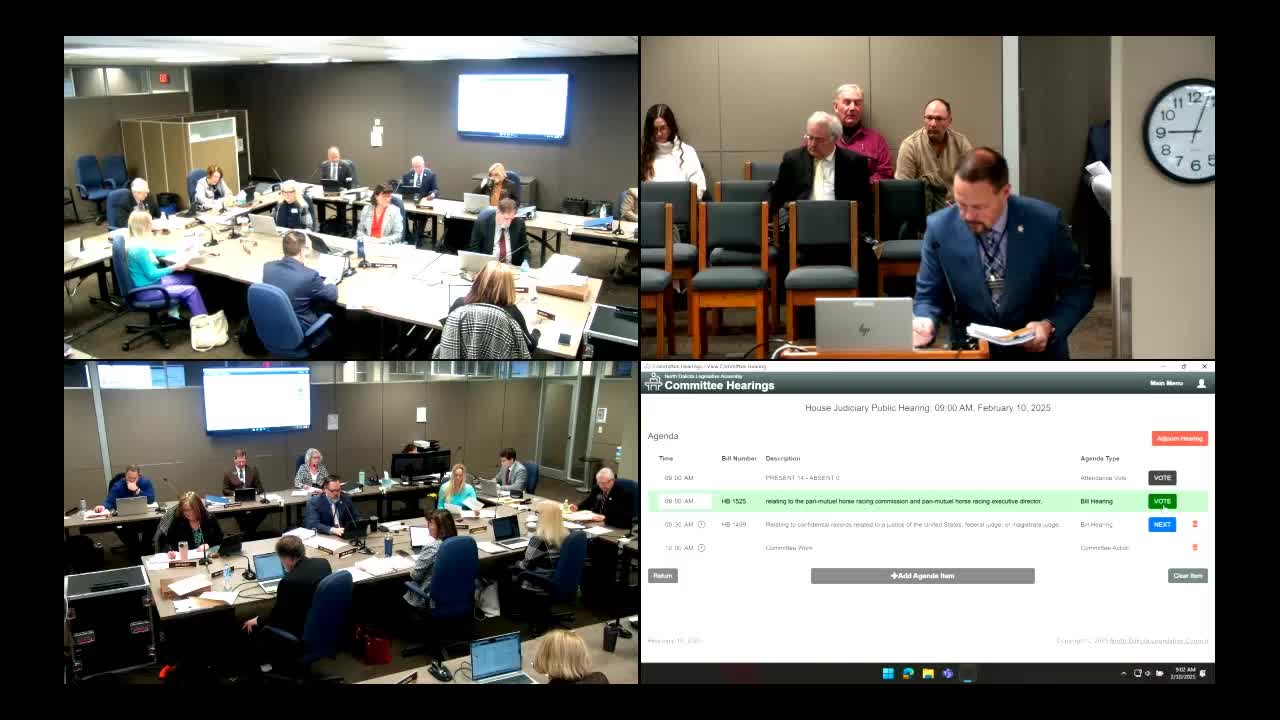
Representative Don Koppelman told the House Judiciary Committee that House Bill 1525, narrowed by amendment, would refocus the state gaming commission on charitable gaming and expand its membership to nine people while shifting some sanction authority into open, televised commission proceedings.
Representative Don Koppelman, sponsor of House Bill 1525, told the House Judiciary Committee he has narrowed the bill’s original scope so it focuses on charitable gaming and the oversight problems the current system creates. He said the proposal expands the five-member commission to nine members and adds industry stakeholders, arguing the change would improve engagement and accountability.
Koppelman said the current system delegates promulgation and investigation to the Attorney General’s gaming division, which approves charities and investigates complaints, but that sanction decisions are made outside open meetings. “The attorney general then, kind of has the unilateral ability to decide what's going to happen there. It's not done in, under a context of an open meeting,” Koppelman told the committee. He said the amended bill would send sanctionable civil matters to the gaming commission to be decided in open meetings and televised hearings.
Why it matters: The bill alters who decides sanctions for charitable gaming and authorized sites, and it would add a public-review layer where the gaming division currently acts unilaterally. Sponsors say the change brings transparency; opponents say it risks conflicts of interest if people with industry ties sit on a sanctioning board.
Supporters and structure: Koppelman described the proposed nine-member commission as a mix of legislative appointees, city representatives, a bar owner, and representatives from large, small, and rural charities. He said the governor would appoint six members, the speaker of the house and senate pro tem would each appoint a legislator to serve on the commission, and he proposed the lieutenant governor — or the governor’s appointee — chair the commission to ensure consistent meetings.
The bill would preserve the Attorney General’s gaming division role in investigations and audit work but require the division to refer civil sanction findings to the commission for public hearings. Koppelman said that if the commission levies fines or sanctions, affected parties could appeal to an administrative law judge and then to district court.
Concerns from the Attorney General’s office: Deb McDaniel, director of the gaming division in the Office of Attorney General, testified in opposition. She told the committee the division already operates under North Dakota open-records and administrative rules statutes and that charitable gaming organizations are not a profession in the same way as licensed trades. McDaniel provided staffing and workload numbers for the gaming division — 20 FTEs, 350 gaming organizations, and thousands of devices and sites — and cautioned the committee that the amendments increase the commission’s sanctioning authority and raise fiscal and operational questions about holding public hearings and producing recordings.
Industry reaction: Bruce Johnson, executive director of the Horse Racing Commission, said he had not seen the amended bill before the hearing but that the commission would likely have opposed the bill in its original form and indicated the amended language may be acceptable.
Fiscal and implementation notes: Committee members asked whether the bill creates a full-time executive director or additional staff. Koppelman said his amended version no longer creates an executive director position; the gaming division would continue to prepare investigative materials for the commission. Several members pressed for an updated fiscal note accounting for increased meeting costs, commissioner pay, and video-televising hearings; Koppelman said he expected the Appropriations Committee to review fiscal impacts when the bill is referred.
Where the measure stands: The committee opened and closed the public hearing on HB 1525 and heard several people testify for and against the amendment. No committee vote on final passage of HB 1525 was recorded on the transcript segment provided. The sponsor asked that the committee consider attaching his amendments if the bill moves forward.
Ending: Committee members signaled they want a revised fiscal note and additional clarifying language on who chairs the commission and whether referrals to the Attorney General for prosecution should be mandatory or discretionary. The bill will proceed through the committee process; the sponsor indicated he can offer additional technical amendments as it moves to Appropriations.