Get Full Government Meeting Transcripts, Videos, & Alerts Forever!
Get email alerts on the Guardianship Healthcare Agent topic
No spam. Unsubscribe anytime.
Senate committee reviews broad rewrite of guardianship and health-care agent language in SB 2297
Summary
The Senate Human Services Committee discussed a large redraft of Senate Bill 2297 intended to clarify when guardians, health-care agents and family members may provide informed consent; Legislative Council will prepare a clean amendment after committee direction.
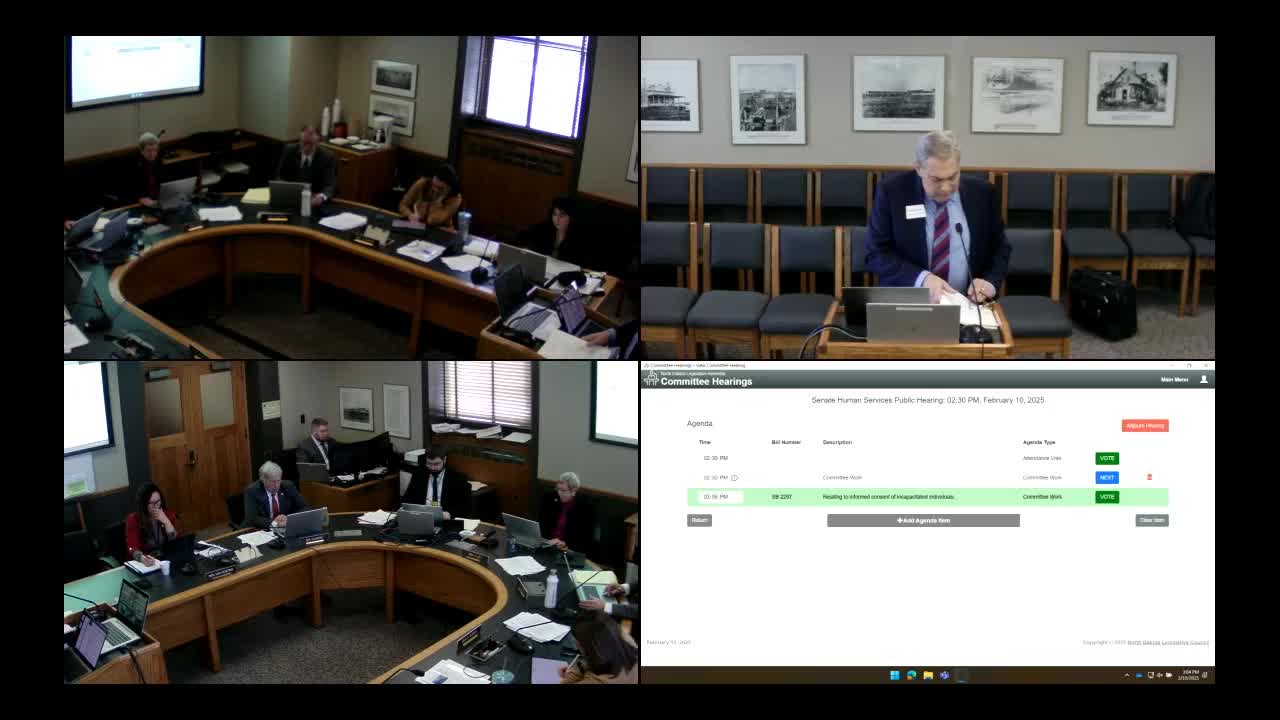
The Senate Human Services Committee on Oct. 12 reviewed a near-complete rewrite of Senate Bill 2297 intended to clarify the order of decisionmakers when a patient lacks capacity and to use health-care directive definitions instead of probate definitions.
Christopher Dodson, legal counsel for the North Dakota Catholic Conference, told the committee he started at the top of the section because small edits to one sentence created cascading problems. Dodson said the draft replaces probate-code definitions of incapacity with the definition used in the health-care-directive statute and reorganizes the order of priority for decisionmakers so the text is clearer.
The rewrite, Dodson said, retains existing substance but “cleaned up a lot of stuff” so sentences read consistently and decisionmakers are listed at the start of subsections. He told the panel the intention of current law is that a guardian who is expressly authorized by court order to override a patient’s appointed health-care agent is the first priority, then the health-care agent, then other guardians or custodians — and that his redraft tries to reflect that intent.
The change replaces a probate-code definition of incapacity with language from the health-care-directive chapter. Dodson quoted the directive-style definition in committee: a patient who is "not able to understand and appreciate the nature and consequences of a health-care decision including the significant benefits and harms of any reasonable alternatives" and whose incapacity is certified in writing by the attending physician and placed in the medical record.
Committee members pressed on how the draft treats minors versus incapacitated adults. Several senators — including Senator Clemens and Senator Weston — said parents should be explicit in the hierarchy for minors, and asked whether the draft should separate minors into a different subsection. Victoria Christian of Legislative Council told the committee the draft intentionally defines “incapacitated patient” to include a minor for the purposes of this section so the section can operate by a single definition, and that the classification would not remove parents’ rights where those apply.
Republican and Democratic senators also asked about the size of an interim interdisciplinary team the bill authorizes to act when immediate decisions are needed. Marnie Waltz of Sanford Health and Melissa from the hospital association (both participating in drafting) told the committee that hospital ethics/clinical teams prefer three-person panels in some circumstances but that rural critical-access hospitals may not always have three clinicians available; the committee discussed allowing nonphysician members (for example, a nurse, spiritual-care staff or legal counsel) to meet a three-person requirement.
Legislative Council staff and the drafter agreed to produce a clean LC amendment to reflect the committee’s questions, including clearer treatment of minors and the guardian/agent priority questions Dodson raised. Victoria Christian told the committee she could prepare either separate subsections for minors and incapacitated adults, or keep a single section with two subsections for clarity; staff recommended language additions to explicitly preserve parental decision authority where applicable.
The committee did not take a formal vote on SB 2297. Members directed Legislative Council to draft an amendment that addresses the committee’s concerns and to coordinate further with Mr. Dodson and hospital stakeholders; committee members deferred further action until they have Legislative Council’s amended language.
The discussion also identified several discrete drafting issues the committee asked staff to resolve before any vote: whether to treat minors as a separate subsection, where to place parents in the order of priority, whether a “guardian with health-care authority” should automatically defer to an existing health-care agent unless a court order says otherwise, and whether an interdisciplinary team should require two or three members.
Victoria Christian told the committee the item does not need to be passed out today and Legislative Council will produce a draft amendment for the committee to review.
The committee's conversation was largely procedural and technical; there were no formal motions or votes recorded on the bill during the hearing.