Get Full Government Meeting Transcripts, Videos, & Alerts Forever!
Get email alerts on the Insulin Affordability topic
No spam. Unsubscribe anytime.
Senate considers expanding $25 insulin cap from state plan to portions of the commercial market
Summary
Senate Bill 2,370 would extend a $25 monthly cap on insulin and diabetic supplies, adopted as a PERS pilot, into parts of the regulated commercial market; proponents cited member savings and minimal premium impact in the PERS pilot while insurers and business groups warned mandates can raise overall premiums and urged alternative approaches.
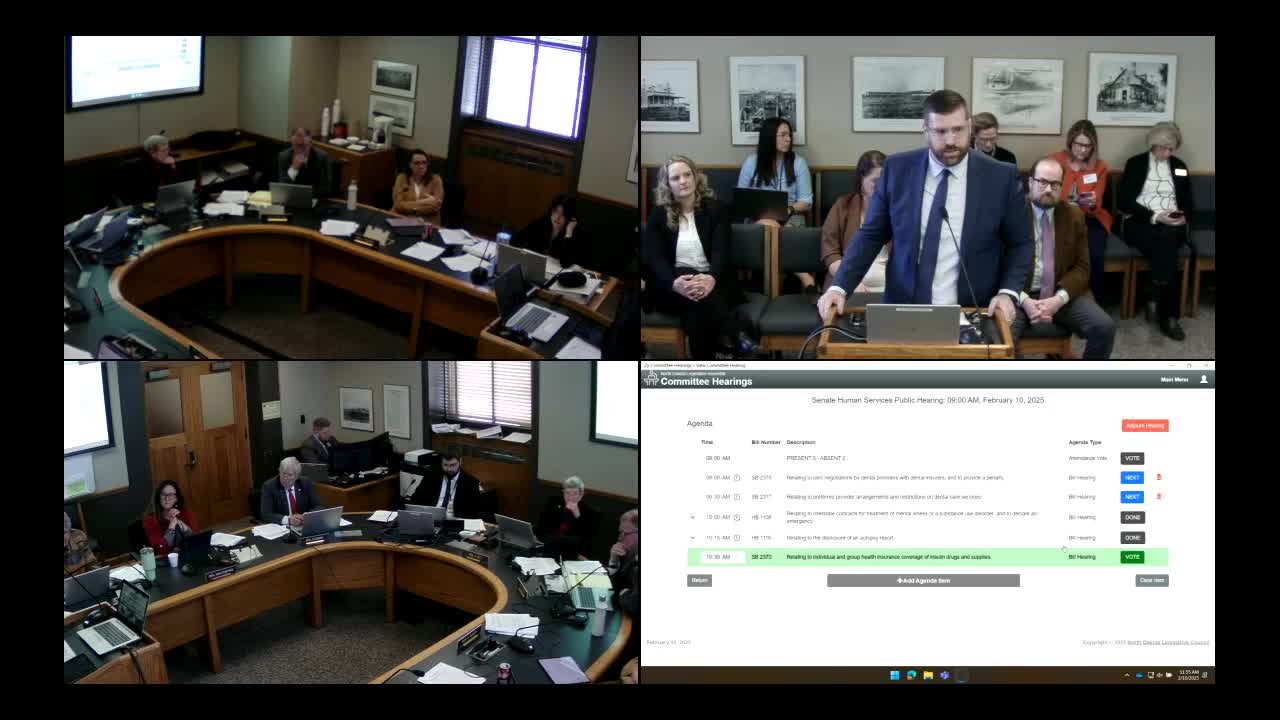
Senate Bill 2,370 would expand a $25 monthly cap on insulin and certain diabetic supplies beyond the PERS pilot program to the stateregulated commercial market, sponsor Sen. Sean Cleary told the Senate Human Services Committee.
Cleary said the underlying PERS pilot (created by a prior session bill) showed member savings of roughly $80 per month per affected member and an estimated increase in premium on the PERS plan of about 0.14 percent. Rebecca Fricke, executive director of the Public Employees Retirement System, told the committee PERSactuarial analysis estimated continuing the cap for the upcoming biennium would increase premium by approximately 0.12 percent or roughly $1.0 million total (about $834,000 for state agencies and $160,000 for participating political subdivisions). PERS recommended continuation for its plan but did not recommend extending the mandate to the broader commercial market without further study.
Advocates testified that the cap improves affordability and reduces dangerous rationing. Danelle Johnson, a North Dakota parent and longtime advocate, described families that have faced large out-of-pocket insulin bills and said the state should "help all the people we can." Other witnesses included parents and nonprofit representatives such as AARP North Dakota and the North Dakota Hospital Association, who urged the committee to consider expanding access.
Insurers urged caution. Dylan Wheeler of Sanford Health Plan and Megan Ruby of Blue Cross Blue Shield of North Dakota said most carriers already offer caps or programs to limit insulin cost exposure, including an existing $25 cap in the ACA individual/small-group market under the states essential health benefits and federal protections such as Medicares $35 insulin cap. Blue Cross argued state insurance mandates apply only to fully insured plans and do not reach ERISA self-funded employer plans, which cover a significant share of North Dakotans; the carrier warned mandates shift costs to policyholders and employers and asked lawmakers to prioritize root-cause reforms rather than additional mandates.
PERS and its consultant Deloitte reviewed other states and concluded the pilot had modest budgetary effects for PERS and that manufacturersprice reductions during the pilot (Eli Lilly and Novo Nordisk reduced list prices) reduced plan reimbursements in the latter half of the pilot year, moderating costs. PERS estimated the cap would add roughly $2.07 per contract for state agencies when spread across contracts.
The committee heard extensive personal testimony from patients and parents describing how insulin costs affect daily life, educational and career planning, and family finances. Opponents including the Greater North Dakota Chamber argued mandates increase premium costs for businesses and may prompt small employers to lose grandfathered plans or exit the market.
No committee vote was recorded during the hearing. Committee members and witnesses recommended technical drafting adjustments, and the Insurance Department said it would circulate a house-side amendment to align statutory language with existing insurance-code definitions.
Ending: The hearing produced detailed cost estimates from PERS and strong personal testimony from patients and advocates; insurers and business groups urged careful consideration of cost-shifting effects and regulatory scope.