Get Full Government Meeting Transcripts, Videos, & Alerts Forever!
Get email alerts on the Water Infrastructure topic
No spam. Unsubscribe anytime.
House committee advances $5.6M in new water-development projects, adds emergency measures for LaPrelle irrigators
Summary
The Wyoming House Committee of the Whole advanced the omnibus water-construction bill (House Bill 117) after hours of debate on LaPrelle Dam, a $20 million proposal for temporary wells, Alkali Creek deadlines and a cloud-seeding provision.
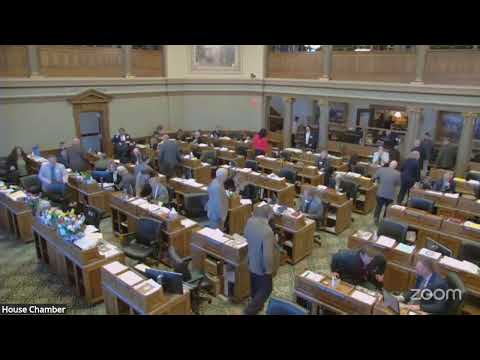
The Wyoming House Committee of the Whole voted to advance House Bill 117, an omnibus water-construction bill that packages dozens of water projects statewide and includes measures aimed at communities affected by the LaPrelle Dam reconstruction.
The bill, which the Select Water Committee shepherded through the interim, contains new development and rehabilitation projects totaling millions of dollars and several account transfers. Representative Larson JT, who presented the bill on the floor, said the measure “invest[s] in our water infrastructure across the state” and asked members to query project details at the mic or consult the binders provided by local communities and the Water Development Office.
Members debated several floor amendments tied to LaPrelle — the irrigation district where dam work will remove reservoir storage during reconstruction — and a standing-committee amendment that would set aside money to investigate and, if feasible, construct wells to supply irrigators while the dam is replaced. Representative Banks, vice chair of the committee, described the standing-committee amendment as intended to “supplement some of their irrigation needs during that construction time” and said it includes a $20,000,000 appropriation from the LSRA for feasibility studies and possible well construction.
The bill’s text (pages 3–11) lists seven new development Level 3 projects totaling $5,583,000; rehabilitation projects on pages 15–38 totaling roughly $17,000,094; and Level 3 project amendments and time extensions on pages 40–57. Section 3 contains a repeal related to the Aladdin water-supply project, and other sections move or reassign specific account funds, including transfers connected with two wells in Laramie County.
On the standing-committee amendment the House divided the question into two parts. Division 2 (which affected the Alkali Creek project deadline) was debated at length; Representative Larson JT told members the Select Water Committee set the Alkali Creek deadline at 2026 to “light the fire” for easement acquisition. Representative Provenza said the committee extended the date because landowners wanted more time for “good faith negotiations.” After floor debate the body approved Division 2 by voice vote; the clerk recorded that “That amendment has been adopted.”
Division 1 — the $20,000,000 for wells to give irrigators temporary supply while LaPrelle is rebuilt — prompted broader debate over precedent, equity and state responsibility. Supporters said the appropriation responds to state-directed action (the dam work) that will leave irrigators without storage; critics argued the proposal effectively picks winners, questioned whether the state should subsidize private agricultural operations and asked for more technical data on aquifer availability and well costs. Representative Larson Lloyd called for caution, saying similar relief is not extended to other industries in distress. Representative Ginn suggested structuring assistance as a loan program instead of an outright grant so the state could recover funds if appropriate.
After further debate the House adopted Division 1; the clerk again recorded the result as adopted. Members then considered committee-of-the-whole amendments on other topics in the water bill. Committee of the Whole Amendment 1 — language addressing the cloud-seeding program included in HB117 — passed after an extended floor discussion. Representative Schmidt, who brought the amendment, said he wanted a pause and more study of potential long-term effects on wildlife and glaciers; opponents cited modeling and field work indicating measurable streamflow gains and warned that ending cloud seeding could signal lower-basin states that Wyoming is retreating from water-yield measures.
Other amendments were offered and debated: Amendment 3 failed on a voice vote; Amendment 4 (which would have committed previously appropriated redundancy funds to the Bitter Creek revitalization project) initially appeared to pass by voice but then failed a subsequent division vote recorded as 29–30. Representative Larson JT moved the committee’s recommendation that HB117 do pass; after votes on the standing and committee amendments the Committee of the Whole reported the bill do pass.
The debate on HB117 lasted several hours and featured numerous members from both parties pressing for local project priorities; floor leaders reminded members the committee had vetted projects through the Water Development Commission and Select Water Committee during the interim. Representative Larson JT urged colleagues to “vote your conscience” and to consider the statewide implications of individual project choices.
The bill returns to the chamber for further consideration on second reading and any additional amendments or adjustments prior to final passage.