Get Full Government Meeting Transcripts, Videos, & Alerts Forever!
Get email alerts on the Economic Development Bioscience topic
No spam. Unsubscribe anytime.
Committee questions move of bioscience grant program to Industrial Commission; action delayed for further review
Summary
Lawmakers discussed transferring a life-sciences grant program from the Agriculture Department to the Industrial Commission and a $12 million appropriation. Legislators debated adding statutory reporting requirements; no vote was taken and the committee will revisit the bill Wednesday morning.
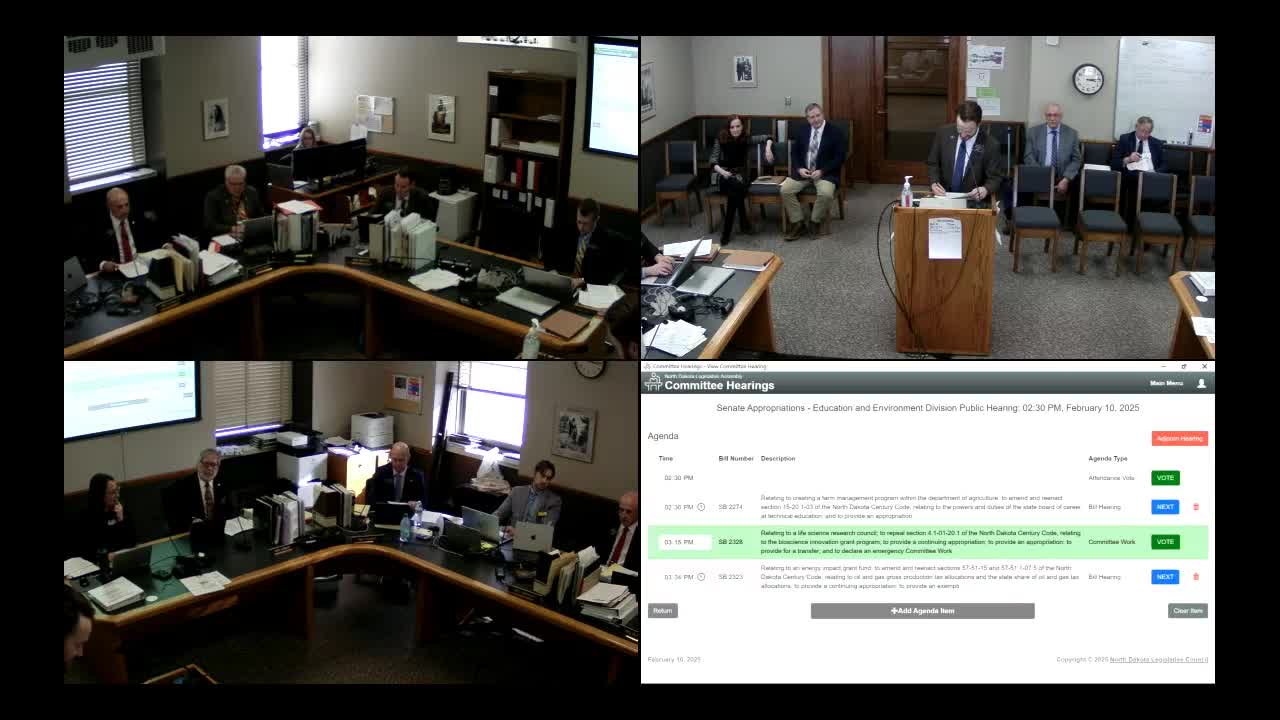
Senators on the Appropriations - Education and Environment Division heard extended testimony about transferring a life-science/bioscience grant program from the North Dakota Department of Agriculture to the Industrial Commission and a proposed $12 million appropriation.
Senator Sean Cleary, District 35, explained an amendment he drafted to add statutory reporting requirements to the bill. Cleary said he sought public reporting of recipients, award amounts, administrative costs, other funding for each project, project status, any repayments, and a return-on-investment summary posted on the Industrial Commission’s website.
Doug Goehring, North Dakota Agriculture Commissioner, told the committee the program has operated for approximately six years and that the Agriculture Department had contracted much of the front- and back-end work to the Bioscience Association of North Dakota. "I believe the return on investment for the state far exceeds 20 to 1," Goehring said, and he said the program has helped recruit 24 to 26 companies to the state. Goehring described the program as a competitive, reimbursable grant process and said about $1 million remained in current balances that could be returned to the General Fund if the program ended before another round was run.
Karen Tyler, Executive Director of the Industrial Commission, said the bill's structure is "substantially similar to the structure of the renewable energy program," and that the commission could incorporate the grant into its grant-management system. She cautioned, however, that adding another program to the commission’s grant-management system would create additional build-out costs.
Randy Schneider, who testified and identified himself as a former president of the North Dakota Ethanol Producers Association and current president of the Bioscience Association, urged rigorous reporting and economic-impact study to ensure taxpayer funds produce measurable returns.
Senators raised several questions about scope, administration and funding levels. Committee members discussed whether the statutory reporting Cleary proposed was necessary because similar information is already available from executive-branch records. The transcript shows no committee vote on the bill; the chair said the committee will take up the Industrial Commission items Wednesday morning to study the amendment language and the $12 million appropriation further.
Committee members offered procedural cautions: if the committee’s amendment would change the policy intent established by the policy committee, the item might need referral back to that committee. No amendment was adopted at this meeting and members identified potential additional administrative costs if the program moves to the Industrial Commission.
Testimony included examples of companies that previously received grants. Commissioner Goehring cited Corvent (respirator/medical equipment) and another developer (referred to as Safety Spec) among firms that received assistance and expanded operations; the transcript does not list complete, itemized economic-impact calculations.
The committee deferred action until its next meeting on Wednesday morning to allow further review of the amendment language and budget implications.