Get Full Government Meeting Transcripts, Videos, & Alerts Forever!
Get email alerts on the Payroll Cards topic
No spam. Unsubscribe anytime.
Committee hears bill to allow payroll cards as a wage-payment option; ADP urges electronic pay to replace paper checks
Summary
Senate Bill 79 would permit employers to pay wages to payroll-card accounts when employees authorize it or have not provided bank-account deposit details; the committee heard proponent testimony from ADP and set the bill aside for later consideration.
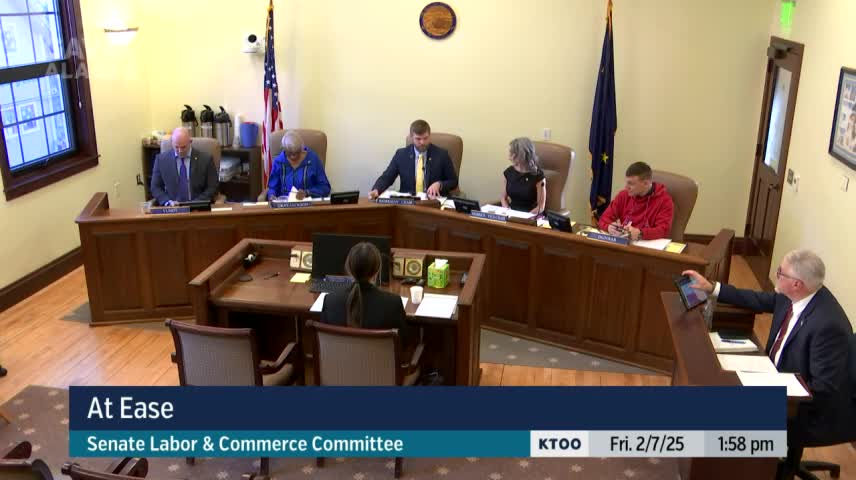
Senator Greg Bjorkman, chair of the Senate Labor and Commerce Committee, opened discussion on Senate Bill 79 on Feb. 7 in Juneau. SB 79 would add a statutory option allowing employers to pay wages to a payroll card account when an employee voluntarily authorizes the account or has not specified a deposit account.
Sevea Bieber, staff to Senator Bjorkman, summarized the bill and identified the statutory sections the bill would add and amend (adding AS 23.10.044 and updating AS 23.10.040). Bieber said the bill is intended to provide employers an electronic-pay option that can reduce the costs and logistical difficulties of issuing paper paychecks, and to give unbanked employees a way to receive wages without check-cashing fees.
Amy Miller, senior director of government affairs for Automatic Data Processing (ADP), testified in support of the bill. Miller said ADP — which processes payroll for a large share of U.S. workers — supports eliminating the requirement that employers offer paper paychecks and described consumer protections and features of payroll-card products. Miller told the committee that SB 79 preserves employee choice: employers could continue offering direct deposit or paper checks, collective-bargaining arrangements remain protected, and state-employee payment rules are not affected.
Committee staff outlined key protections in the bill’s sectional analysis: employers using payroll-card accounts would have to notify employees of terms and fees; payroll cards must provide at least one cost-free withdrawal per pay period up to the employee’s net wages and cost-free balance checks by phone and electronically; employers could not require employees to pay application, participation, card-issuance or annual replacement fees, or charge for transferring wages to the account or for point-of-sale purchases; and payroll-card accounts must be insured on a pass-through basis by an entity that insures bank deposits. The bill also includes language protecting collective-bargaining rights.
Miller argued payroll cards can reduce delays and access problems associated with paper checks, especially in Alaska where weather or mail delays can prevent timely payment. She said payroll cards provide free savings features, fraud protections, and prevent overdraft/NSF fees that can arise with other payment methods. ADP cited national adoption rates for electronic pay and noted that more than 30 states allow employers to pay wages electronically.
No public opponents testified. Committee members asked procedural questions about the bill’s pedigree and amendments; Senator Grama Jackson asked whether the version before the committee was the original House version or an amended version and was told it was the original. The committee took no final vote and set SB 79 aside for further consideration at a future meeting.
Ending
The committee will consider the bill again at a later date; no formal action was taken during the Feb. 7 session.