Get Full Government Meeting Transcripts, Videos, & Alerts Forever!
Get email alerts on the Average Daily Membership topic
No spam. Unsubscribe anytime.
Committee hears ADM decline and foundation-funding overview; members press for transportation cost data and ideas for a second count or multi-year averaging
Summary
The Department of Education briefed the House Finance Education Subcommittee on Feb. 7 that statewide ADM is showing a modest decline and that foundation funding and statutory ADM counts govern state aid; committee members pressed for district-level transportation cost data and asked the department to study alternate ADM methods such as a second count or multi-year averaging.
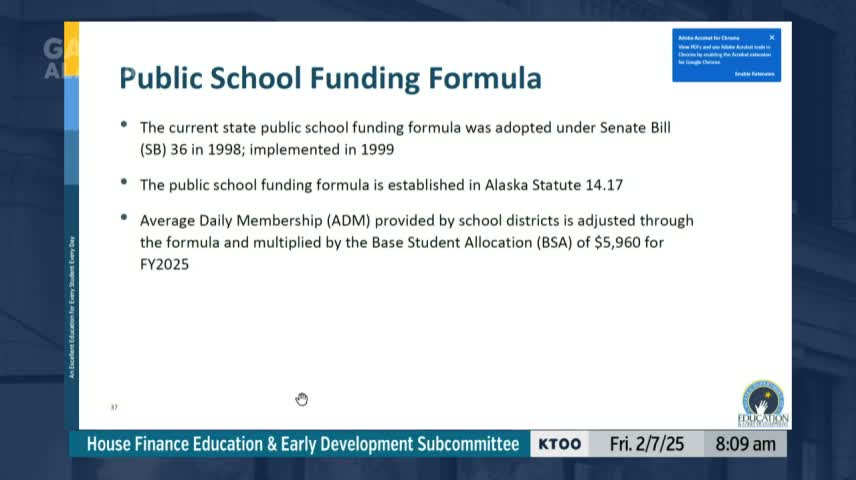
Department witnesses told the House Finance Education Subcommittee on Feb. 7 that Alaska's average daily membership (ADM) shows a small downward trend and that foundation funding remains the statutory mechanism for calculating state aid.
Deputy Commissioner Karen Morrison reviewed how foundation funding is calculated under statute and explained the ADM count process: districts submit student count data during the 20-school-day count period ending in October; counts were due Nov. 5 for the 2024–25 school year and districts must submit counts within two weeks after the period per Alaska statute 14.17.600 (as cited in the hearing).
The department presented historical charts showing foundation funding and ADM. For fiscal 2025 the department presented a foundation funding total of about $1.17 billion and preliminary ADM figures the department described in the presentation as approximately 126,700 students statewide; projected fiscal 2026 ADM was presented as about 124,700, a 1.6% decline from preliminary 2025 figures.
Committee members raised repeated concerns about the October-only count. Representative Rebecca Schwanke asked whether a second count in the second semester would be practical to capture students (for example, homeschool students who enroll in semester courses later in the year). Morrison said a second count is a recurring topic in legislative sessions, and noted projected counts are used only for statewide budgeting; statute does not allow paying state aid based on projected counts.
Representative Schwanke and Representative Hemshute asked whether a multi-year look-back average (three- or five-year average) with hold-harmless guardrails might smooth funding impacts when enrollment spikes or declines. Department staff said they would research alternative ADM calculation models and return cost estimates for the subcommittee.
On pupil transportation, department staff said FY25 grant awards were about $68.7 million, with a FY26 projected award of $67.8 million and an additional one-time $7.3 million provided by the legislature for FY26 above statutory amounts. Committee members requested district-level data showing which districts spend more than the state allotment on transportation, which spend less, and the percentage of districts exceeding transportation allotments.
Department staff said they will provide requested breakdowns and follow up on legal and budget implications of alternate ADM methods; committee work on these items will continue during the subcommittee's budget deliberations.