Get Full Government Meeting Transcripts, Videos, & Alerts Forever!
Get email alerts on the Alaska Performance Scholarship topic
No spam. Unsubscribe anytime.
Panel urges sustained outreach for Alaska Performance Scholarship; ACPE requests funding for one full-time communicator
Summary
Department of Education and ACPE told the House Finance Education Subcommittee that outreach for the Alaska Performance Scholarship (APS) increased after eligibility changes and that additional, targeted communications — likely a single full-time position — would improve FAFSA/APS awareness statewide.
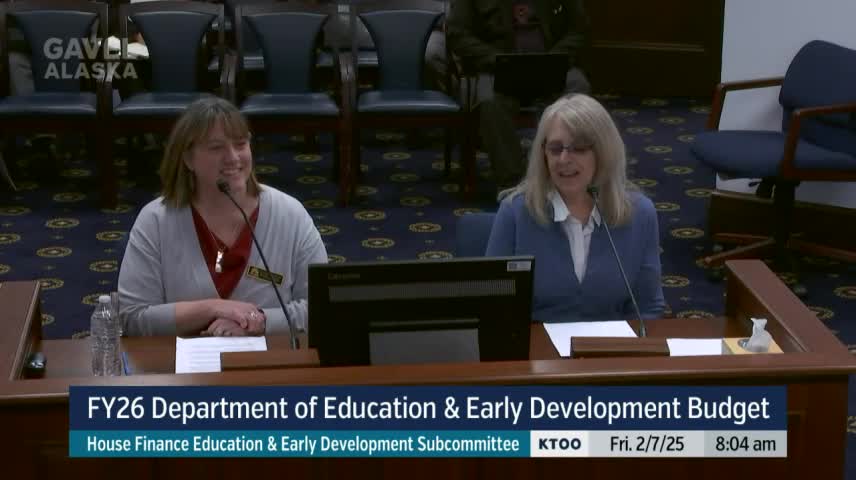
Deputy Commissioner Karen Morrison and Alaska Commission on Postsecondary Education (ACPE) acting executive director Carrie Thomas told the House Finance Education Subcommittee on Feb. 7 that outreach for the Alaska Performance Scholarship (APS) needs steady funding and coordination to reach eligible students and families.
The APS is administered financially by ACPE while the Department of Education and Early Development gathers eligibility data, Morrison said. After changes in state law, ACPE and the department reported an ‘‘uptick’’ in eligible students from the class of 2024 and said districts scrambled to identify graduates who might now qualify.
"If we had additional funding, we could do more targeted training with school districts about APS eligibility, especially focusing on areas where there's turnover," Carrie Thomas said. She told the committee ACPE conducts regular communications but lacks funding for a sustained, statewide outreach campaign.
Committee members pressed how to reach students and families before high school graduation and whether FAFSA completion could be paired with APS outreach. Thomas said ACPE and the department are part of a cross-agency work group that recommends pairing APS and FAFSA messaging so students hear about both throughout high school.
Representative Andy Story asked whether one position would suffice for statewide communications. Thomas said one full-time position focused exclusively on APS communications would likely be sufficient to increase outreach and district training.
Committee members suggested a mix of strategies discussed in the hearing: a dedicated communications staffer, a train-the-trainer approach for counselors and career advisors, and targeting middle-school and early high-school outreach so students plan coursework to meet APS requirements.
The presenters offered to provide the committee a copy of ACPE's current communications plan and to follow up with FAFSA completion data; ACPE said it will provide that information on request.
Sources in the hearing also emphasized that students must submit a FAFSA (Free Application for Federal Student Aid) to be considered for APS even if they do not ultimately receive federal aid, and that FAFSA simplification efforts appear to have improved completion rates, though the department said it would supply completion statistics on follow-up.
Committee members asked for a clearer, written proposal detailing duties and costs for the communications role; ACPE and department staff agreed to provide materials to the committee.
The department and ACPE framed the outreach need as both a communications challenge and an implementation task involving district staff training, not as a request for additional scholarship dollars.