Get Full Government Meeting Transcripts, Videos, & Alerts Forever!
Get email alerts on the Supportive Housing topic
No spam. Unsubscribe anytime.
Nevada County officials defend rapid bid for Prop.1 funds to buy six‑bed Truckee supportive housing amid neighborhood pushback
Summary
Nevada County officials and behavioral‑health staff told a packed Truckee forum they are preparing to apply for state capital funding to acquire a six‑bed permanent supportive housing residence in the Armstrong Tract, but paused any immediate move‑ins after residents pressed for more outreach and safety guarantees.
Nevada County officials and behavioral‑health staff told a packed community forum in Truckee that they are preparing to apply for state capital funds to acquire a six‑bed permanent supportive housing residence in the Armstrong Tract, but they paused any immediate move‑ins after residents raised concerns about outreach, vetting, property selection and long‑term oversight.
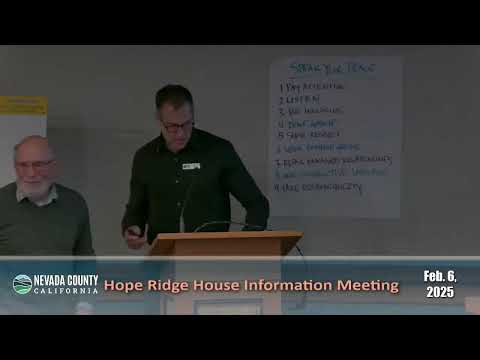
At the forum, Nevada County Supervisor Hardy Bullock, Health and Human Services Director Ryan Groover and Behavioral Health Director Phoebe Bell described the proposal, the services that would support residents and the short window for state capital grants; residents and nearby homeowners told officials they felt blindsided by the timing and wanted stronger guarantees about safety, staffing and property impacts.
Why this matters: Truckee currently has no permanent supportive housing beds managed by the county and local advocates and officials said a small, fast purchase could begin filling a documented local gap. Officials said the state funding window is brief and many eligible applicants are expected, which is why staff sought site control and a grant application quickly. Neighbors countered that quick action without broader outreach undermined community trust and risked making a difficult problem worse if the project fails to perform.
Nevada County’s plan and grant timeline
Hardy Bullock, Nevada County supervisor for the district that includes Truckee, told the forum the county has secured site control through an option/lease and that staff received board authorization to pursue a state capital grant. “This is not a homeless shelter being installed in your neighborhood. It is a potential project in the inception phase. The project is not authorized. It hasn't been funded,” Bullock said. He added that the county paused any immediate plans to move people into the house after the meeting drew stronger local opposition.
Health and behavioral‑health staff explained the funding context. Ryan Groover said the state grant program (capital funding under Proposition 1 and related Homekey funding programs) opened a short application window; he told the room the funding window opened Jan. 31 and that the state expects many applicants. Groover said that because the grant rules require site control and a feasible property, “it behooves us” to move quickly when a suitable site and willing seller appear.
What the county says the house would be and how it would operate
Phoebe Bell, Nevada County behavioral health director, described the house as permanent supportive housing — not a shelter — that pairs a residence with case management and clinical services. She said eligibility would focus on people with a Truckee connection who are homeless and have behavioral‑health or substance‑use needs. Bell said the operator would be AMI Housing, which already provides supportive services in the region, and that AMI currently has roughly “3.5” FTE of staff serving Truckee clients.
Bell and Groover described the planned operational elements: - On‑site supportive services and case management during daytime hours (AMI staff). - An overnight house manager to handle behavioral and community rules at night (not a clinical role). - Tenants would pay 30 percent of their income in rent; some tenants will start with no income and pay $0 until income is established. - Background checks and selection criteria intended to exclude people with histories of significant violence or arson; staff said misdemeanors such as public intoxication are possible in a population that has contact with the criminal justice system. - If rules are broken, AMI can end a lease and pursue eviction processes in accordance with tenant‑rights law; staff said there are multiple remedial options including hospitalizations or treatment placements before eviction.
“People are going to be people’s brothers, sisters, children, mothers and fathers,” Bell said, adding that staff have repeatedly seen recovery and stabilization after people move into housing.
County officials and advocates also spelled out constraints: capital grants typically fund acquisition and renovation, not long‑term operations. Groover and Bullock said owning a property helps sustainability by reducing ongoing facility rent costs, but operating funds must come from other county, state or program budgets.
Neighborhood concerns and county response
Many nearby residents said they were not aware of the property option or the grant timing until flyers circulated and some said they learned about it only after the county secured a lease. Speakers asked for more data and written commitments on safety, staffing levels, drug‑use rules, eviction standards, effects on property values and the county’s contingency plan if the program fails.
Bullock acknowledged outreach problems and said staff should have done more door‑to‑door and earlier community engagement. He said the county authorized staff to apply for the grant at a recent board meeting and that the board will formally consider the matter again; he also said the county is not moving people into the property while the community discussion is ongoing.
Residents pressed specific operational concerns: whether residents would be drug‑tested (Bell said California funding and law for these types of programs do not allow sobriety or mandatory treatment as a precondition for tenancy, but that the house will enforce strict behavior rules and prohibit illicit drug dealing in the unit), whether children would be allowed (staff said no children would be placed in this house), and how the county will track complaints and meet with neighbors (staff offered phone contacts, an FAQ and a public email and said they will post answers online).
Selection, site control and costs
Officials said site selection is constrained by grant rules: the property needs to be properly zoned for residential use (or usable “by right”), affordable within per‑door cost caps, available for site control and relatively quick to adapt. Groover said “numerous properties” were considered but did not meet those criteria; the site under consideration had an option/lease and an adjacent small parcel the county also acquired for defensible‑space and parking needs.
Jan Zabriskie, mayor of the town of Truckee, framed the local need and the estimated costs. Citing regional calculations, he said the community’s annual fiscal cost attributable to homelessness — emergency health, law enforcement and other public costs — is about $3,100,000 and that the upfront capital needed to house the most vulnerable roughly equates to about $2,000,000 in the scenario he described.
What officials said about scale and next steps
Groover and Bell emphasized that the proposed six‑bed house is a small part of a larger continuum the Truckee Tahoe Homeless Advisory Committee and the county are working to build; Groover said Western Nevada County already has about 221 supportive housing beds and Truckee has none. The county also pointed to the recently completed regional plan prepared by THAC as the strategic framework for future work.
Bullock said staff were authorized to apply for the capital grant and that the state’s guidance for this grant round allows some flexibility to substitute sites later, but that any such change would require further local discussion. He gave residents an email contact and said the county will post and update a public FAQ; staff also said the application process is competitive and that failing to act during the short window could mean losing the opportunity for months or years.
Community reaction and next steps
Local reaction at the forum ranged from strong support to sharp opposition. Supporters, including behavioral‑health workers and some neighbors, said supportive housing reduces public costs and improves safety and public health. Opponents and many nearby homeowners said the county’s outreach was insufficient and asked for legally binding neighborhood safeguards and clearer staffing and financing commitments before any permanent changes to the property occur.
Officials said they will continue the outreach, publish a frequently asked questions page, accept written submissions to county behavioral health addresses and brief the Board of Supervisors in public session on the next scheduled board agenda. Until those steps are complete, the county said it has paused any plan to move people into the residence.
Ending
County staff and elected leaders closed the meeting by repeating an offer to continue public Q&A online and in person and by pledging further community outreach. “We have heard you. We take responsibility for the lack of information,” Supervisor Hardy Bullock said. The county posted an FAQ and an email contact and said it will update the community as the grant process and any board decisions proceed.