
Depoe Bay council approves Phase 2 zone change for Hills of Depoe Bay; clears small commercial parcel for observation tower
Get AI-powered insights, summaries, and transcripts
Subscribe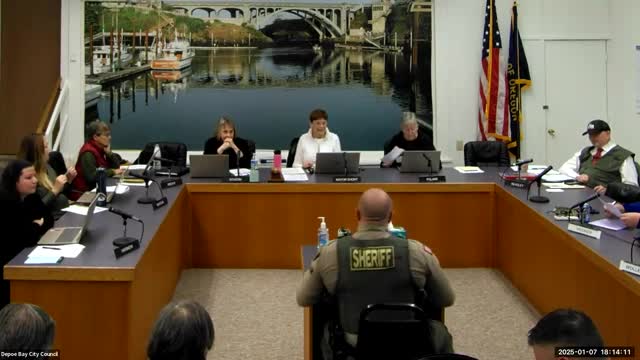
Summary
The Depoe Bay City Council voted to approve a zone change that applies a planned-development overlay to Phase 2 of the Hills of Depoe Bay master plan and to rezone about a quarter-acre for an observation tower and parking.
The Depoe Bay City Council voted to approve a zone change that applies a planned-development overlay to Phase 2 of the Hills of Depoe Bay master plan and to rezone a small parcel for commercial use to accommodate a planned observation tower and its parking. The council directed staff to prepare findings and then adopted the implementing ordinance; the ordinance takes effect under the city—s standard timeline (30 days).
The action followed a public hearing in which the city—s contract planner and the applicant—s engineer summarized the request and answered council questions. "The request tonight is simply to apply the plan-development zoning designation to the Phase 2 portion of the Depot Hills master plan area," said Zach Pels, the city—s contract planner, describing the proposal and the single code criterion the council needed to consider: whether the change is consistent with the master plan for the area.
The applicant seeks to extend the R-2/PD designation already applied to Phase 1 across the remainder of Phase 2 and to convert roughly a quarter-acre at the top of the site from R-2/PD to C-1 to accommodate the observation tower and an adjacent parking area. "Based off our preliminary plat, it's about a quarter of an acre, not a tenth of an acre," said Zach Garrett of Parametrics, the engineering firm working with the applicant, correcting initial materials that listed multiple different area figures.
Speakers at the hearing split between support from the applicant and neighbors who opposed the change or expressed concerns. A representative for the applicant said the observation tower and limited commercial area were in the master plan approved in 2017 and described the proposed commercial parcel as a small, planned visitor amenity where a coffee shop or similar tenant could serve tower users.
Opponents stressed worries about short-term rentals, neighborhood character and infrastructure. "When we're talking about 33 potential properties there, 24 of them being vacation rentals, that we no longer have a neighborhood," said Bill Masella, a resident who testified in opposition. "In effect, what we're doing is we're taking our residential zoning and turning it into commercial zoning." Krista Robinson, a lifelong Depoe Bay resident, said she feared the town—s character would shift toward a "motel zone" if the master plan was fully built out for short-term rentals.
Council deliberations referenced the 2017 Depot Hills master plan, the Planning Commission—s recent recommendation, and the potential fiscal effect of additional visitor housing. Mayor Kathy Short and other council members said the project is largely consistent with prior approvals and noted the site—s separation from established neighborhoods. Council members also asked about utilities and operations: the applicant said a water tank is under construction and that operational agreements with the city for water and sewer remain "in the works." The applicant—s representative said the project team is coordinating with agencies on permits and environmental delineations.
The council first voted to direct staff to prepare findings that the application met the applicable criteria (roll-call: Councilor Cohen: yes; Mayor Kathy Short: yes; Councilor Valerie Sovereign: yes; Councilor Rapp: yes; Councilor Autumn Watson: no; Councilor Harmon: yes). That motion passed 6— 1. The council subsequently completed the required ordinance process and adopted Ordinance 353-25 to place the overlay and the small C-1 parcel on the city map; the ordinance adoption vote was recorded as unanimous on the second reading.
What happens next: staff will finalize the written findings and complete the ordinance adoption process; the ordinance becomes effective on the city—s regular schedule (30 days after adoption unless an emergency provision is invoked). The project team will continue permitting steps and agency coordination required for construction of the water tank, tower and associated road and utility work.
The public hearing generated detailed discussion about how many short-term rentals the master plan allows and about operational responsibilities for water and sewer. Councilors and members of the public requested continued oversight of infrastructure and assurances that any future commercial uses within the planned-development area remain limited to the footprint described in the approved master plan.
Ending: With the vote, the council preserved the master-plan approach the city approved in 2017 while authorizing the modest, site-specific rezoning the applicant requested for a tower and its parking. Council direction and public comments made clear that infrastructure agreements and future licensing for short-term rentals will be points of follow-up as the development proceeds.