Get Full Government Meeting Transcripts, Videos, & Alerts Forever!
Get email alerts on the Insurance Regulation topic
No spam. Unsubscribe anytime.
Expert tells Senate committee weak regulation, not jury payouts, drives high Louisiana premiums
Summary
Former state insurance official Jay Angoff told the Senate Judiciary A committee that Louisiana's regulatory framework and insurer pricing practices, not payouts in lawsuits, help explain higher insurance premiums. He recommended more transparency and authority for the insurance commissioner.
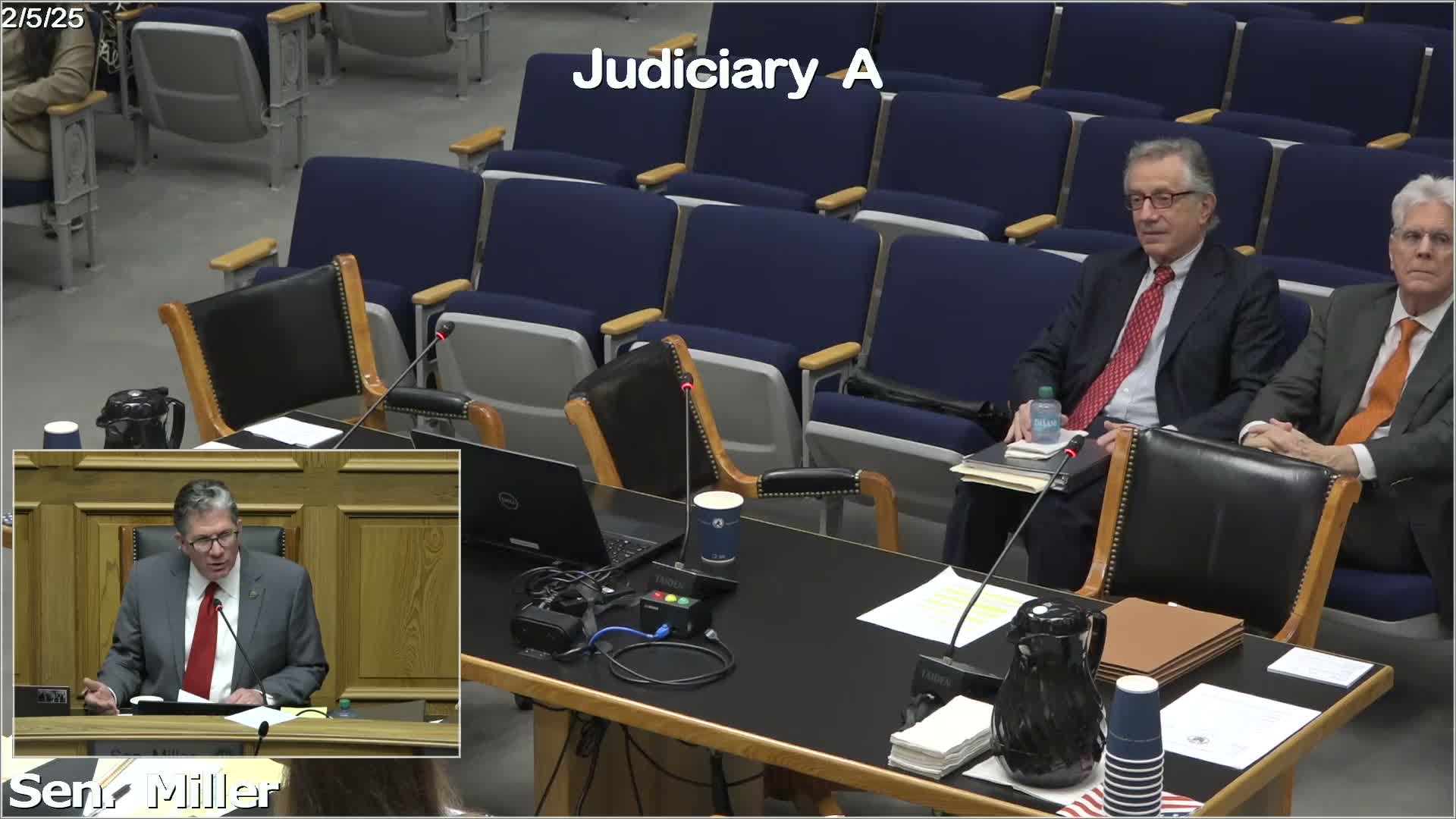
Jay Angoff, a former deputy insurance commissioner of New Jersey and former insurance commissioner of Missouri, told the Senate Committee on Judiciary A on Feb. 5 that Louisiana's insurance rates appear to be driven more by regulatory limits and insurer pricing practices than by payouts to injured parties.
Angoff summarized national and state data from the National Association of Insurance Commissioners and told the committee that "insurance is the only industry that's regulated primarily at the state level." He cited 2023 property-casualty industry figures showing large surpluses and strong returns, and said the industry as a whole posted an 8.5% return on surplus and about $87,000,000,000 in net income in 2023.
The issue, Angoff said, is the state's rate-review framework. He told senators Louisiana is an outlier because its commissioner lacks practical authority to disapprove excessive rates. "Louisiana is the outlier with the exception of Illinois," he said, noting Illinois lacks a rating law; he added that in Louisiana the commissioner can find a rate inadequate but can practically never find a rate excessive under current statute.
Why that matters: Angoff pointed to NAIC loss-ratio data showing Louisiana policyholders received about 57 cents on the dollar in claims payments in 2023 (57.1%) and about 59.8% in 2022 for property-casualty lines. "In Louisiana, the company's paid out 57¢ on the dollar in claims. That leaves 43¢ left over for the insurance company's expenses," he said. By contrast, he said Arkansas and some other neighboring states returned a larger share of premium dollars in claims in those years.
Angoff repeatedly told the committee those numbers come from insurance companies' own annual filings compiled by the NAIC. Senators asked whether the figures include reserves or surplus; Angoff explained loss ratio reflects paid and reserved losses for policies written in the year and does not include investment income, which companies earn on reserves and surplus.
On tort reform and litigation-related proposals often advanced as premium-reduction measures, Angoff cited a 2019 Louisiana actuarial task-force study and other filings as evidence those changes would have only small effects on premiums. He said company actuaries who modeled proposals such as lowering the jury-trial threshold or changing the collateral-source rule estimated less than 1% change to the liability portion of premiums in many instances.
"The companies' actuaries said these things are gonna have no effect," Angoff said, summarizing the task-force findings and rate-filing evidence he reviewed. He also cited historical rate filings from other states (Florida rate filings by Saint Paul and others) that, in his description, reached similar conclusions for medical-malpractice lines.
Angoff recommended several steps for the Legislature and the insurance department if they want to address rates: grant the insurance commissioner authority to disapprove excessive rates (for example, prior-approval or file-and-use with meaningful review); stop allowing insurers to unilaterally deem filings proprietary so they remain opaque; require insurers to demonstrate that rating factors (such as insurance-based credit scoring or so-called "elasticity of demand") are related to risk; and publish comparative premium information so consumers can see how carriers price standard hypothetical risks.
On rating factors, Angoff said Louisiana currently permits insurers to use a wide set of variables and that the state law lets insurers withhold the algorithms behind insurance-based credit scores as proprietary. "You can't find out what's in that rating factor. You can't find out what to do to improve the score that the insurance companies gives you," he said, and urged giving policyholders access to the elements that affect their price.
Angoff also addressed the homeowners and commercial-auto markets: homeowners results fluctuate sharply with catastrophic years (he said 2020'21 were bad years and 2022'23 were strong), and commercial auto shows much wider variation among carriers than personal auto. He suggested one possible approach used when he was Missouri's commissioner: competitively bidding or otherwise restructuring residual-market business so willing carriers with surplus could offer guaranteed coverage rather than assess the voluntary market.
Committee members asked about truck safety, road conditions and other nonregulatory contributors to claims frequency and severity. Angoff noted Louisiana ranks poorly on truck-crash metrics in the data he reviewed and said road quality, vehicle weights and industry safety practices can affect losses; he recommended the committee consult safety experts for that portion of the problem.
The committee did not take formal action on the presentation. Angoff's testimony and the NAIC figures he cited were the principal substantive record of the meeting.