Get Full Government Meeting Transcripts, Videos, & Alerts Forever!
Get email alerts on the Historic Preservation topic
No spam. Unsubscribe anytime.
Heritage Commission backs Dunbar School nomination for state and national registers
Summary
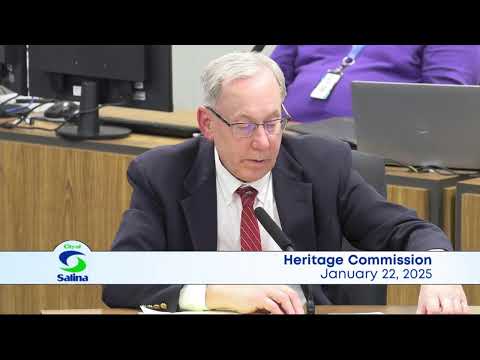
The Salina Heritage Commission unanimously recommended that the former Paul Lawrence Dunbar Elementary School be considered eligible for the Kansas Register of Historic Places and the National Register of Historic Places and will forward that recommendation to the Salina City Commission ahead of a Feb. 1 state review.
The Salina Heritage Commission voted unanimously to recommend that the former Paul Lawrence Dunbar Elementary School be considered eligible for listing on the Kansas Register of Historic Places and the National Register of Historic Places and to forward that recommendation to the Salina City Commission for a resolution of support ahead of the State Historic Sites Review Board meeting on Feb. 1.
A city staff member told commissioners the building, on the north side of East Elm Street between Second and Front streets, was constructed in 1921–22 and was designed by Oklahoma City architect William T. Schmidt. The building served as a segregated elementary school for Black children under the separate-but-equal laws in place at the time, the staff member said. Enrollment dropped after Brown v. Board of Education, and the school closed in 1955; it later served St. Francis Boys Home until about 2003 and is currently owned by CKF Addiction Treatment, which prepared the nomination form attached to the commission packet.
The nomination submitted by the property owner argues the site meets two National Register criteria: association with events that contributed to Salina's historical development and architectural significance as the work of a recognized architect. The staff report, based on research by long-time preservation planner John Berger, notes the building retains much of its original masonry exterior and continues to read visually as a historic school building.
Public commenters and representatives of the owner and the Dunbar School Alumni Association urged support. Cara Fisk, chief executive officer of CKF Addiction Treatment, said the organization has “a bold vision for the future of the Dunbar Building” and thanked the commission for considering the nomination. Kirk Holt, president of the Dunbar School Alumni Association, told the commission the school helped attract and retain community leaders and said the site’s history reflects how Salina confronted segregation. Jennifer Gordon, an association member and local historian, described the nomination as “a full circle experience” that fulfills a goal long held by alumni families.
Commission discussion emphasized the detail and breadth of supporting materials in the packet, including letters of support submitted to the State Historic Preservation Office; the staff member said eight to ten additional letters arrived after the packet was prepared and that USD 305 submitted a letter in support. Commissioners also noted the building had previously been recognized locally: the Heritage Commission recommended and the City Commission designated the property as a heritage conservation landmark in 1998, and a memorial plaza and commemorative marker were dedicated at the site in February (year not specified in packet).
The commission’s options, as outlined in the staff report, were to recommend eligibility and forward that recommendation to the City Commission, to postpone consideration, or to find the property did not meet the applicable criteria. The commission chose the first option and voted to concur with the findings in the nomination form and recommend to the City Commission that the former Dunbar School meets the applicable criteria for listing on both the Kansas Register and the National Register of Historic Places. The staff member said the recommendation will be taken to the City Commission at their next meeting, after which the local resolution and the Heritage Commission recommendation will be forwarded to the State Historic Sites Review Board for its Feb. 1 meeting.
The nomination, if approved at the state and national levels, could make the property eligible for federal rehabilitation tax credits and other incentives available to owners of listed properties, the staff member said. The nomination materials and staff report credited John Berger for the historical research underlying the packet.
Votes at a glance
- Approval of minutes (Nov. 19, 2024 special meeting): motion carried by voice vote; unanimous (5–0). Mover/second not specified in the transcript.
- Recommendation of eligibility for the Dunbar School (application HC 25-1): motion carried by voice vote; unanimous (5–0). Motion text: “I move that we approve and concur with the findings in the nomination form and make a recommendation to City Commission that the Dunbar School meets the applicable criteria for eligibility for listing on both the Kansas Register and the National Register of Historic Places.” Mover/second not specified in the transcript.
- Approval of the Heritage Commission 2024 annual report to the City Commission: motion carried by voice vote; unanimous (5–0). Mover/second not specified in the transcript.
- Adjournment: motion carried by voice vote; unanimous (5–0).
The commission will forward its recommendation and the materials in the packet to the Salina City Commission for a resolution of support; the city staff member said those materials would accompany the city resolution to the State Historic Sites Review Board for its Feb. 1 meeting.