Get Full Government Meeting Transcripts, Videos, & Alerts Forever!
Get email alerts on the Estate Tax topic
No spam. Unsubscribe anytime.
House Committee on Revenue hears estate tax overview, public testimony on bill to raise exemption to $7 million
Summary
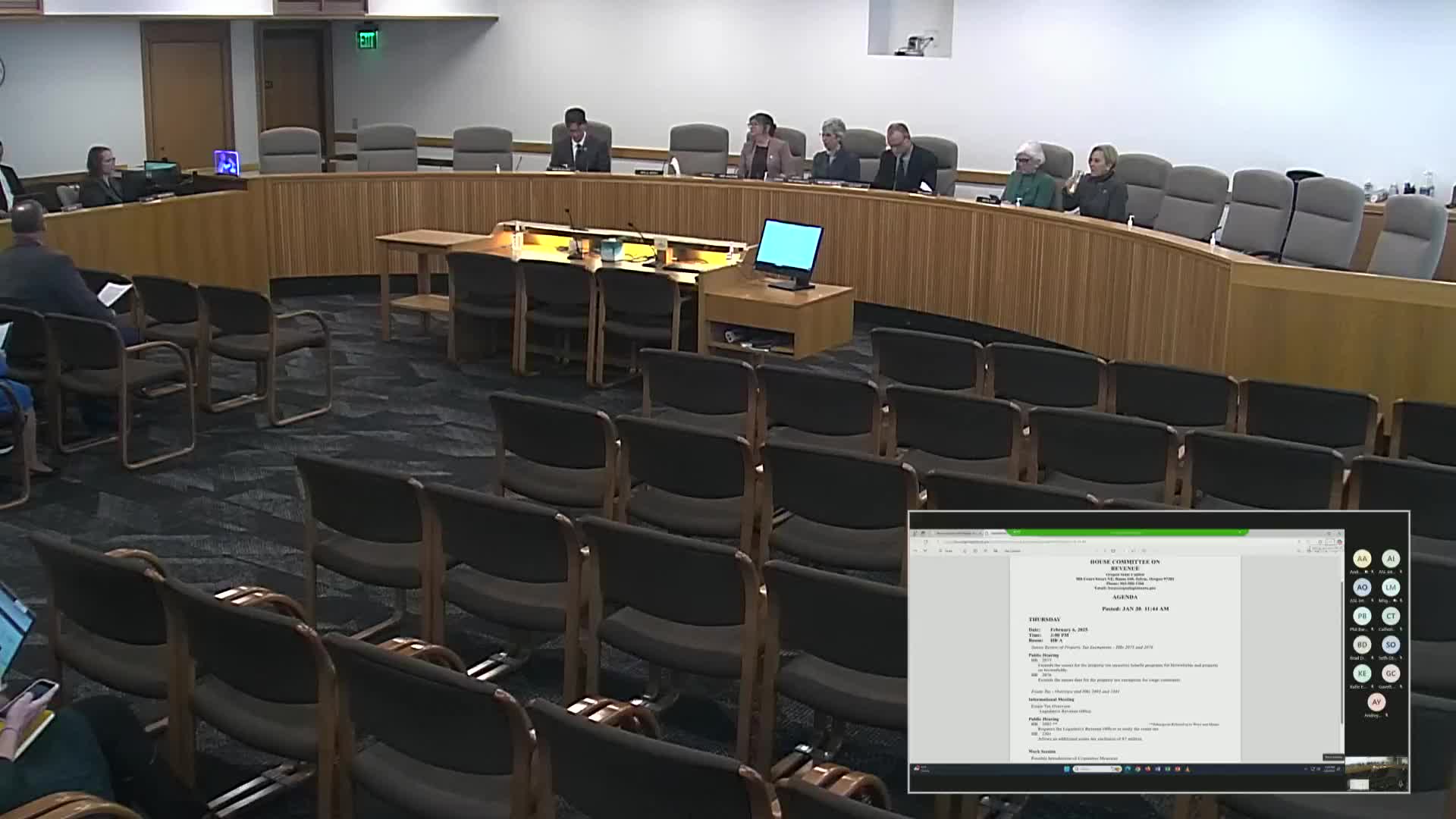
The House Committee on Revenue met Feb. 6 in Salem for an informational briefing and public hearing on Oregon's estate tax and on House Bill 2,301, which would raise the estate tax exemption to $7,000,000 and set a 7% flat rate.
The House Committee on Revenue met Feb. 6 in Salem for an informational briefing and public hearing on Oregon's estate tax and on House Bill 2,301, which would raise the estate tax exemption to $7,000,000 and set a 7% flat rate. John Hart of the Legislative Revenue Office opened with an LRO overview of the current statute and recent receipts, and lawmakers heard more than two hours of public testimony both for and against the bill.
The overview and why it matters
John Hart, Legislative Revenue Office, told the committee that Oregon's estate tax returns are concentrated and volatile: "for our most recent tax year where we have somewhat complete data... we had 3,106 tax returns and you'll see that 888 of those were in the 0% bracket," and that the program currently embeds a $1,000,000 exemption. He summarized the tax's legislative history, noting the federal changes in 2001 (the Economic Growth and Tax Relief Reconciliation Act) and Oregon's 2011 statutory rewrite, and explained how the state calculates taxable estate and apportions liability for property located both inside and outside Oregon.
Why lawmakers are discussing HB 2,301
Sponsor Representative Kevin Mannix described House Bill 2,301 as "a dramatic change" intended to make Oregon more competitive and to reduce the burden on family farms, small businesses and retirees. "We've presented to you in this bill a $7,000,000 exemption across the board with a reduced rate of 7%." Proponents argued the change would keep multigenerational farms and family-owned businesses in Oregon and reduce incentives for retirees with substantial assets to change residency to avoid state taxes.
Numbers and revenue effects presented
Hart told members that the LRO presents its most recent complete data as tax year 2022. The office showed that a relatively small number of large estates create peaks and valleys in receipts and that the average estate tax payment has been roughly $100,000 in recent years. When the committee asked for an estimate of the fiscal effect of HB 2,301, LRO staff said a micro‑simulation of returns from 2016–2022 produced a preliminary estimate that a $7,000,000 exemption with a 7% rate would reduce estate tax receipts by about 86% versus current law — roughly $600 million per biennium when phased in.
Public testimony: arguments for and against
Supporters who testified included Representative Bobby Levy, who urged relief for rural and family businesses; Jody Weiser, who said she would pay the tax under current law and argued it should not be the state’s role to tax inherited capital gains; and organizations including the Oregon Bankers Association, Oregon Small Business Association, National Federation of Independent Business, Taxpayers Association of Oregon, Oregon Business and Industry, and the Oregon State Chamber of Commerce. Scott Bruin, president and CEO of the Oregon Bankers Association, said borrowing to pay estate taxes "is not helping that company grow or thrive." Katie Aaron, a former legislator and CPA who does estate planning, recommended indexing exemption levels for inflation.
Opponents and fiscal caution
Former Representative Phil Barnhart and other witnesses urged caution. Barnhart told the committee, "My estimate is that we would lose at least two thirds of that revenue if this bill were to pass as it exists today," and warned that lost revenue would come from the general fund and support education, health care and public safety. Testimony from the Tax Foundation's Andrei Yushkov framed HB 2301 as "a step in the right direction" for competitiveness but also noted Oregon remains one of 12 states with an estate tax and cited interstate migration trends.
Committee requests and next steps
Committee members asked LRO for more detail on migration data (net migration by age cohort) and on the difference between estates that file returns and assets subject to probate or estate planning strategies. Chair Nathanson closed the hearing without a committee vote; members requested additional LRO analysis for any subsequent work session. The committee also opened a public hearing simultaneously on House Bill 2,093 but testimony and discussion focused chiefly on HB 2,301.