Get Full Government Meeting Transcripts, Videos, & Alerts Forever!
Get email alerts on the Sports Complex Funding topic
No spam. Unsubscribe anytime.
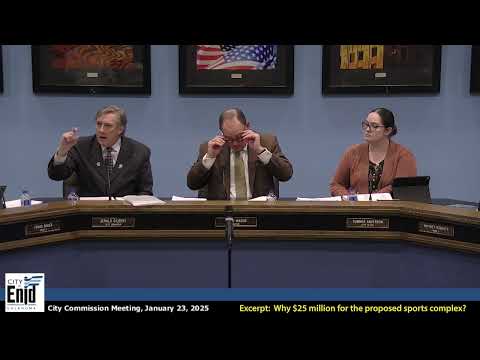
City officials outline funding plan for proposed $25M youth sports complex
Summary
City officials said they will pursue a mix of Department of Commerce pooled-payroll participation, federal and state grants, private donations and limited city funds to reach a roughly $25 million target for a proposed youth sports complex in Enid.
City officials said they will pursue a mix of state and federal grants, employer-participation pooled-payroll programs, private donations and limited city funding to reach a roughly $25 million target for a proposed youth sports complex in Enid.
Speaker 2, a city official, told the Mayor and Board Commissioners that the city does not have $25,000,000 available to pay for the project up front. “We do not have $25,000,000 to write a check for this facility,” Speaker 2 said, and outlined several funding avenues the city plans to pursue.
The official described a Department of Commerce pooled-payroll program that routes state withholding payroll taxes back to a participating locality over time; the city has used the program previously for airport hangars. Speaker 2 said that, with enough employer participation, the program could yield about $10,000,000 for a project and cited a recent $10,000,000 award used on the Ames Waterline project (a roughly $32,000,000 project) as an example of success with similar funding mixes.
Officials also discussed pursuing a National Park Service outdoor recreation grant, which the speaker said can range from $300,000 to $15,000,000, and noted an application strategy that would request up to half the project cost (about $12,500,000 in the example given). Speaker 2 said combining roughly $10,000,000 from the pooled-payroll program and $12,500,000 from an outdoor recreation grant, plus a potential tourism/recreation award of up to $1,000,000, could bring the total close to the $25 million target. The speaker cautioned that grants are not guaranteed and that awards affect cash flow and phasing: “Now, we probably it's not a guarantee we'll get that, and we may not end up asking for that much,” Speaker 2 said.
The official identified employers already signed or expected to sign for similar programs, naming ASRC and Amentum and referring to a federal-employment participation tied to a military installation. He said a staff member, Stephen, is actively working on the National Park Service grant and that city staff will continue applying to multiple programs.
Speaker 2 emphasized the project’s expected economic benefits, citing past tourism and sports events in Enid. He referenced a prior study showing an average ratio of 2.7 adults accompanying each visiting athlete and said tournaments generate hotel stays, restaurant business and other local spending. He also noted existing city and private contributions, including an Allen family gift of 54 acres at $10,000 per acre, which the speaker calculated as “over a half million dollars.”
City officials said they prefer not to raise taxes or issue bonds for the project. “At no time since I mentioned this project have I thought about or intend to raise any taxes or a bond,” Speaker 3 said during the discussion. The speakers said they will phase engineering work to fit available cash flows and may reallocate prior ARPA funds if needed.
Officials also described outreach to state and federal elected officials and agencies. The speaker reported meetings with state appropriations leaders and named Commerce and the Oklahoma Water Resources Board (OWRB) as examples of agencies that have provided or could assist with economic-development infrastructure. He suggested that demonstrating improved local amenities could help sustain nearby military bases.
The speakers flagged uncertainties that will affect cost and schedule, including the need for civil engineering to determine earthwork and other site-specific costs, potential cash-flow constraints tied to grant award timing, and employer recruitment levels required by the pooled-payroll program. No formal vote or binding commitment was recorded in the transcript.
Next steps described in the discussion include continued staff work on grant applications, employer outreach for the pooled-payroll program, phased engineering tied to available funds, and continued engagement with state and federal officials to seek additional appropriations or support.