Get Full Government Meeting Transcripts, Videos, & Alerts Forever!
Get email alerts on the Health Policy Oversight topic
No spam. Unsubscribe anytime.
Bill would bolster oversight role, staffing and composition of Oregon Health Policy Board
Summary
Senate Bill 388 would strengthen the Oregon Health Policy Board's authority, require more independent staffing and revise board composition to add management and behavioral health expertise, sponsors and witnesses told a Senate hearing on Feb. 6.
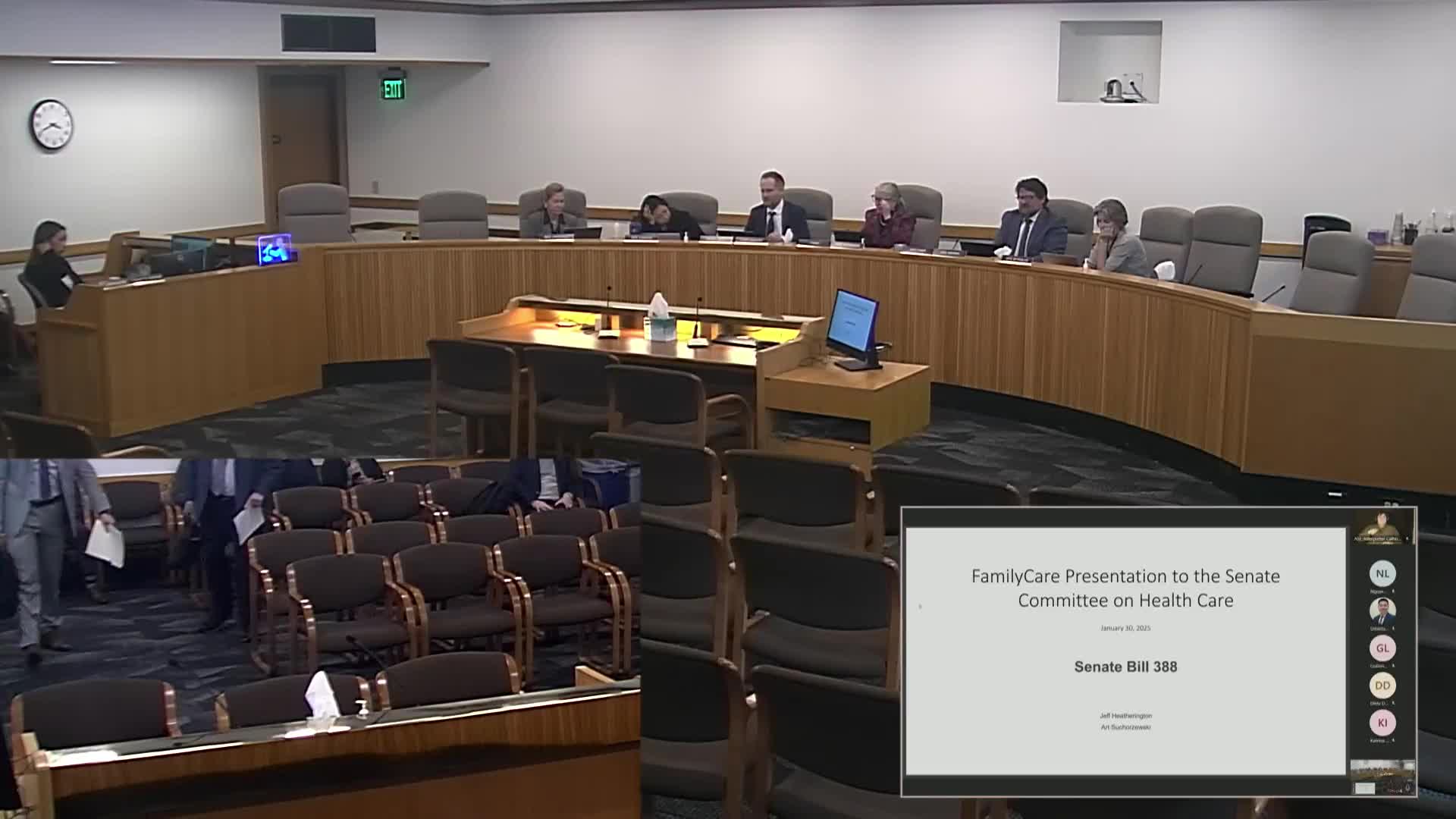
Senate Bill 388, presented to the Senate Committee on Health Care on Feb. 6, 2025, would require the Oregon Health Policy Board to produce a report on the state's integrated and coordinated care system and would change the board's membership, staffing and operations to strengthen independent oversight of the Oregon Health Authority.
Sponsor Senator Hayden said the board was created in 2009 as an oversight body to the Oregon Health Authority but that over time the board had not consistently exercised the authority envisioned in statute. "The concept here ... is to push forward the oversight, of the Oregon Health Policy Board to define who's on the Oregon Health Policy Board," Senator Hayden said, describing the proposal as an effort to restore the board's intended governance role.
Art Sukhozhevsky (identified in testimony as representing FamilyCare Health) told the committee the statute (cited in testimony as "ORS 4 13") lists the board's authorities, including reorganization, submitting legislation, adopting rules and establishing committees, and that the board has not regularly used several of those authorities. "To our knowledge, the Oregon Health Policy Board only uses the fourth authority on a regular basis," Sukhozhevsky said.
What the bill would do
Witnesses described several planned changes. The proposal would allow the board to hire its own staff and secure independent office resources so the board could carry out statutory duties without relying on OHA staff. The sponsors said the bill would also change board composition so that, among nine members, at least three members have expertise in health care management, delivery and finance; other slots would include behavioral health, primary care and public health or social‑determinants experience. The bill would also alter meeting frequency; sponsors proposed moving from monthly meetings to meeting every two months to give members time for substantive work between meetings.
"The statute is very clear. In ORS 4 13, the board is the oversight and policy making body of the Oregon Health Authority and all of its departmental divisions," Sukhozhevsky said in testimony describing the legislative intent dating to 2009.
Support and rationale
Supporters argued the board needs resources and composition changes to act as a true policy‑making board rather than an advisory body dependent on OHA staff. Proponents said the Oregon Health Authority now manages a biannual budget they described as approximately $35 billion and that stronger independent oversight will improve strategic policy decisions, including in behavioral health.
Jeff Hetherington (testimony identified him as a witness) said the bill will "give the OHPB independence because it does flatly say they can have their own staff, and, their own offices. And so they will not be dependent, which they are now, on the Oregon Health Authority."
Questions and next steps
Committee members asked whether the board as originally intended could perform effective oversight if given resources, and whether other state agencies use similar commission structures. Witnesses pointed to existing state commissions such as the Oregon Liquor Control Commission and the Transportation Commission as points of reference. The bill's sponsors and witnesses said they will propose modest amendments to clarify membership requirements and meeting cadence.
The public hearing closed after testimony and committee questions. No committee vote occurred at the Feb. 6 hearing.