Get Full Government Meeting Transcripts, Videos, & Alerts Forever!
Get email alerts on the Oregon Reinsurance And Provider Assessments topic
No spam. Unsubscribe anytime.
Officials urge six‑year extension of insurer and hospital assessments to keep Oregon reinsurance program intact
Summary
State insurance and health officials told the committee that renewing insurer and hospital assessments and the Oregon Reinsurance Program will keep premiums lower, preserve insurer participation statewide and continue federal matching funds; witnesses warned failure to extend the assessments would force substantial general‑fund offsets.
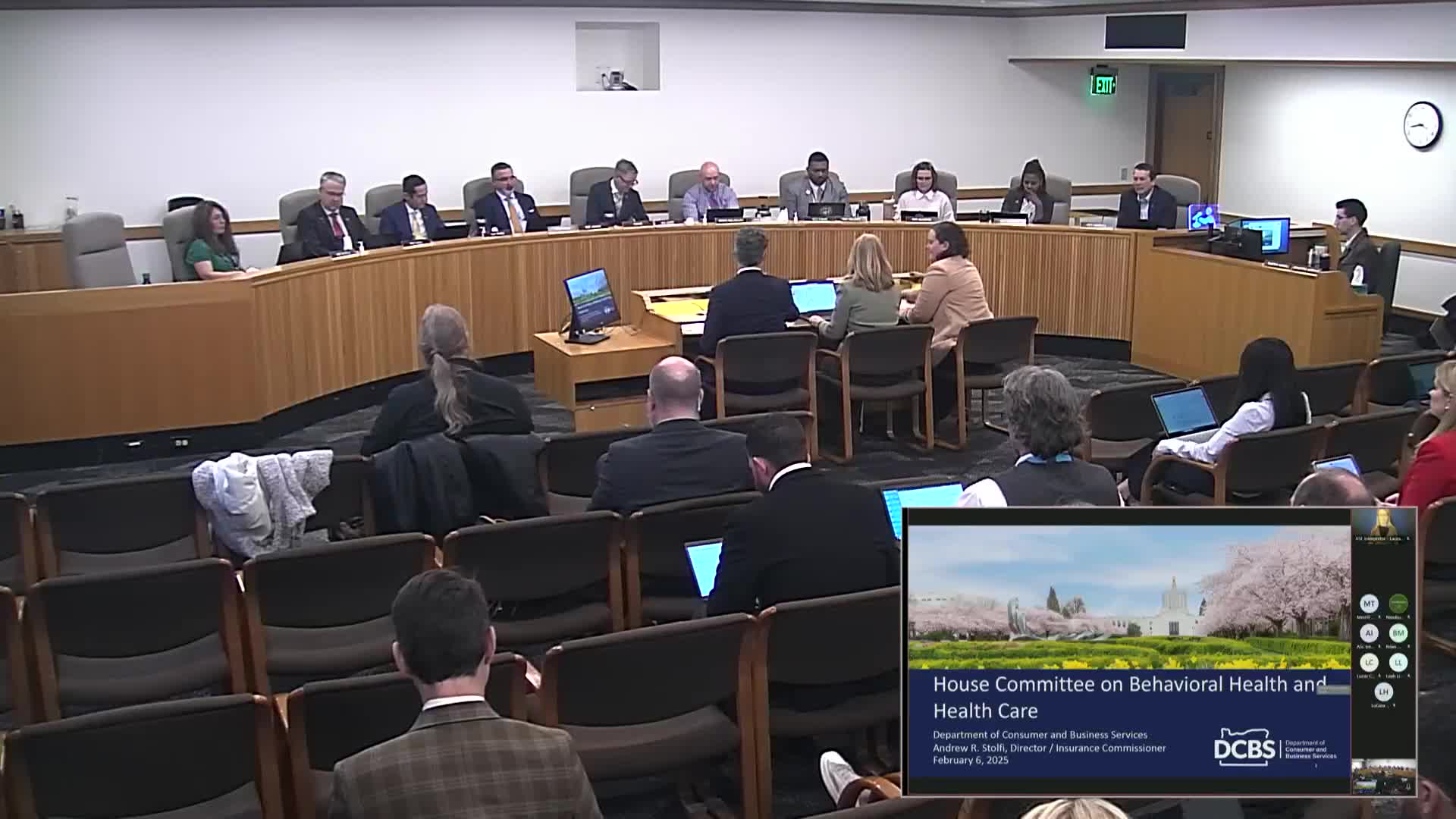
State insurance and health officials and a broad coalition of health industry groups urged the House Committee on Behavioral Health and Health Care on Feb. 6 to extend the insurer and hospital assessments that fund Oregon's Reinsurance Program and substantial portions of the Oregon Health Plan.
Andrew Stolfi, director of the Department of Consumer and Business Services (DCBS), told the committee the reinsurance program and the insurance premium assessment were established in 2017 (House Bill 2391) and later increased and extended in 2019. “For the 2025 plan year, for example, it will reimburse insurers for 50% of their costs over an attachment point of $103,000 and up to $1,000,000 per member,” Stolfi said, describing one of the program’s cost‑containment mechanics.
Why it matters: The assessment (set at 2% since 2019) generates state funds that, together with a federal match, finance the Oregon Reinsurance Program (ORP) and other Medicaid supports. Officials said the ORP has helped stabilize the individual market, increase insurer participation and lower premiums — collectively saving Oregonians nearly $600 million in premiums over the program’s operation.
Key testimony and details - Program history and mechanics: Stolfi traced the program from a 1.5% initial assessment in 2018 (approved by voters in a 2018 special election) to a 2% rate authorized in 2019 and extended through 2026. The ORP reimburses insurers for extreme high‑cost claims and is approved in five‑year federal waiver increments (next renewal 2027). - OHA perspectives: Emma Sando (Medicaid director) and Rochelle Layton (OHA CFO) described Medicaid budget drivers, including caseload growth, federal match rate changes and program investments in behavioral health and services. They noted enrollment and spending patterns vary by region and cited the program’s role in preserving county‑level access to multiple insurers. - Broad industry support: Multiple organizations — hospitals, insurers, unions and provider groups — urged extension. Mary Ann Cooper of Cambia (Regence/Blue Cross Blue Shield region) said renewing the assessment at current levels “is critical to supporting the Oregon reinsurance program and stabilizing Medicaid.” Hospital Association of Oregon, the Oregon Medical Association, unions such as SEIU, and regional CCOs testified similarly.
Budgetary and policy implications Witnesses emphasized that assessments leverage federal matching dollars and support Medicaid without an equivalent general‑fund increase. Committee members pressed officials on tradeoffs: if the assessment is not extended, OHA said a material portion of the Medicaid budget would need replacement from general fund dollars, and staff said there are only limited quarters of assessment revenue remaining without legislative action. Officials indicated the total program draws more than a billion dollars annually in combined state and federal funds and that failure to renew would require significant budget adjustments.
Other program design points discussed - Scope and sunset alignment: HB 2010 proposes to align sunset dates of the insurer and hospital assessments and extend the package for six years, allowing DCBS to seek a corresponding extension of the federal reinsurance waiver. - Equilibrium and protections for rural hospitals: OHA staff described “equilibrium” mechanics that seek to draw federal funds while protecting hospitals — particularly rural type A/B hospitals — through targeted pools and enhanced payments. - Questions from lawmakers: Members asked about changing the program’s target (for example, raising an intended net premium reduction above the current design target of 6%), the meaning of stop‑loss insurance inclusion, and whether the state retains fund balances or “rollover” dollars; agencies said adjustments are possible but would require actuarial work and fiscal decisions.
Ending: Committee members closed the public hearing and scheduled follow‑up work sessions; sponsors and agencies signaled a technical amendment to clarify administrative details and to align the IGT (intergovernmental transfer) treatment for OHSU over the extended period.