Get Full Government Meeting Transcripts, Videos, & Alerts Forever!
Get email alerts on the Health Care Marketplace topic
No spam. Unsubscribe anytime.
Oregon officials say state-based marketplace transition on track after procurement restart
Summary
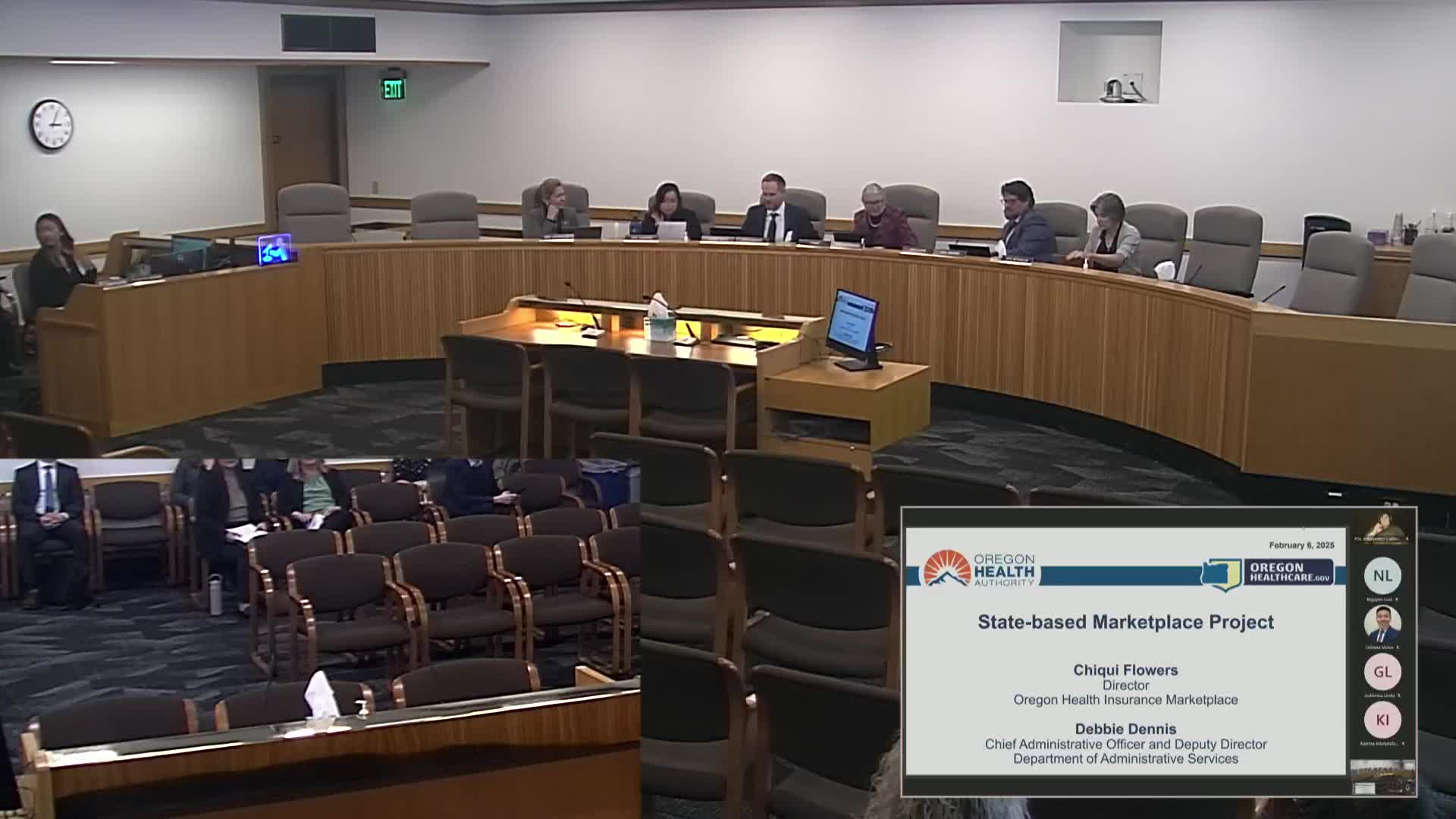
Oregon Health Authority officials told the Senate Committee on Health Care on Feb. 6 they have passed early project stage gates and restarted procurement for a state-based marketplace required by 2023 law, while lawmakers pressed for assurances after past technology failures and a consultant conflict.
Oregon Health Authority officials told the Senate Committee on Health Care on Feb. 6, 2025, that the state remains on track to launch a state-based health insurance marketplace by Nov. 1, 2026, after passing early project milestones and restarting a procurement that was paused for conflict-of-interest review.
The update, given to the committee during an informational meeting, focused on steps taken since Senate Bill 972 passed in 2023 and was signed into law. The bill requires Oregon to transition off the federal marketplace platform healthcare.gov and operate its own eligibility, enrollment and consumer assistance services. Chicky Flowers, director of the Oregon Health Insurance Marketplace, told the committee the move aims to improve service levels, operationalize state policy priorities and provide real-time enrollment and demographic data to target outreach and equity efforts.
"Simply put, with this transition, we will be in a much better place to improve service levels, be more flexible to operationalize the state's policy and programmatic priorities, and utilize enrollment or demographic, data in real time," Flowers said.
Why it matters: a state-run marketplace could let Oregon tailor outreach, provide local consumer assistance in preferred languages and better identify enrollment gaps among communities of focus. Flowers said the project officially launched soon after SB 972 became law in July 2023, and that the project has passed stage gates 1 and 2. OHA has posted project materials at orhim.info/sbmtransition and said July 2025 is the next major milestone as the agency completes a Centers for Medicare & Medicaid Services (CMS) blueprint for state exchanges.
Procurement status and oversight concerns
Debbie Dennis, chief administrative officer and deputy director at the Department of Administrative Services (DAS), said the initial RFP was canceled last fall and a new solicitation (RFP number 12121) closed on Jan. 8, 2025. Evaluation teams held product demonstrations in late January and are completing evaluations.
"That, the current RFP closed in January and we are currently in evaluation," Dennis said.
Committee members pressed officials about oversight and past failures. Senator Hayden raised the state's earlier multi‑year Oracle contract that cost about $200 million and asked how Oregon can avoid a repeat. "Where is the oversight on OHA and where can we be assured that we're not going into another boondoggle like the 200,000,000?" Hayden asked.
OHA and DAS officials said procurement responsibility lies with DAS and that project oversight is shared between the state's IT organization and OHA leadership. Flowers and Dennis said the agency halted the earlier procurement when a potential conflict of interest involving a consultant was called to their attention and coordinated that halt with the Department of Justice and DAS.
Dennis said the consultant contracted for initial advisory services was not a technology vendor and that the contract with the consultant (referred to in committee as Mr. McKee) was "less than $25,000" for consulting services; she added the state did not pay for technology in the halted procurement.
Committee members asked how the process being used now differs from earlier attempts. Dennis described changes to the RFP to simplify requirements, replacement of most evaluators and added non‑voting subject-matter advisors.
"There were some modifications made to the RFP itself, just to simplify, the the procedure, and to clarify some of the requirements," Dennis said. "There are 7 evaluators for this RFP. 6 are brand new. 1 returned, but 6 of them are brand new. And then there is also a series of advisors ... they are not voting, they are not evaluating, but they are, noting their areas of expertise and providing that to the evaluation committee to consider."
Timeline and vendor interest
Flowers told the committee the project team built a 19.5‑month implementation timeline even though vendors told the state they could implement in about 12 months; that buffer, she said, keeps the project on track despite the re‑procurement. "July 2025 is our next mile marker to start the next phases of work to ensure we launch on November first of 20 26," Flowers said, noting the target go‑live aligns with the 2027 open-enrollment period.
When asked how many vendors responded to the closed RFP, Dennis said three vendors submitted proposals.
What the committee heard: the project has moved through initial gates, launched a second procurement that closed in January, and is in evaluation. Committee members sought and received specific clarifications about oversight, consultant pay and evaluator turnover. OHA emphasized real‑time data access and more localized consumer assistance as key benefits of a state-based marketplace.
Next steps and public materials
The committee closed the informational session after roughly an hour of questions and proceeded to three scheduled public hearings. OHA and DAS said they will continue coordination with legislative staff, carriers and community partners, and that the project website and newsletter will provide updates.
The committee did not take formal legislative action on the marketplace at the Feb. 6 meeting; procurement evaluation and CMS blueprint work remain in progress.