Get Full Government Meeting Transcripts, Videos, & Alerts Forever!
Get email alerts on the Rural Provider Tax Credit topic
No spam. Unsubscribe anytime.
Committee weighs proposals to expand and raise Oregon rural provider tax credit
Summary
Lawmakers heard a cluster of bills Jan. 30 proposing to add professions and raise award amounts for Oregon's rural provider income tax credit; the Office of Rural Health warned adding providers without more program funding would dilute the benefit and offered cost estimates.
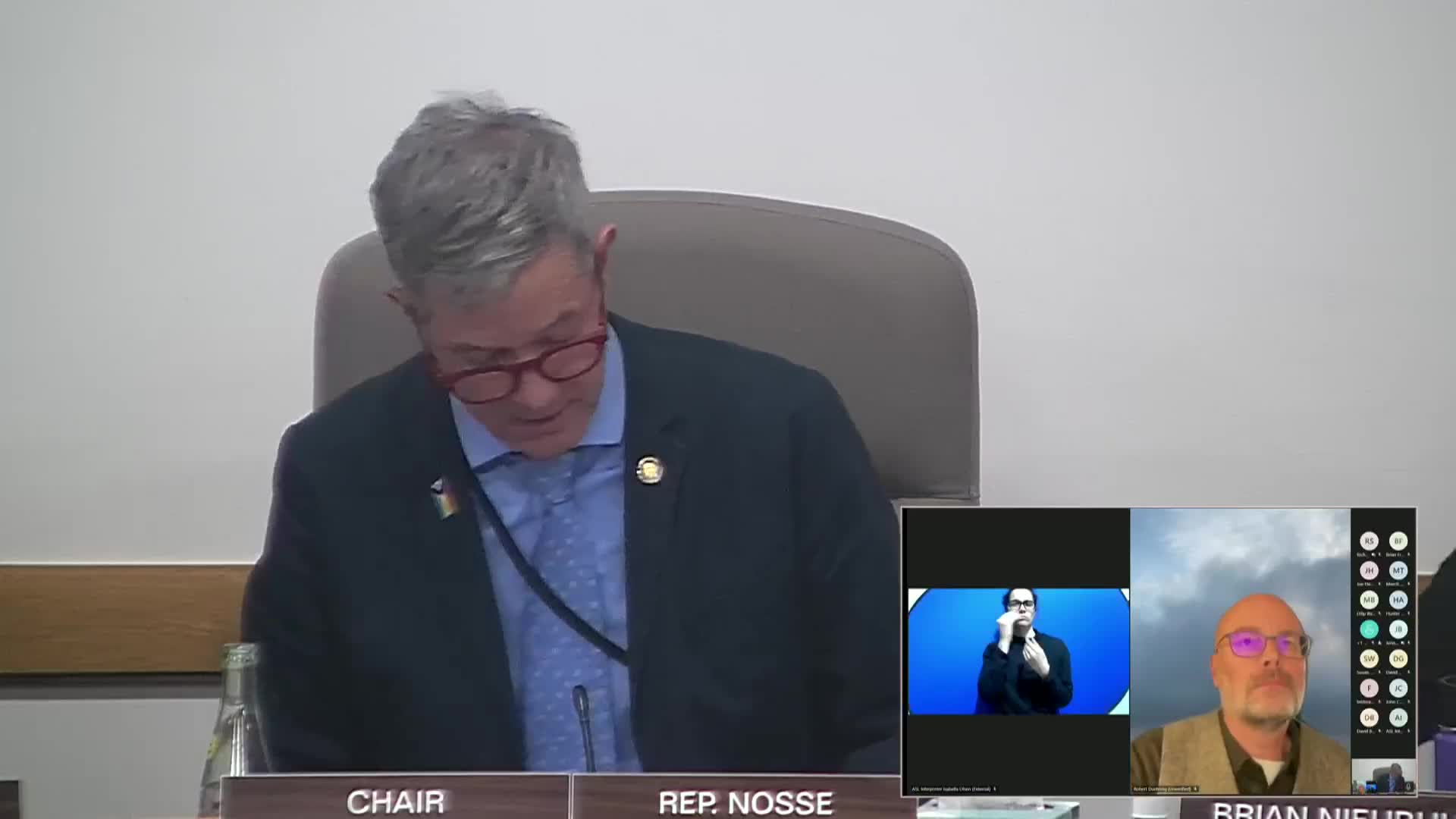
The House Behavioral Health and Healthcare Committee heard multiple bills Jan. 30 that would expand the list of health professions eligible for Oregon's rural provider income tax credit and increase award amounts.
Robert Dimock, director of the Oregon Office of Rural Health, briefed the committee on program history and fiscal implications. "The rural provider tax credit was authorized in 1989...the tax credit was $5,000 in 1999, and it remains that today," he told lawmakers, tracing subsequent changes that added tiers, means tests and service requirements. Dimock said tiers currently pay $3,000, $4,000 and $5,000 depending on distance from urban areas and that one bill under consideration would raise those tier amounts to $6,000, $8,000 and $10,000.
Dimock provided costing estimates for the proposed increase: under the current participation it would raise the annual cost from roughly $7,744,000 to about $15,000,489. He warned that adding more eligible professions without increasing the program's overall funding would dilute the benefit across recipients. "You're watering thin in the soup," he said, explaining that program effectiveness depends on investment matching demand.
Bills discussed would add or clarify eligibility for several professions, including optometrists (removing a hospital-privileges requirement in HB 2204), CRNAs and anesthesiologists (in HB 2591 / HB 2591-related language and HB 2591-adjacent proposals), pharmacists and other allied health providers (HB 2365 and HB 2549 referenced by proponents), and a separate measure (HB 2390) that would increase award amounts and remove some income caps.
Medical groups, professional associations and rural health providers testified in support. Jeff Knapp, executive director of the Oregon Optometric Physicians Association, told the panel that requiring hospital privileges for optometrists to qualify has been a barrier in rural hospitals and urged HB 2204 support. "A lot of the rural hospitals do not even have criteria built in for us to apply for it," Knapp said.
Anesthesia providers testified that lack of local anesthesiologists and CRNAs constrains surgical and obstetric services. "CRNAs do about 80% of rural anesthesia throughout the state," said David Bullock, a CRNA who testified in support of including anesthesia providers in incentive programs. Pediatric and hospital anesthesiologists described graduates leaving the state for higher pay or loan forgiveness elsewhere and urged loan-repayment and tax-credit inclusion as retention tools.
Opponents questioned whether tax credits are the right tool. John Calhoun of Tax Fairness Oregon called expanding credits "an expanded giveaway at taxpayer expense" and urged reliance on coordinated care organizations and other workforce strategies instead of broad tax exemptions.
Committee members asked the Office of Rural Health to model potential impacts for specific professions and geographies; Dimock agreed the office could estimate numbers of providers in rural/frontier areas to inform fiscal decisions. Representative Bobby Levy, sponsor of some expansion measures, described the bills as efforts to "level the playing field" and address rural shortages by making rural practice more financially viable.
There were no committee votes at the hearing. Lawmakers closed public testimony and signaled follow-up work with the revenue and tax-expenditure processes that would be required to set funding and evaluate trade-offs among competing tax-credit proposals.