Get Full Government Meeting Transcripts, Videos, & Alerts Forever!
Get email alerts on the Law Commission Projects topic
No spam. Unsubscribe anytime.
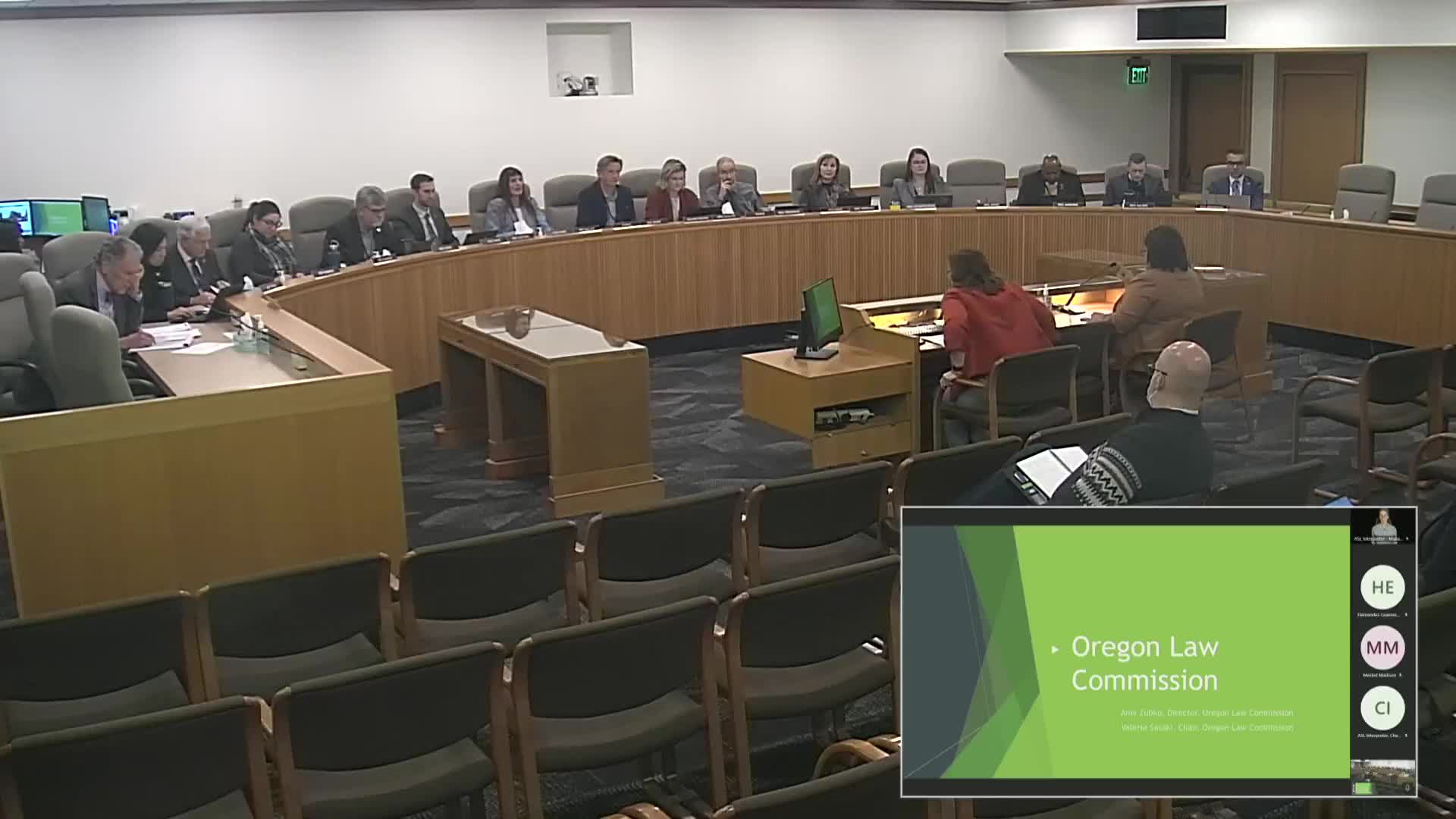
Oregon Law Commission outlines multi-year projects, including LLC modernization and municipal-justice appeals reform
Summary
The Oregon Law Commission described its role as a volunteer-driven body that drafts technical, multi-year statutory reforms. The commission said it will bring bills this session including municipal and justice court appeals modernization (HB 2460) and the LLC-act modernization (SB 164).
Amy Zebko, director, and Valerie Sasaki, chair of the Oregon Law Commission, told the Judiciary informational hearing that the commission conducts a continuous program of law revision and reform and relies heavily on volunteer subject-matter experts.
“The law commission was created by statute, and is designed to conduct a continuous program of law revision, reform, and improvement,” Sasaki said. She described a 15-member commission that includes judicial, legislative and law-school representation and that frequently convenes work groups composed of attorneys, agency staff and others to draft technically detailed bills.
Zebko and Sasaki said the commission’s work is often lengthy and technical: some projects span months while others take years. They said two bills coming to the legislature this session grew from long-running work groups: HB 2460, a municipal- and justice-court-appeals modernization bill grounded in work that began after the commission’s 2016 direct-criminal-appeals work, and SB 164, a five-year project to modernize Oregon’s limited-liability-company statute.
Zebko explained the commission’s process: commissioners and volunteer work-group members prepare draft bills and a report that explains each section’s purpose, origins and policy tradeoffs. “If you have a question about section seven in a bill, you can go to the report, and it will say, here's what section seven means, where it came from, why if we changed it from existing law, why we did that,” she said.
The commission also listed four upcoming projects it plans to start this year, including electronic wills, partition of heirs property, follow-up work on municipal and justice court appeals, and a potential update of Oregon’s corporations act.
Ending: Members of the committee praised the commission’s technical work and volunteer contributions and encouraged the commission to continue partnering with legislative and judicial stakeholders as bills move forward.