Get Full Government Meeting Transcripts, Videos, & Alerts Forever!
Get email alerts on the Law Commission topic
No spam. Unsubscribe anytime.
Oregon Law Commission describes projects from municipal appeals to LLC modernization
Summary
The Oregon Law Commission briefed the committees on two bills for the session — HB 2460 on municipal and justice court appeals and SB 164 to modernize the LLC Act — and outlined upcoming projects including electronic wills and heirs' property.
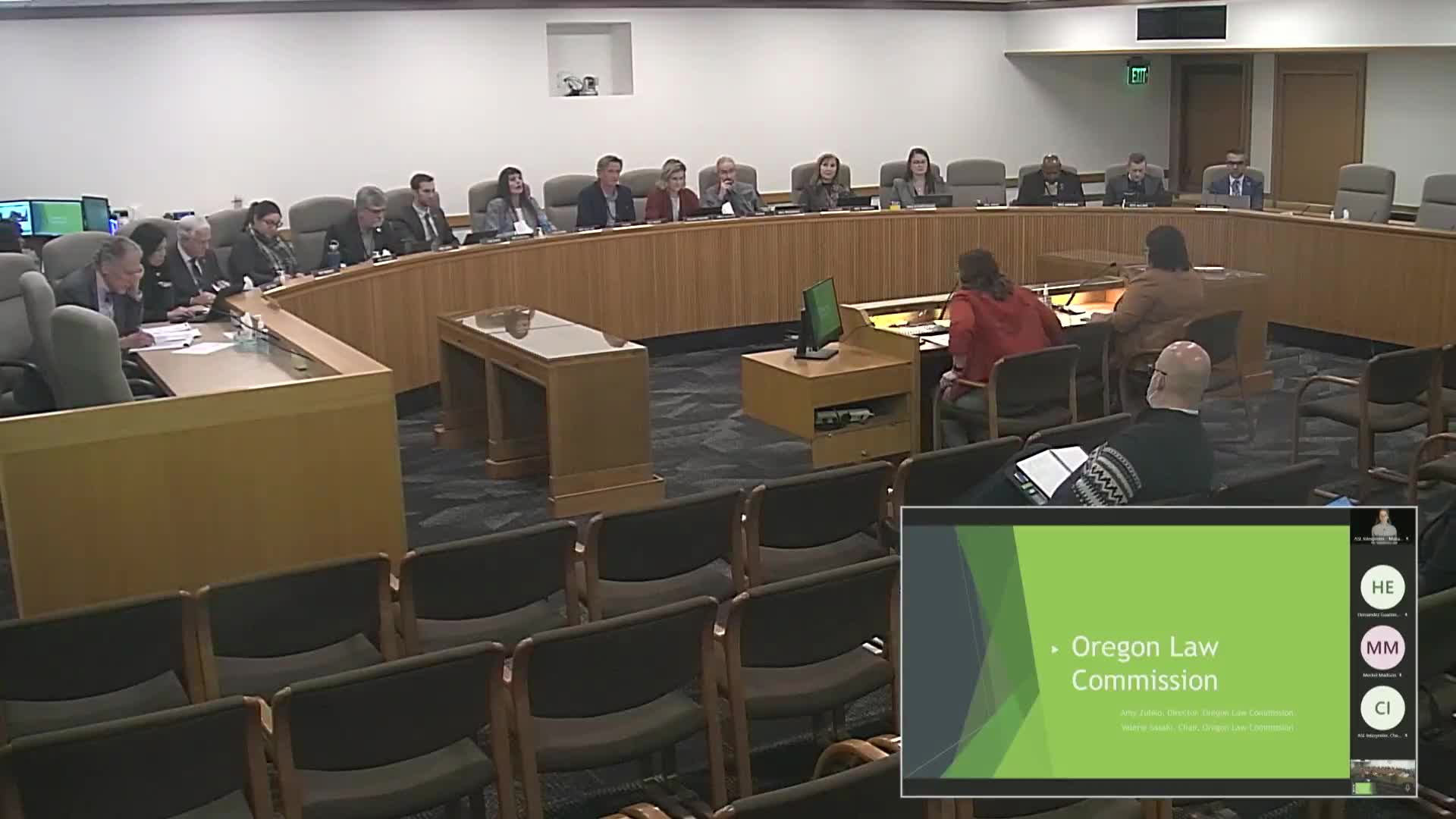
Amy Zebko, director of the Oregon Law Commission, and commission chair Valerie Sasaki told the Judiciary committees that the commission serves as a long-term law-revision resource for the Legislature and that it expects to submit two primary bills this session.
Sasaki said the commission, established by statute, conducts a continuous program of law revision, reform and improvement and uses volunteer work groups of stakeholders and subject-matter experts. "The law commission provides structure for addressing and exploring some of the really tough questions and big legislative questions," she said.
Zebko and Sasaki said the commission will forward HB 2460, a package updating municipal and justice court appeals procedures that grew out of a multi-year work group, and SB 164, a modernization of the Oregon Limited Liability Company Act that reflects five years of stakeholder review. Zebko noted the commission produces detailed work-group reports alongside bill text to explain drafting choices and record points of debate.
The commission also previewed four upcoming projects the group expects to begin this year: an electronic wills project planned for March, a partition of heirs property work group likely to start in midyear, further work on municipal and justice court appeals beyond this session, and a possible update to Oregon's Corporations Act. Sasaki highlighted the commission's model of recruiting volunteers from across the state, law schools and the bar to reduce the Legislature's need to staff extended technical projects.
Ending: Members thanked the commission for the overview and noted that the commission’s sustained volunteer expertise has supported technical, multi-year legislative fixes in the past.