Get Full Government Meeting Transcripts, Videos, & Alerts Forever!
Get email alerts on the Real Estate Agency Budget topic
No spam. Unsubscribe anytime.
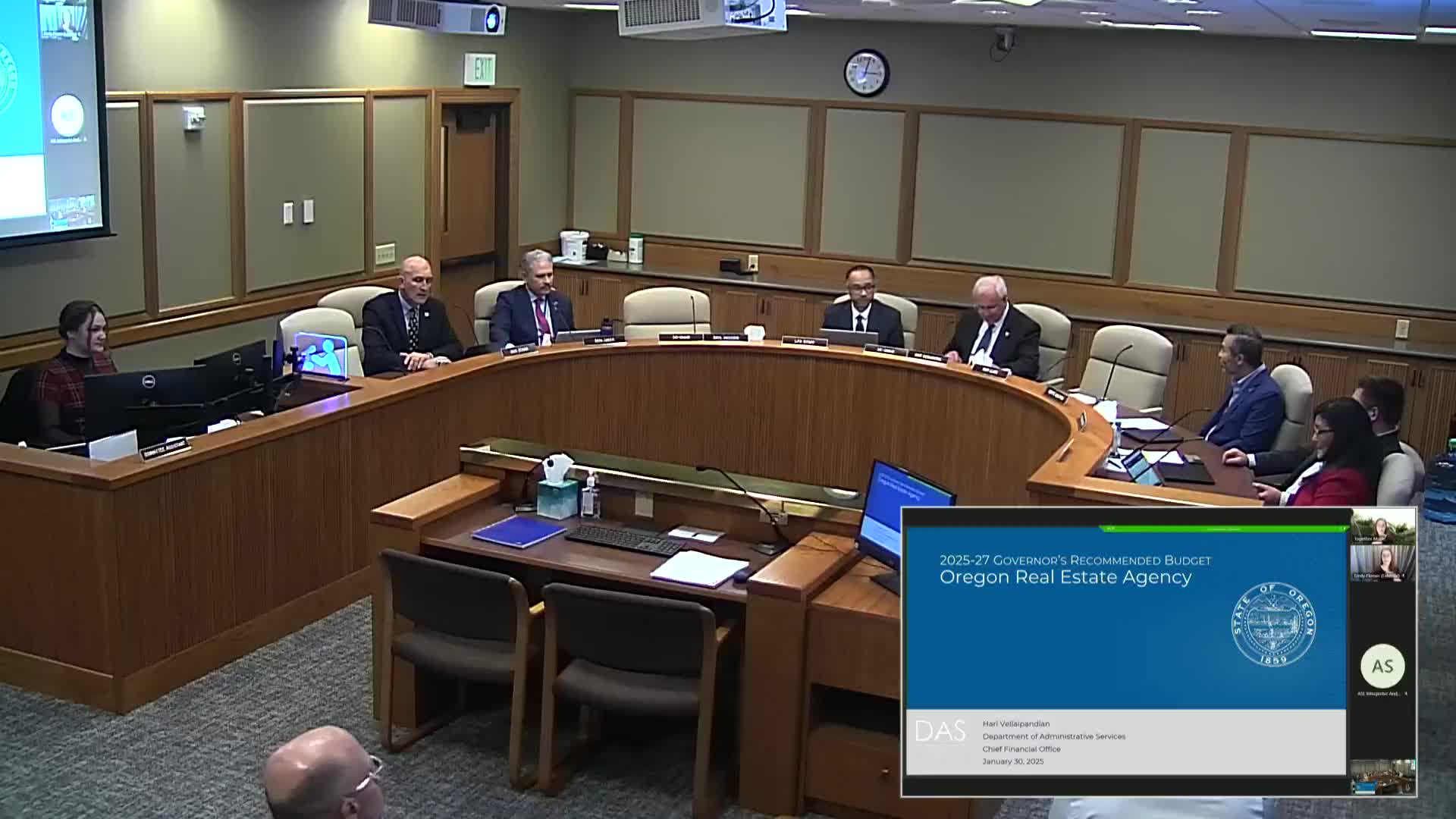
Oregon Real Estate Agency outlines budget, e-licensing timeline and stepped-up compliance at public hearing on HB 5036
Summary
At a Jan. 30 public hearing on House Bill 5,036, the Oregon Real Estate Agency presented a $15.7 million governor's recommended budget that emphasizes staff costs, completion of an e-licensing system, and expanded property-management compliance work; agency leaders warned revenues may fall with fewer licensees and described steps to reduce costs.
The Transportation and Economic Development Subcommittee of the Ways and Means Committee opened a public hearing Jan. 30 on House Bill 5,036, the governor's recommended budget for the Oregon Real Estate Agency. Agency leaders told the committee the $15,734,253 proposal focuses on personnel, finishing an e-licensing system and continued investments in compliance and investigations.
“The agency projected to finish the biennium with approximately 2 months of operating reserves just short of the recommended 3 to 6 months,” said Hari Belopondian, representing the Department of Administrative Services Chief Financial Office, during his budget overview to the committee.
That shortfall prompted the agency to reduce services and supplies, eliminate one vacant position and take additional vacancy savings to bring reserves in line with guidance. The governor's recommended budget does not request fee increases for the 2025–27 biennium; agency leaders said they will monitor revenue and may propose adjustments in a later cycle.
Oregon Real Estate Commissioner Steve Stroud described how the agency's work is funded mostly by license fees and exams and outlined the agency’s priorities. “Our mission is to provide quality protection for Oregon consumers of real estate, escrow, and land development services balanced with a professional environment, which is conducive to a healthy real estate market atmosphere,” Stroud said.
Key budget facts and near-term plans
- Total governor's recommended budget: $15,734,253 for 2025–27. - Funding composition (2023–25 baseline): about 71% from license renewals, 19% from new applications and 10% from other fees, fines and condominium filings. - Projected closing balance for the current biennium: roughly $6.1 million, about 15 months of operating expenses, with about $2 million of capital outlay remaining for the e-licensing project. - Capital project: a replacement e-licensing system is in execution; vendor configuration and data conversion are underway and the agency expects a 2026 go-live.
Stroud said the new licensing platform will be mobile-friendly and add improved communications such as opt-in text notifications. The budget includes capital outlay payments tied to deliverables; once the system is deployed, capital spending for the project will phase out.
Compliance, enforcement and workload
The agency said it has increased client trust-account reviews and compliance audits. Stroud reported that data from the first cycle of reviews showed up to 80% of audited licensees had at least one compliance-related issue and about 5% had more serious problems. The agency has doubled its client trust-account reviews over recent biennia and plans periodic reviews on a two- to three-year cycle for property managers.
Investigations remain largely complaint-driven. The agency said the average time to complete an investigation is about 120 days; roughly 85% of investigations are completed within the target of 150 days. If a respondent requests a hearing, the administrative hearing phase adds time: the agency reported an average of about 379 days to conclude contested-case hearings after referral to the Office of Administrative Hearings and the Department of Justice. Stroud said roughly 98% of cases are resolved before formal hearings through settlements or other informal resolutions.
Legislators pressed the agency about timelines and consumer protection. Committee members noted that lengthy proceedings can leave complainants and respondents in limbo; Stroud said the agency prioritizes cases by potential consumer harm and can suspend licenses if a licensee refuses to provide required records in serious cases.
Statutory and rule changes: HB 4058 implementation
Stroud reviewed changes from the 2024 session embodied in House Bill 4,058, which (per the agency) created a residential property wholesaler registration category, mandated buyer service agreements and prohibited future right-to-list contracts. Agency rulemaking for the buyer service agreements took effect Jan. 1; wholesale registration becomes effective July 1. The agency requested formal legislative authority to collect a $300 registration fee directed by HB 4,058; it estimates the wholesale-registration receipts will be modest (about $15,000 in the next biennium).
Programs, performance measures and operational items
- Personnel comprises roughly 60% of the agency's budget; services and supplies are about 27%. - Key performance measures: percent of property managers meeting compliance within 45 days (target 90%), percent of investigations completed within 150 days (target 80%, current 85%), and percent of cases resolved without hearing (about 98%). - Examination satisfaction: about 72% of test-takers rated the board-administered exam as good or excellent (target 75%); the agency plans an RFP to review testing-provider contracts. - Customer service ratings exceeded targets (cumulative 93% and 96–97% in recent months) with phone and email support during business hours.
Operational items the agency flagged for the coming biennium include issuing an RFP for the exam provider, continuing compliance and audit work for property managers, completing the e-licensing deployment (target 2026), and negotiating new office space when its downtown Salem lease expires in July.
Why this matters
Agency leaders told the committee that license counts can shift with housing-market cycles and regulatory changes, which affects fee revenue because the agency is entirely other-funded. The subcommittee heard that a recent influx of pandemic-era licensees contributed to reserve growth, and that current attrition and a slowdown in transactions could reduce revenues going forward. The agency said it adjusted staffing and vacancy plans to align with expected lower license counts.
The public hearing record closed after questions from committee members and no public testimony was taken in the meeting room. The subcommittee did not vote on the budget during the hearing; the session was an informational public hearing on HB 5036.