Get Full Government Meeting Transcripts, Videos, & Alerts Forever!
Get email alerts on the Behavioral Health Facility Investments topic
No spam. Unsubscribe anytime.
Oregon Health Authority outlines $130M+ behavioral health facility investments; 35 projects and roughly 191 licensed beds funded so far
Summary
Oregon Health Authority staff told the Human Services subcommittee the agency used a mix of state and ARPA funds to award facility and housing grants, reporting 35 projects, about 191 licensed beds and 93 units funded across the state and a public dashboard tracking progress; lawmakers flagged staffing and permitting bottlenecks.
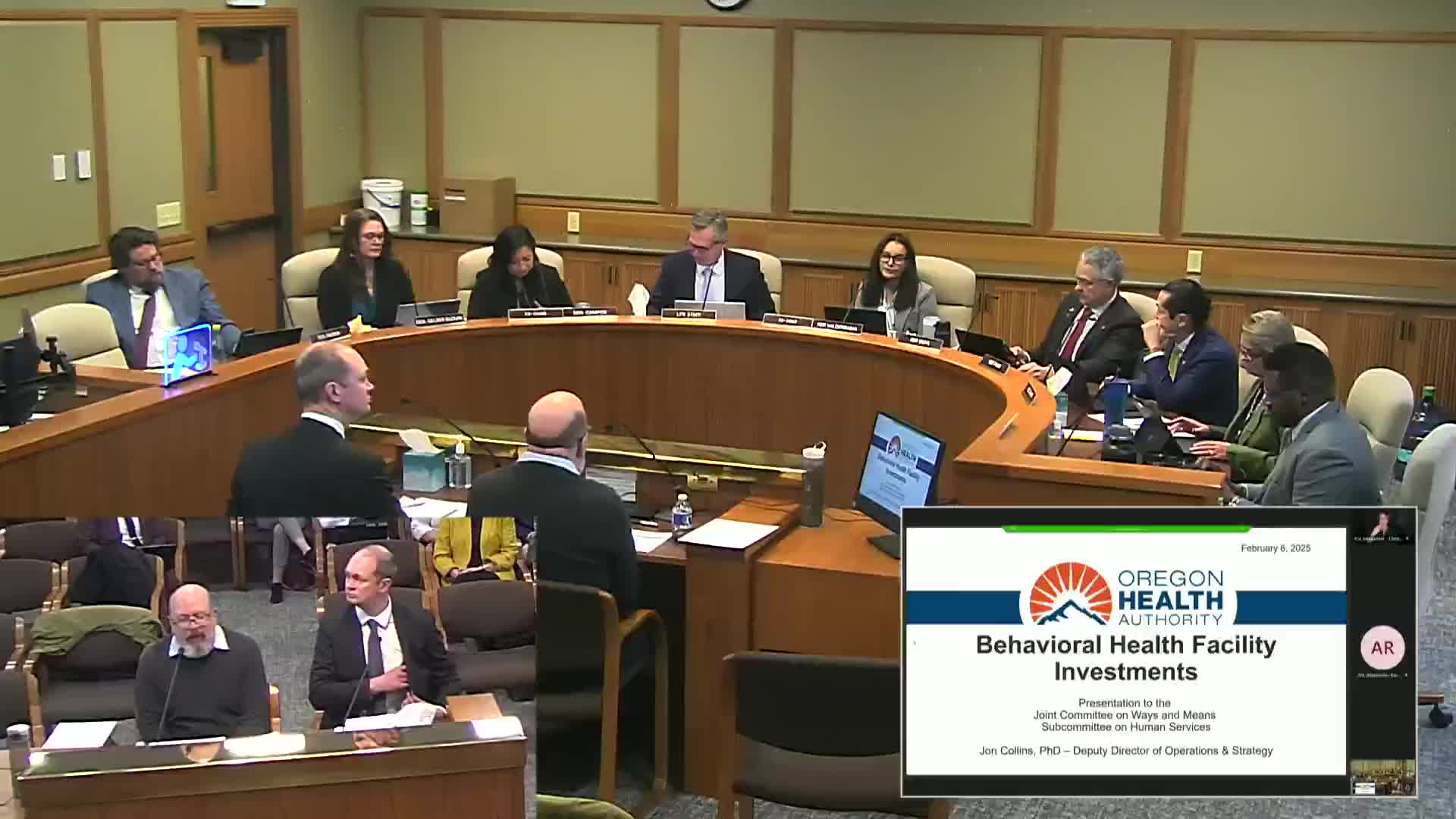
John Collins, deputy director for operations and strategy in OHA’s Behavioral Health Division, told the Joint Interim Subcommittee on Human Services on Feb. 6 that the agency has moved multiple funding streams into community behavioral‑health facilities and housing since mid‑2023 and published a public dashboard to track awards and occupancy.
Collins said House Bill 5024 provided $130 million (half general fund, half ARPA) with a $20 million tribal set‑aside and that those dollars, together with other appropriations, have been distributed through a mix of solicitations and direct awards. “We developed a dashboard on the website so that we can demonstrate and be very transparent about where these funds are going and what they are, what they are developing in terms of the types of facilities,” Collins said.
What OHA reported to the committee: - HB 5024 funding and other streams supported more than 25 organizations and 35 projects, producing 191 beds and 93 housing units (units include recovery or supported housing); beds and units are distributed across urban, rural and frontier counties including Multnomah, Jackson, Clatsop, Coos and Deschutes. - Senate Bill 5525 supplied $15 million of general fund aimed at substance‑use‑disorder facilities; some of those dollars supported operations where providers demonstrated need and six projects produced 73 SUD residential beds. - House Bill 5030 (lottery bond proceeds) funded nine projects totaling 178 beds and five crisis‑service chairs, guided by the Residential Plus (ResPlus) study contractors identified statewide gaps. - OHA directed roughly $9.4 million of general‑fund dollars to address capacity tied to community restoration and “aid and assist” litigation needs.
Collins described implementation work the agency created to manage contracts, monitor occupancy and help projects through development. He said the state assembled a behavioral health investments team, worked with the Association of Oregon Community Mental Health Programs on a distribution formula for a large $100 million allocation to community mental health programs, and used the ResPlus study (a Public Consulting Group report) to guide investments in licensed residential capacity.
Lawmakers asked about two recurring implementation challenges: workforce and licensing/permitting timelines. Representative Deal asked whether counts reported are licensed beds or staffed capacity; Collins said the ResPlus study and OHA’s award tracking focus on licensed beds, and he acknowledged workforce shortages can make staffed capacity lower than licensed capacity in some locales. Representative Beal raised an example — Jackson House — where a provider told the committee a completed facility was waiting months for licensing paperwork review; OHA said it is working with that provider, acknowledged some reviews take longer for novel or first‑in‑state facilities, and emphasized the licensing work is meant to ensure quality and safety.
Formal action: Patrick Heath of the DAS Chief Financial Office recommended the committee acknowledge receipt of the behavioral health facility investments report; the Legislative Fiscal Office made the same recommendation. Senator Campos moved the LFO recommendation; there were no objections and the motion passed by unanimous consent. Committee staff asked OHA to correct a nonfunctional link to the online dashboard in the written report; OHA agreed to provide a working link in follow‑up materials.
Collins concluded by urging continued investment in both facility capacity and community services, noting that expanded community‑based care and workforce investments could change long‑term residential bed needs. OHA told the committee it will provide supplemental data on occupied beds and a corrected dashboard link in writing.