Get Full Government Meeting Transcripts, Videos, & Alerts Forever!
Get email alerts on the Public Comment Rules topic
No spam. Unsubscribe anytime.
Residents urge commission to retain longer public-comment periods and raise safety and inclusion concerns
Summary
Multiple residents used the public-comment period at the Feb. 4 Manhattan City Commission meeting to oppose a proposed change to shorten individual public comments from five minutes to three and to raise worries about community polarization, migrant-related threats and mental-health impacts.
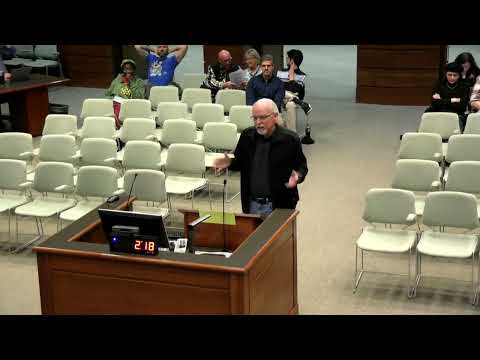
The Manhattan City Commission heard more than a dozen public comments on Feb. 4 opposing a proposed rule change to shorten individual public-comment time from five minutes to three minutes and to cap public-comment segments at 30 minutes. Commenters also raised broader concerns about civic trust, local growth strategy and safety for migrants and nonwhite residents.
“Reducing it to three minutes starts to feel like you don't really want to hear from the public,” said Kathy Joweltowski, who gave her address as 100 South Delaware Avenue. Joweltowski said a previous limit of five minutes had been a reasonable compromise and warned a new cap could exclude people who decide to speak after the speaker list is full.
Amber Starling, who gave her address as 408 Houston Street, urged the commission to reconsider growth strategies that she said have left infrastructure in poor condition and to hold local partners to performance benchmarks. Starling criticized the commission’s outreach and said she and a team of younger supporters had been curtailed in earlier meetings when speaking time was reduced.
“Now it's three minutes with a 30-minute max,” Starling said, adding that controversial items have in the past drawn more than 30 speakers.
Several commenters urged the commission to address the impacts of dehumanizing language and policies on mental health. Katie Smith said hate speech and the dehumanization of immigrants are an early warning sign that a community may be preparing for violence and asked how the city would respond if vigilante or extremist actors appeared. “When fear and dehumanization take hold, this is the outcome,” Smith said.
Other speakers expressed concern about reduced opportunities for civic participation. David Chiboltowski said he supported making public comment more effective but opposed shrinking the time without first discussing engagement strategies on a work agenda. “I don't think eliminating public comment is a solution,” he said.
Mayor McCullough told speakers the commission planned further discussion: motions to consider shortening individual public comments to three minutes and capping segment lengths to 30 minutes will be considered at a Feb. 11 work session and at the Feb. 18 legislative session. Commissioner Adamczak said the commission had not yet adopted any policy and invited residents to bring thoughts to the Feb. 11 discussion.
Several commenters also raised local accountability issues tied to economic-development policy, the chamber of commerce and rec-center fees, with one speaker recounting past instances where commissioners truncated speakers’ time. Tessa Anderson (who gave a preferred name of Rowan) offered a broader critique of commissioners’ responsiveness and called for action to protect vulnerable residents.
The public-comment period closed after the mayor asked whether there were additional speakers; the commission moved on to its consent and public-hearing business afterwards.