Get Full Government Meeting Transcripts, Videos, & Alerts Forever!
Get email alerts on the Local Income Tax topic
No spam. Unsubscribe anytime.
Businesses and local governments split over bill to standardize local income-tax rules
Summary
House Bill 2,110, which would require local income taxes to conform to state definitions of net income, drew sharply divided testimony. Local governments warned the measure could preempt voter-approved tax policy and threaten regional programs; business groups and tax consultants said the bill would reduce compliance costs and protect businesses.
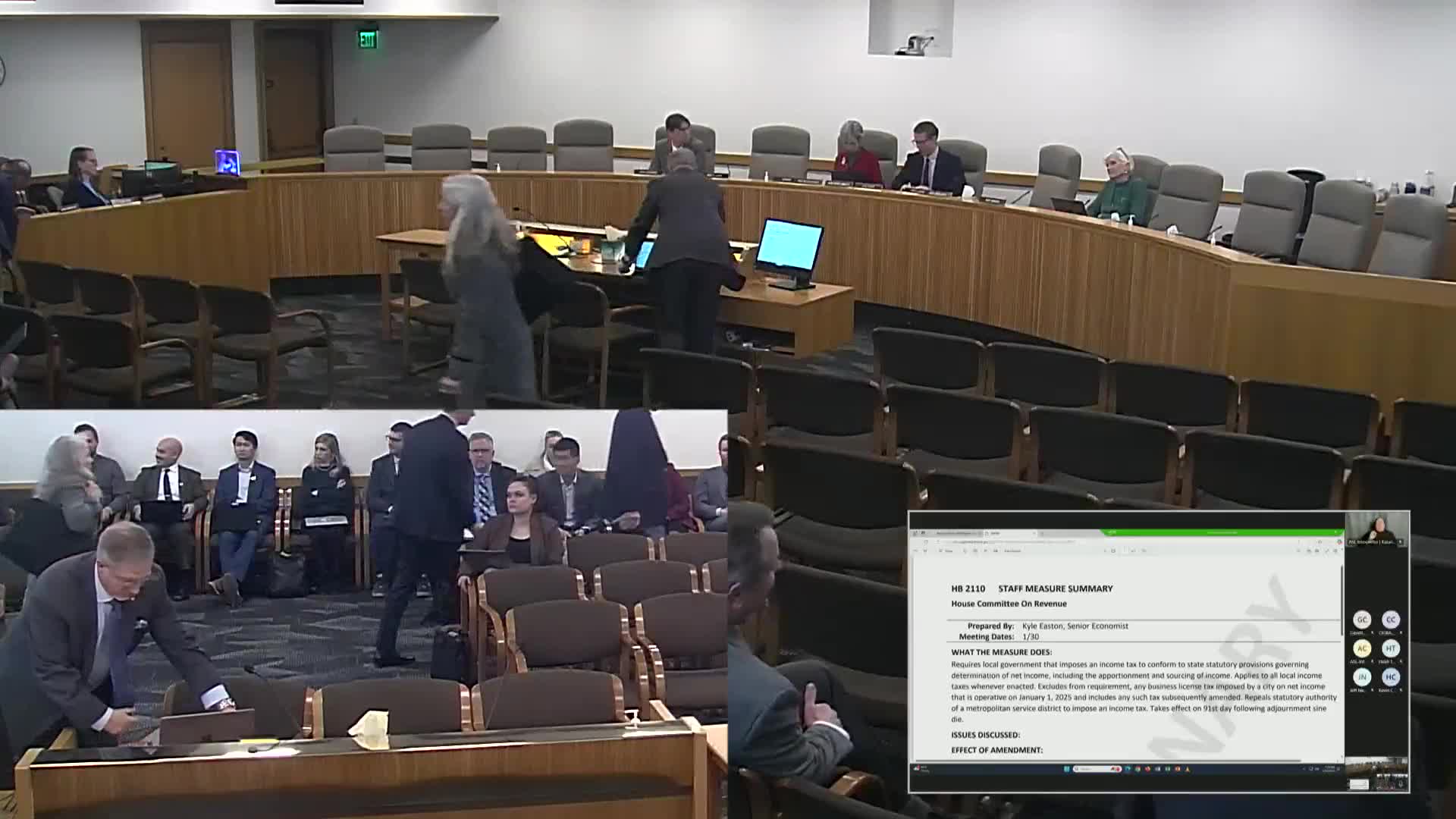
The House Revenue Committee heard Jan. 30 on House Bill 2,110, which would require local governments that impose income taxes to conform to state statutory provisions that define net income.
Legislative Revenue staff explained the bill’s purpose is to reduce complexity by aligning local income-tax definitions with state law and noted it would not eliminate home-rule authority. The bill also removes a statutory authorization for a metropolitan service district to impose income tax while preserving home-rule authority, staff said.
Representative Reschke, speaking in support of seeking a uniform approach, said inconsistent local rules make compliance difficult and urged further analysis of the bill’s fiscal effects. “My goal with House Bill 2,110 is to bring about better compliance,” Representative Reschke said.
Local governments urged caution. Brian Kennedy, chief financial officer for Metro, said the bill could undermine funding for regional programs that rely on local income taxes, including the Supportive Housing Services program. Kennedy warned that limiting metro’s authority “could result in a significant loss of funding potentially dismantling programs and progress that thousands of individuals rely on.” He cited program outcomes through Sept. 2024: more than 6,000 households placed in housing, more than 15,000 eviction preventions, and more than 1,800 shelter beds created or sustained.
Thomas Lanham of the City of Portland Revenue Division said the bill’s broad language risks preempting voter-approved local tax policy and called for a detailed tax-by-tax impact analysis. Multnomah County likewise asked the committee to refrain from advancing the bill without fuller review.
Business groups spoke in favor. Derek Sangston of Oregon Business and Industry and tax consultant Jeff Newgard said conformity would remove a costly patchwork of different definitions and reduce accounting and compliance costs for businesses operating across multiple local jurisdictions. Sangston cited research showing local business taxes in the Portland area rose 82% since 2019 and argued the bill would not eliminate local taxes but would standardize definitions to lessen administrative burden.
Stakeholders flagged several open questions: whether conformity would create double-taxation risks for certain pass-through entities, how the bill would interact with existing local exemptions and thresholds, and whether the Department of Revenue should administer or collect local income taxes.
The committee took testimony from city, county, metro and business representatives and closed the public hearing without taking a vote. Representative Reschke invited stakeholders to work with his office and staff to find a collaborative path forward.