Get Full Government Meeting Transcripts, Videos, & Alerts Forever!
Get email alerts on the Behavioral Health Ccbhc topic
No spam. Unsubscribe anytime.
Oregon Health Authority reports CCBHC pilot showed higher quality, modest cost offsets; OHA readies Medicaid state-plan expansion
Summary
Oregon Health Authority officials on Feb. 6 told the Joint Interim Subcommittee on Human Services that the state’s Certified Community Behavioral Health Clinics (CCBHC) demonstration produced better quality measures and reductions in high-cost services compared with non‑CCBHC programs, and that the agency is pursuing a Medicaid State Plan Amendment to make the model permanent.
Oregon Health Authority officials on Feb. 6 told the Joint Interim Subcommittee on Human Services that the state’s Certified Community Behavioral Health Clinics (CCBHC) demonstration produced better quality measures and reductions in high-cost services compared with non‑CCBHC programs, and that the agency is pursuing a Medicaid State Plan Amendment to make the model permanent.
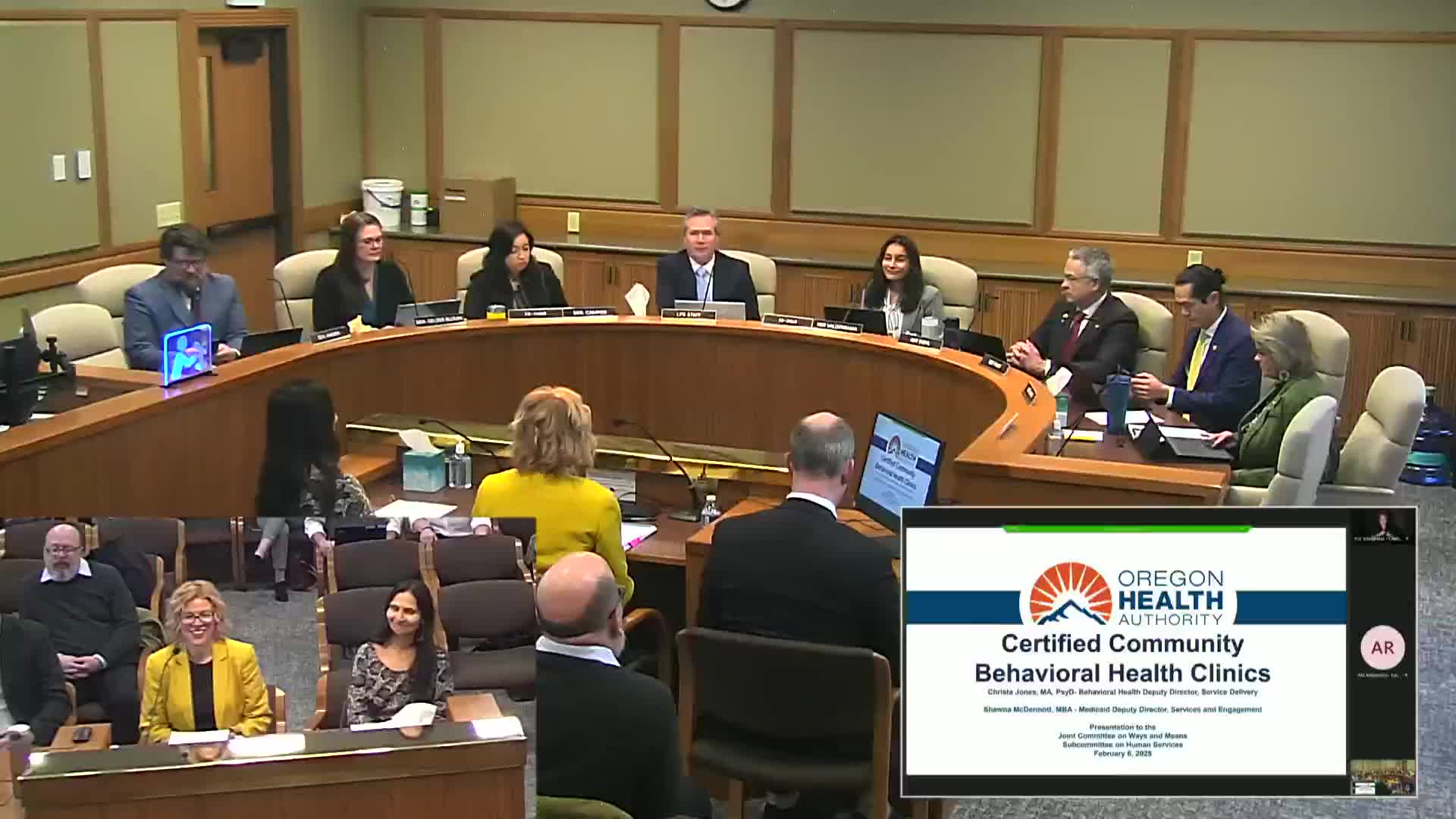
The OHA presentation, given by Dr. Krista Jones, deputy director for the Behavioral Health Division, and Shauna McDermott, deputy director for Medicaid services and engagement, summarized a legislatively required evaluation of the CCBHC pilot covering the 2021–2023 biennia. “The CCBHC program is a federal demonstration pilot…with an innovative payment model, the Prospective Payment System, and a set of stringent clinical and operational standards,” Dr. Jones said. OHA said the program is overseen by SAMHSA, CMS and ASPE.
Why it matters: The evaluation was requested in the 2023 budget note (Senate Bill 5525) and examined use of funds, barriers to full utilization, health outcomes, costs, and the effects of ending the pilot. OHA told lawmakers that because the agency has submitted a State Plan Amendment under 2024’s House Bill 4002, items about redirecting funding and ending the pilot are no longer applicable.
Key findings presented by OHA: - Service utilization and the number of individuals served were “relatively consistent” between 2022 and 2023; overall OHA reported a 14% increase in utilization of CCBHC funds during the review period. - CCBHCs outperformed the broader CCO population on several CMS core-set metrics, including follow-up after emergency department (ED) and inpatient visits for mental illness and measures of initiation and engagement for substance use treatment. - The CCBHC population saw reductions in several high‑cost services that OHA estimated produced roughly $7.2 million in annual cost savings during the biennium reviewed. - CCBHCs showed smaller increases in per‑member‑per‑month costs compared with comparable community mental health programs, suggesting better containment of cost growth.
OHA officials described three core elements of the model: integrated, coordinated care across a broad service array (including crisis services and primary care screening); an emphasis on quality and community needs assessment; and the Prospective Payment System designed to address historical underfunding. Shauna McDermott said the 2023 rebase of PPS rates brought clinic rates closer to actual costs and, as a result, “these clinics are now able to draw down wrap funds,” enabling clinics to receive the full PPS-derived rate for covered services. OHA noted that the rate rebasing occurred at the end of 2023 and therefore the effects were not fully reflected in the historical data presented.
OHA gave the following program and population details: the CCBHC budget for the 2021–23 biennium was estimated at about $50 million (this estimate excludes funds provided directly by CCOs), roughly 25% of CCBHC clients fall outside Oregon Health Plan claims data (uninsured, Medicare-only, TRICARE, private pay) and therefore were not included in the OHP-only service counts, and the state currently has 12 clinics covering 21 sites across 14 counties. OHA said it anticipates expanding access by 12 to 15 sites in the first year under the state‑plan amendment.
On outcomes, OHA reported better performance for CCBHC patients on many metrics but noted areas where high acuity made improvement difficult: for example, CCBHC populations showed lower adherence to antipsychotic medication measures for people with schizophrenia or schizoaffective disorder, which OHA attributed to the complex needs of a higher‑acuity caseload. The agency also reported a greater decrease in substance‑use‑disorder ED visits and reductions in several inpatient and emergency usages for behavioral health.
Questions from legislators focused on conversion of dollars to service counts and staffing/implementation challenges. Representative Nelson asked how dollar figures translate into visits and patients; OHA pointed lawmakers to slides showing the number of individuals served in 2022 and 2023 and to follow‑up slides on payments. On staffing and expansion readiness, OHA said it was collecting readiness information from prospective sites and would provide further detail.
Formal action: Patrick Heath of the DAS Chief Financial Office recommended the committee “acknowledge receipt of the report.” The Legislative Fiscal Office offered the same recommendation. Senator Campos moved to accept the LFO recommendation to acknowledge receipt; there were no objections and the motion passed by unanimous consent. Patrick Heath’s recommendation was recorded in committee minutes.
What’s next: OHA said it will proceed with the State Plan Amendment required by House Bill 4002 and that the Governor’s budget includes the state share and federal match OHA expects will accompany the SPA. OHA also said it will continue CCBHC evaluation with increased emphasis on health equity and culturally and linguistically specific services.