Get Full Government Meeting Transcripts, Videos, & Alerts Forever!
Get email alerts on the Medicaid Budget topic
No spam. Unsubscribe anytime.
Oregon Health Authority outlines Medicaid growth, 1115 waiver services and Bridge expansion at Jan. 30 briefing
Summary
Oregon Health Authority officials told a legislative interim subcommittee that Medicaid now covers about 1.4 million people, described implementation of a first-in-the-nation 1115 waiver for health-related social needs and reentry, and reported enrollment figures for the Healthier Oregon and OHP Bridge programs.
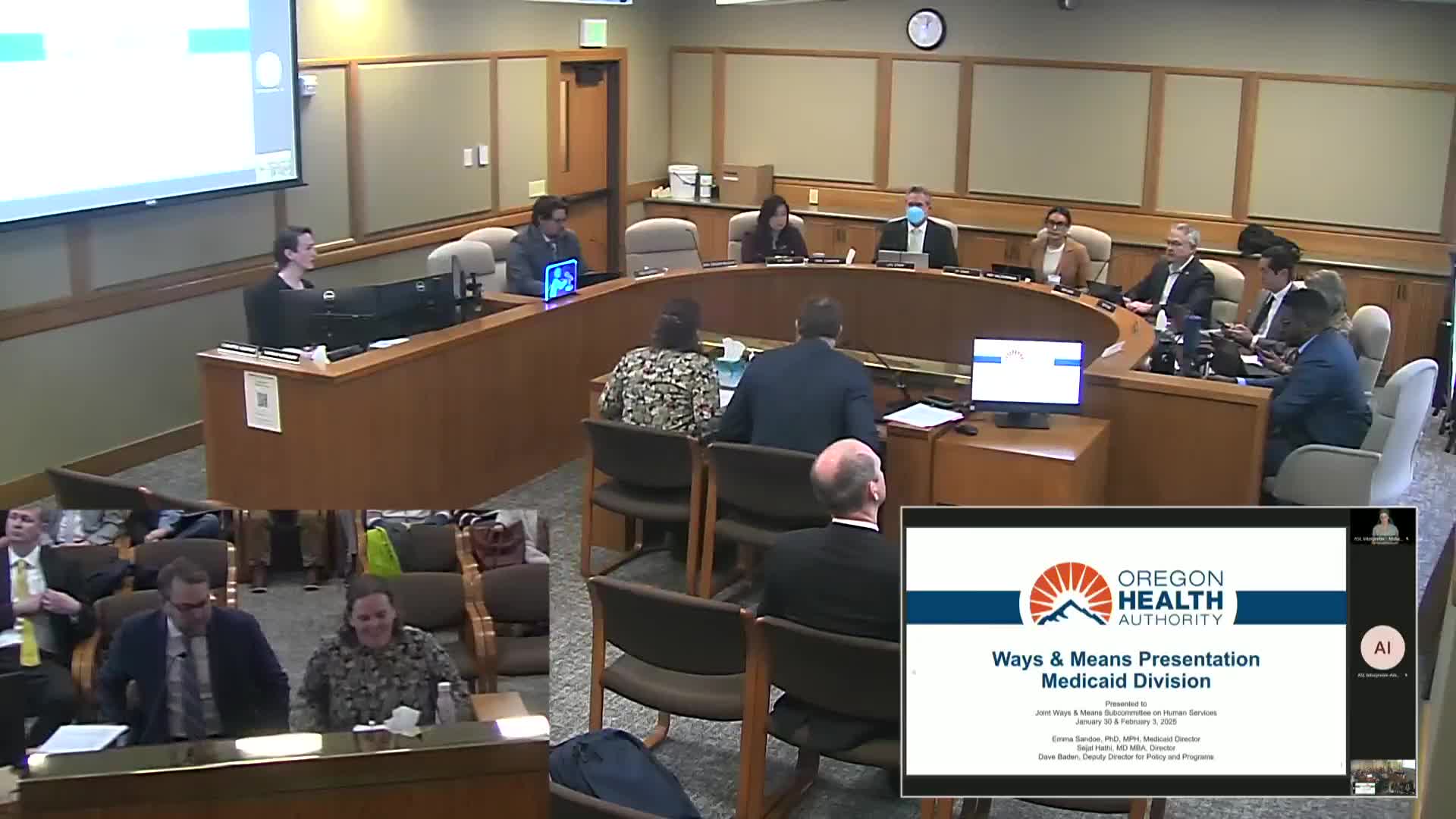
The Joint Interim Subcommittee on Human Services heard a briefing Jan. 30 on House Bill 5025, the Oregon Health Authority’s primary budget bill, with agency leaders detailing the size of Oregon’s Medicaid population, new waiver-driven benefits and recent program expansions.
Emma Sandow, Medicaid director for the Oregon Health Authority, told the committee the Medicaid program covers about 1,400,000 people in Oregon — roughly one in three residents — and that the agency now serves “about 57% of youth” and covers “over 40 percent of all births” in the state. Sandow said the Medicaid division administers three programs under the Oregon Health Plan umbrella: the Oregon Health Plan (traditional Medicaid), the Healthier Oregon program for people ineligible for federal Medicaid due to immigration status, and the OHP Bridge program for people up to 200% of the federal poverty level.
The briefing emphasized two implementation priorities. First, the 1115 waiver the agency received in pieces beginning in October 2022, which Sandow said enables the state to cover health-related social needs (HRSN) such as housing and nutrition, expand continuous eligibility for children and create new services such as a reentry benefit and a traditional healing program for tribal members. Second, the Healthier Oregon and OHP Bridge rollouts: Sandow said Healthier Oregon had “close to a hundred thousand members” as of December 2024, and that about 33,000 people were enrolled in the Bridge program, which covers people under 200% of the federal poverty level (about $51,000 annual income for a family of three).
Dave Baden, deputy director for policy and programs at OHA, told the panel the agency is publishing outcome dashboards and monitoring CCO (coordinated care organization) metrics and public-health indicators to measure whether increased coverage is translating into better health. “Those scorecards show us sort of about nineteenth or twentieth in a variety of health outcomes,” Baden said, noting both progress and remaining gaps.
Committee members pressed staff on access and program details. Senator Hayden and others asked about network adequacy for the fee-for-service population (commonly called the “Open Card” arrangement), which serves roughly 7.5% of members and includes federally recognized tribal members, youth in child welfare and Medicare dual-eligibles. Sandow said OHA is reviewing fee-for-service rates and implementing federal rule changes that aim to improve parity between managed care and fee-for-service network adequacy.
Representative Diehl asked whether OHA tracks primary care utilization; Sandow and Baden said the data exist and offered to follow up with specifics. Representative Deal asked whether the Healthier Oregon rollup included undocumented people; Sandow said the agency would provide a written follow-up because the exact count was not on hand.
On waivers and new authority, Sandow described the 1115 waiver’s HRSN benefits and other changes: continuous enrollment for children ages 0–6, two-year continuous enrollment for those older than 6, a young-adult special health needs program (ages 19–26), and a reentry benefit slated for implementation in 2026. The agency also reported launching HRSN services in 2024 (housing and other benefits) and a January 2025 nutrition benefit. Sandow said OHA was working with the nine federally recognized Oregon tribes on a traditional healing waiver to pay for traditional health practices.
Budget and funding questions surfaced. Baden said the OHP Bridge biennium budget includes a relatively small general-fund share ($13.4 million) and a larger total-fund plan (about $557 million), most of which is federal. He said OHA is analyzing possible federal policy changes, including the end of enhanced subsidies tied to ARPA, for potential impacts on enrollment and costs.
Members also raised data-privacy concerns after enrollment for Healthier Oregon requires personal information. Baden and Sandow said state laws and federal standards govern transmission and protection of health data and that OHA is “paying very close attention” to safeguarding privacy while complying with federal reporting requirements.
Sandow and Baden asked the subcommittee to direct additional technical questions to staff for follow-up; no formal actions or votes were taken at the Jan. 30 informational meeting.
The agency said it will return with more detailed materials and that the committee has another scheduled session to continue HB 5025 discussions.