Get Full Government Meeting Transcripts, Videos, & Alerts Forever!
Get email alerts on the Prison Education Reentry topic
No spam. Unsubscribe anytime.
State agencies outline expansion of prison education, Second Chance Pell approvals and reentry job services
Summary
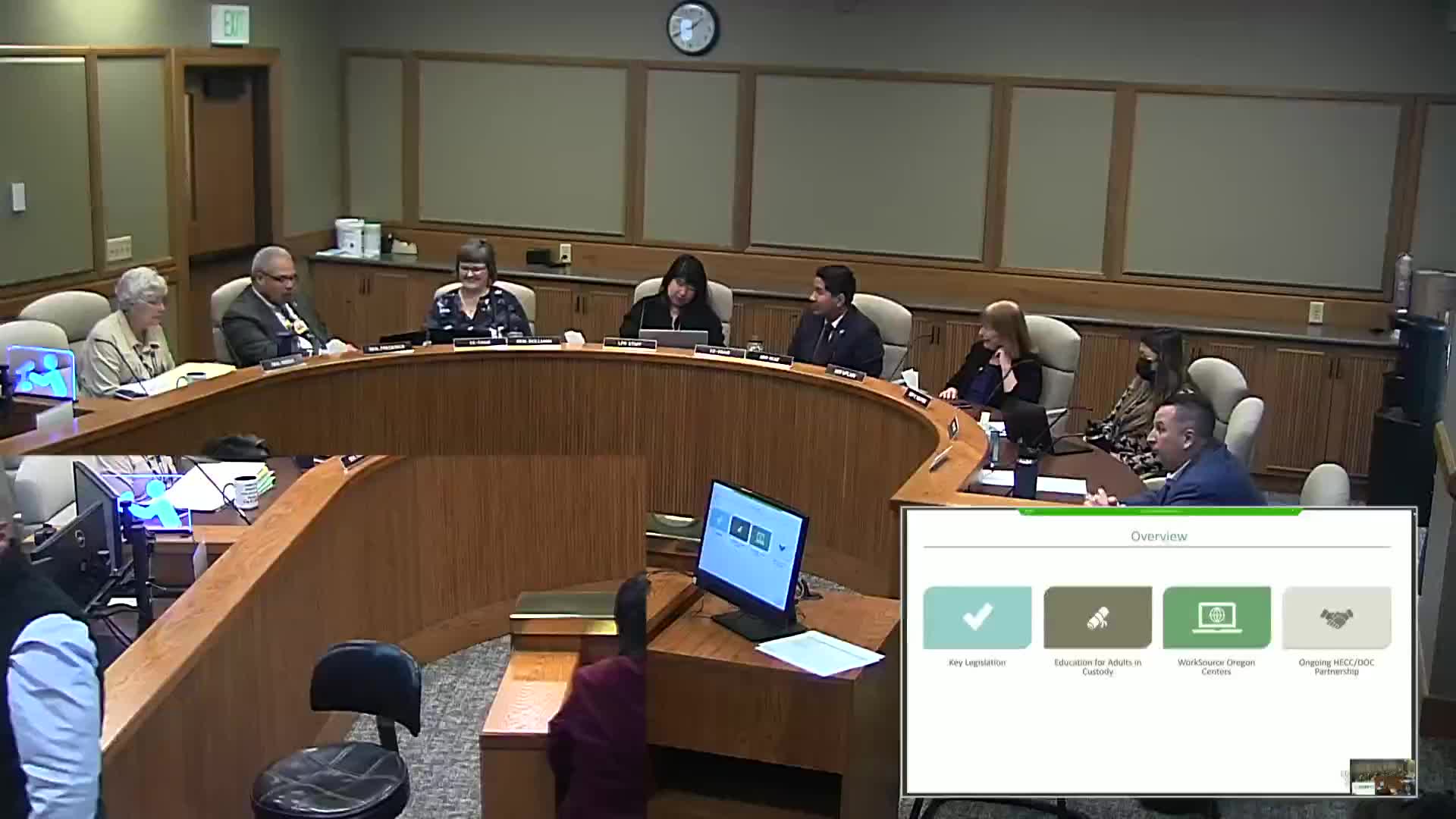
Donna LaWelling told the Education Subcommittee that recent legislation and interagency work are expanding post‑secondary education and reentry services for adults in custody.
Donna LaWelling told the Education Subcommittee that recent legislation and interagency work are expanding post‑secondary education and reentry services for adults in custody.
"The work continued, as a result of Senate Bill 269, which was passed in 2023. That particular bill, required, the development of a memorandum of understanding between the Department of Corrections and the Higher Education Coordinating Commission," LaWelling said, describing an advisory committee charged with data sharing, a distance‑learning policy and pathways for adults in custody to access federal financial aid.
LaWelling traced the legislative history back to Senate Bill 234 (2021), which convened a work group to recommend expansion of higher education within prisons. SB 269 required the agencies to formalize an MOU and an advisory committee that also serves the U.S. Department of Education’s Second Chance Pell oversight role.
LaWelling said the state partners have moved to scale post‑secondary access inside correctional facilities. Two colleges — Central Oregon Community College and Portland State University — have received U.S. Department of Education approval to provide renewed Second Chance Pell enrollments for adults in custody; several other Oregon institutions have applied and are awaiting approval, she said.
The agencies reported institutional partnerships for basic and adult education: Central Oregon, Chemeketa, Portland and Treasure Valley community colleges provide adult basic skills and other coursework to incarcerated students. LaWelling said apprenticeship pathways exist inside correctional settings: the Department of Corrections runs eight apprenticeship programs across 13 facilities covering multiple occupations, though enrollment varies by site.
LaWelling described the WorkSource Oregon reentry program, a team‑based approach that begins in custody 90–180 days before release. WorkSource staff and Department of Corrections personnel create individualized employment plans, assist with resumes and interview preparation, and coordinate post‑release job placement and training. LaWelling said WorkSource computer labs are established at all 12 state prisons; the equipment was funded by a U.S. Department of Labor Pathways grant.
On outcomes, LaWelling reported a 1.43 percent recidivism rate for the cohort measured one year after release — compared with an official Oregon rate of 40.5 percent — but she cautioned the measures use different years and the WorkSource figure covers an early cohort.
Committee members and legislators described individual success stories from program participants. Senator Frederick and several representatives recounted formerly incarcerated people who completed coursework and found employment and housing after release; the committee said stories reinforced the programs’ value.
(Ending) LaWelling said the HECC and Department of Corrections will continue implementing SB 234 and SB 269 recommendations, finalize the MOU and pursue expanded distance learning, data sharing and federal financial‑aid access for adults in custody.