Get Full Government Meeting Transcripts, Videos, & Alerts Forever!
Get email alerts on the Property Tax Reform topic
No spam. Unsubscribe anytime.
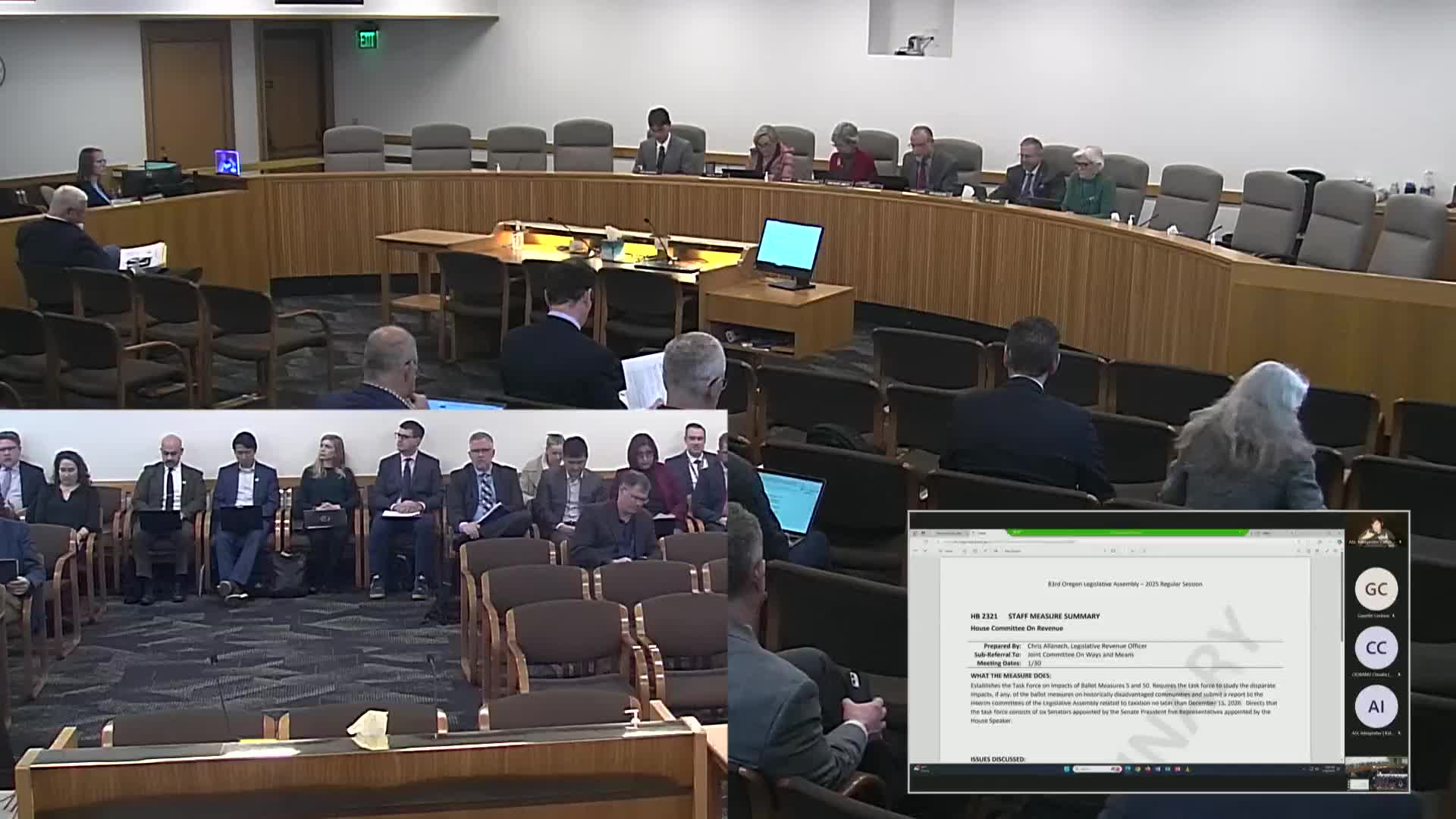
House committee opens hearings on four bills to create task forces studying Measures 5 and 50
Summary
The House Committee on Revenue opened public hearings Jan. 30 on four related bills that would create task forces to study the long-term effects of Oregon ballot Measures 5 and 50.
The House Committee on Revenue opened public hearings Jan. 30 on four related bills that would create task forces to study the impacts of Oregon ballot Measures 5 and 50.
The measures, passed in the 1990s, capped property tax growth and remain a central constraint on local revenue. Chris (staff member) told the committee the bills are “largely the same” and would create task forces with differing focuses: historically disadvantaged communities, local governments, the cost of public higher education and small versus large taxing jurisdictions.
Representative Paul Evans, House District 20, urged the committee to examine not only revenue shortfalls but the real-world effects on services and opportunities. “My goal in this task force approach is not to get a group together to look for new taxes,” Representative Paul Evans said. “Instead… look at what we can demonstrate and what we know about the impacts of Measure 5 and 50 on our decision making.”
Jenna Jones of the League of Oregon Cities said property taxes remain the largest source of revenue for many cities, and she asked lawmakers to study how the measures have contributed to “compression” — a loss of locally available revenue — and to consider how a system tied to current market value would affect services. “Property taxes are really the foundation,” Jones said. She told the committee that in fiscal year 2023–24 cities collected about $1,900,000,000 in property taxes and that compression cost cities roughly $50,000,000 that year.
Ethan Nelson, intergovernmental relations manager for the City of Eugene, gave local budget context: Eugene is working through an $11,000,000 general fund gap and has reduced roughly $67,000,000 in general fund spending since fiscal 2010. “Over the course of that time we’ve reduced $67,000,000 out of the general fund in staff cuts, budget cuts, reduction services,” Nelson said.
Mayor Travis Stovall, speaking for the Metro Mayors Consortium, said the Metro region — home to 1.7 million residents — supports creation of a task force and urged that metro-area cities be represented. “We are here to express our strong support for the house bills regarding Measures 5 and 50,” he said, adding that the measures have made it “increasingly challenging to sustain critical and essential services.”
Legislative counsel Deputy Victor Reuther clarified that “local governments,” as used in the bills, would include cities, counties, metros, special districts and school districts.
Committee members asked for additional data on how service levels and specific infrastructure metrics have changed since the measures were passed. Chair Nathanson requested that advocates provide comparative metrics such as miles of sidewalks, acres of parks per 1,000 residents, and other service-level indicators to help the legislature judge the measures’ practical effects.
The committee took testimony from multiple local-government associations and officials and closed the hearing on the four bills without taking formal action. Lawmakers and witnesses suggested amendments to clarify task force membership and scope, and several witnesses urged explicit inclusion of local-government representation on any task force that studies local impacts.
What happens next: Committee staff and proponents signaled intent to craft amendments that would clarify definitions and membership; the committee did not advance or vote on the bills during the Jan. 30 hearing.