Get Full Government Meeting Transcripts, Videos, & Alerts Forever!
Get email alerts on the Consumer Protection Privacy topic
No spam. Unsubscribe anytime.
Oregon DOJ outlines consumer‑protection and privacy enforcement priorities, calls for staff expansion
Summary
Department of Justice officials told the committee the state’s consumer‑protection unit is small (about seven attorneys) but active; the agency described recent settlements, the new Oregon Consumer Privacy Act work and a plan to expand capacity to pursue larger investigations.
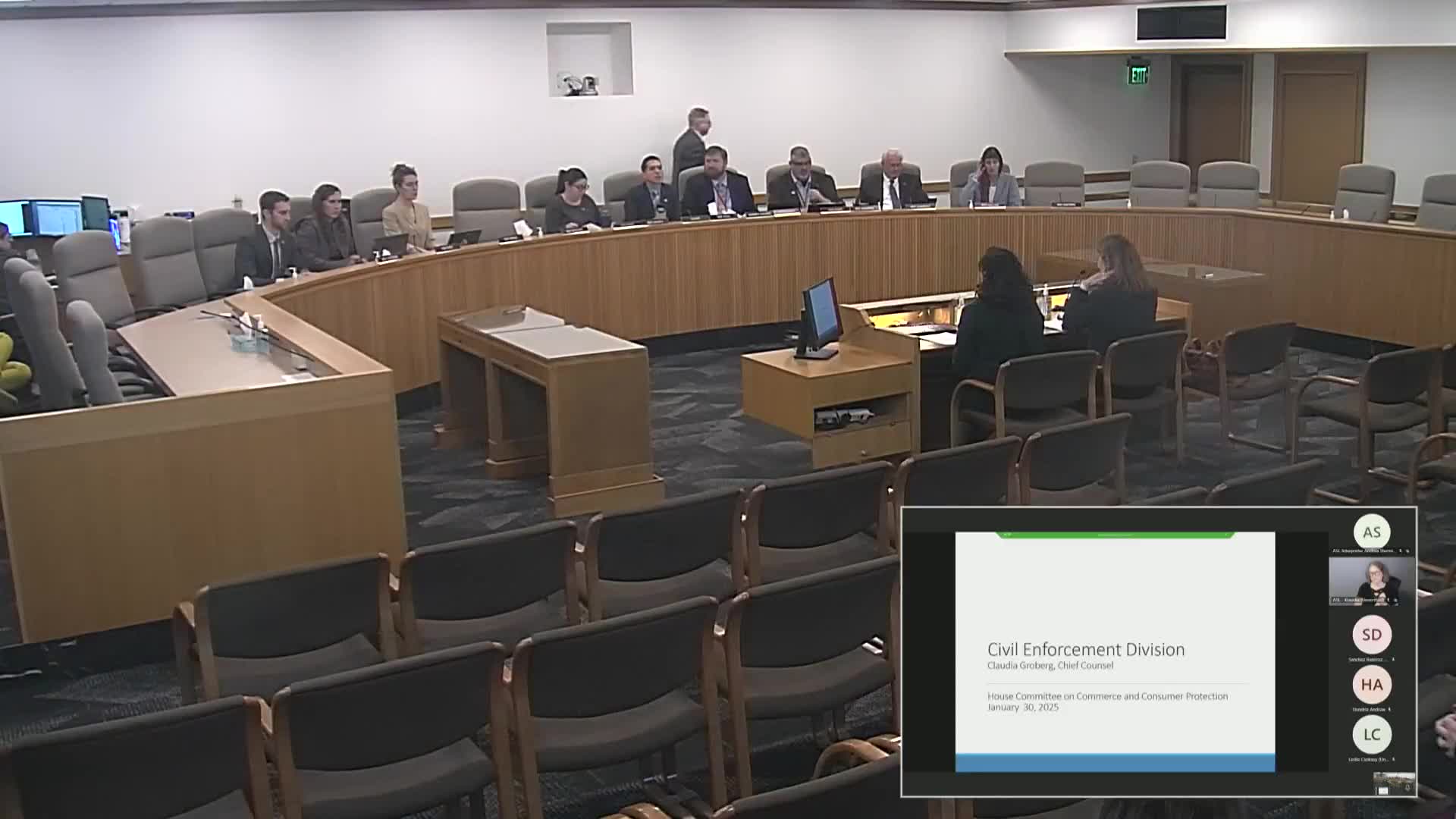
Leslie Wu, policy adviser to Attorney General Dan Rayfield, and Claudia Groberg, chief counsel of DOJ’s Civil Enforcement Division, presented an informational update to the House Commerce and Consumer Protection Committee on Jan. 30 about consumer protection and the department’s new privacy enforcement work.
Wu said consumer protection is an administration priority and that DOJ’s capacity is limited: she said the civil enforcement division’s consumer‑protection team has approximately seven attorneys and that neighboring Washington state has more than triple that staffing level. Wu said the department receives thousands of consumer complaints each year and that greater capacity would allow the state to pursue larger, systemic investigations.
Groberg summarized the Civil Enforcement Division’s structure and recent cases. She said the division enforces the Unlawful Trade Practices Act and related provisions (citing ORS 646.608 as among the statutory tools discussed in committee) and that the division divides its consumer work between enforcement and a public‑facing complaints program. Groberg described a recent settlement with Camping World in which DOJ recovered $3,500,000: $3,000,000 would refund consumers while the remainder flows into DOJ’s consumer protection account.
On privacy, Wu and Groberg described the Oregon Consumer Privacy Act (effective July 1, 2024), the department’s new privacy team (initially funded with five positions, with three hires to date) and an online privacy complaint portal. Groberg said the new law gives consumers rights over data collection and imposes limits on commercial collection of personal and sensitive data; nonprofits become subject on 07/01/2025. The department has opened consumer privacy complaints through the portal and reported receiving 10 privacy complaints in the first six months, which the presenters said compared favorably to other states that implemented similar laws.
DOJ described other multistate enforcement work and settlements, including a multistate settlement tied to a Marriott data breach that will deliver approximately $2.1 million to Oregon as part of a larger settlement. Wu asked lawmakers to consider capacity increases to enable the agency to pursue more cases, pursue large tech‑sector investigations and staff a prospective working‑families unit aimed at wage theft and labor enforcement work modeled on other states.
Committee members asked procedural and jurisdictional questions (for example, whether fuel‑station self‑service complaints fall to DOJ or another regulator, and how consumers decide whether to seek AG enforcement versus private legal action). DOJ staff said they would follow up with written answers on jurisdiction and enforcement strategy. The session was informational; DOJ did not request immediate legislation but described staff and funding needs to expand enforcement.