Get Full Government Meeting Transcripts, Videos, & Alerts Forever!
Get email alerts on the Higher Education Finance topic
No spam. Unsubscribe anytime.
State agency urges carryover of $11.1 million to continue support for technical, regional universities and PSU
Summary
The Higher Education Coordinating Commission told the Education Subcommittee it has distributed most of a 2023 $25 million one‑time sustainability package to five universities and recommends carrying $11.1 million into the 2025–27 biennium to finish multiyear projects.
The Higher Education Coordinating Commission on Thursday told the Legislature it has committed most of a 2023 one‑time $25 million appropriation to improve the financial sustainability of Oregon’s technical and regional universities and Portland State University and is asking that $11.1 million be carried into the 2025–27 budget.
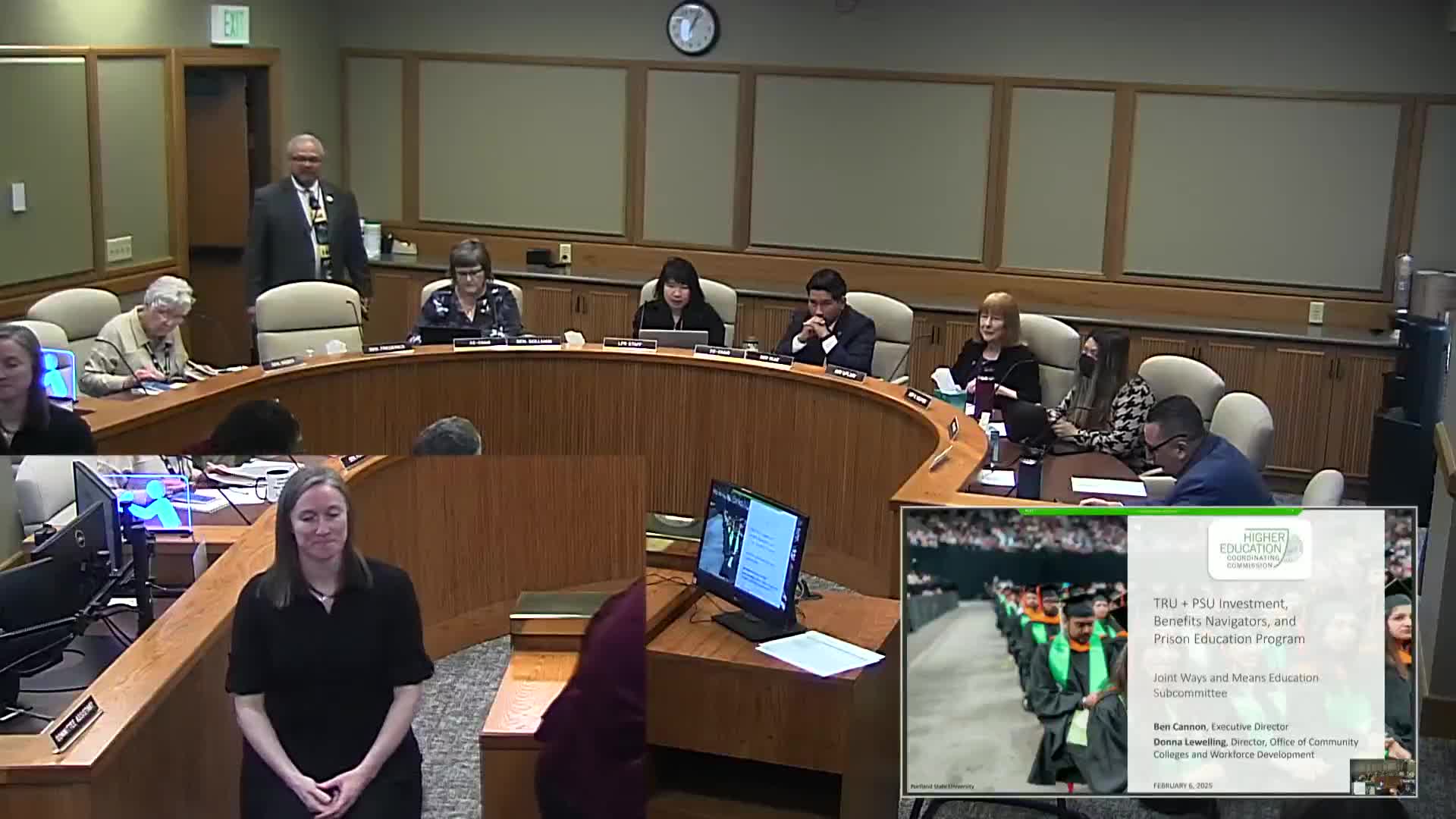
Ben Cannon, executive director of the Higher Education Coordinating Commission, summarized work funded so far and the agency’s plan for remaining dollars. "We recommend the inclusion of 11,100,000.0 in general fund be reappropriated for 25‑27 for continuing and concluding this project," Cannon said.
Cannon said the 2023 package aimed to address demographic and enrollment pressures, increase retention and completion rates, and support institution‑specific paths to long‑term financial stability. The Legislature provided $25 million in one‑time funding: roughly $6.1 million distributed in September 2023 on a formula basis for proof‑of‑concept efforts, $100,000 for an independent report, and an $18.7 million special appropriation that the HEC is allocating through competitive grants.
The commission issued a request for applications in 2024 with three funding categories: strategic cost reductions, revenue growth initiatives and collaborative shared‑services projects. Cannon said the commission received 19 proposals and has committed to fund 15 projects, totaling $16.8 million in awards; payments are being made through multi‑year grant agreements rather than as a single upfront disbursement.
Under the distribution rules the commission described, each technical and regional university is eligible for up to $2.3 million of sustainability funding and Portland State University is eligible for up to $7.7 million, with $2.5 million reserved for collaborative projects among the five institutions. Cannon said the commission expects to spend about $7.6 million of the special appropriation during the current biennium and leave about $11.1 million to complete work through June 2027.
Cannon described planned collaborative work that would be coordinated through Oregon Tech with a third‑party consultant to identify shared administrative services — areas such as procurement, compliance, risk management and internal audit — that could reduce costs if consolidated. He also said the universities are developing a collaborative student‑support proposal focused on reengaging “stopped‑out” students, but that proposal had not been funded at the time of the presentation.
Representative Pam McLean, who praised the institutions’ efforts, asked about reporting and evaluation. Cannon said the first $6.1 million produced an end‑of‑year report shared with the Legislature and that current grants require ongoing reporting; the institutions will provide updates as the projects progress.
Cannon and the committee emphasized that the funding was explicitly one‑time state support and that funded projects were required to demonstrate they would not create ongoing state funding needs. The HEC cited an institutional estimate — which it said it had validated — projecting an $88 million net return over the lifetime of the funded projects through a combination of cost savings and incremental revenue.
The commission noted that some projects — such as replacing a core information system at Southern Oregon University and program revitalization efforts at Portland State University — require sizable up‑front investment to deliver long‑term savings or revenue alignment.
Cannon concluded by flagging the appropriation‑carryover request for the committee’s budget work on the 2025–27 biennium.
The informational hearing included questions from committee members but produced no formal votes.
(Ending) The commission said it will continue to finalize grant contracts and provide regular reporting on outcomes to the Legislature as projects are implemented.