Get Full Government Meeting Transcripts, Videos, & Alerts Forever!
Get email alerts on the Racing Commission Funding topic
No spam. Unsubscribe anytime.
Oregon Racing Commission seeks budget backfill as wagering and operating revenues fall
Summary
The Racing Commission asked the House committee for funding to restore staffing and safety programs after multiple revenue losses, saying a modest appropriation would help sustain veterinary services, testing and other safety work for horse racing.
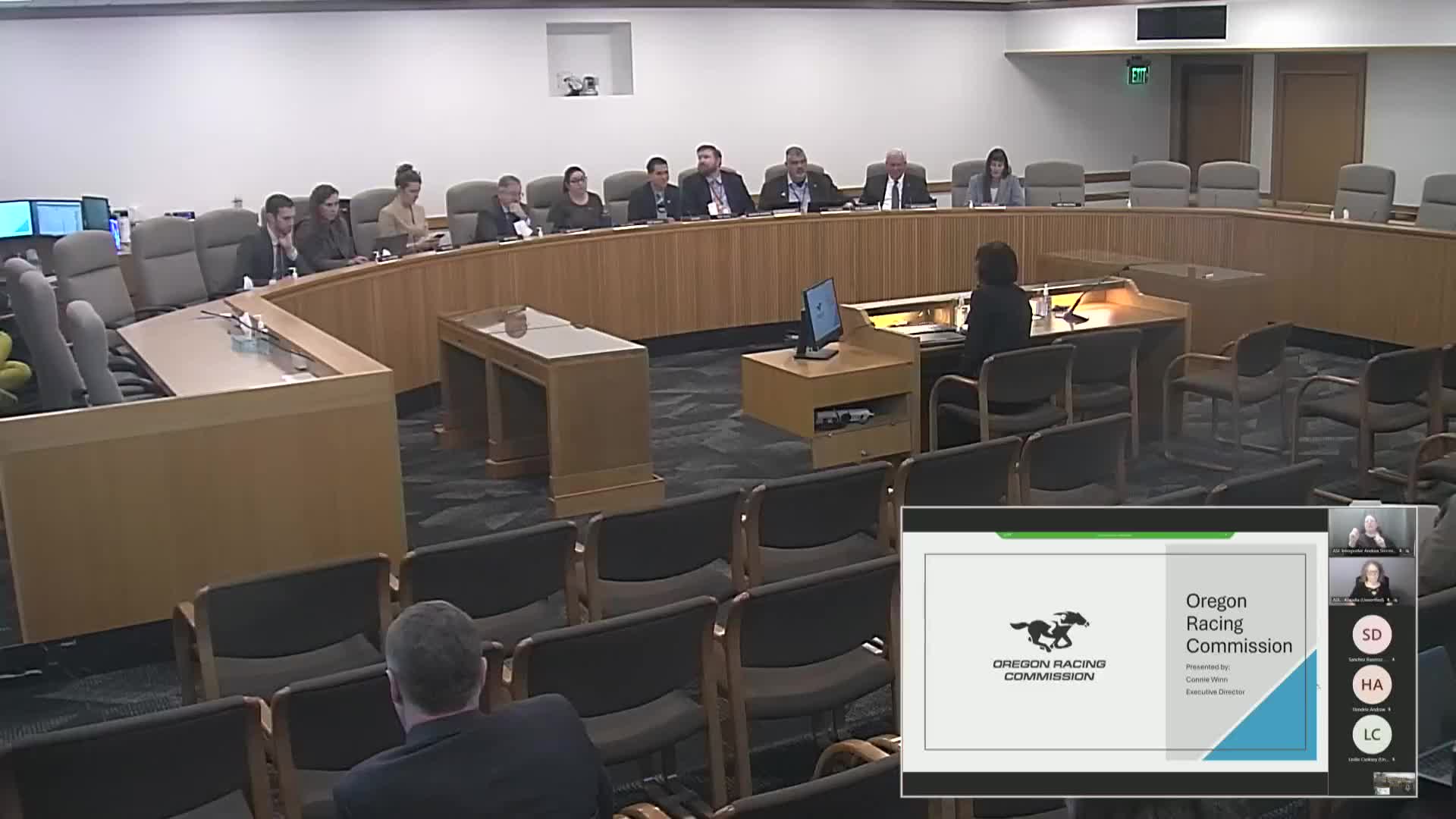
The Oregon Racing Commission told the House Committee on Commerce and Consumer Protection that HB 3023 is a budget‑level measure intended to offset recent and anticipated revenue losses and restore staff and safety services for regulated racing.
Connie Wynne, executive director of the commission, told lawmakers the commission supported HB 3023 and the governor had included the request in the executive budget. Wynne listed a series of revenue declines: the loss of year‑round racing at Portland Meadows, the loss of on‑site simulcasting, the closure of three off‑track betting locations (Ontario, Medford and Roseburg), declines in historical horse racing (HHR) at Portland and Grants Pass, and the loss of three online wagering companies. She estimated the restoration need at roughly $850,000 a year and said funds would be used to restore positions (including veterinary staffing), enhance testing and safety initiatives, and support on‑the‑ground regulatory services.
Wynne framed the request as a targeted stabilizing step. “This isn’t just the greyhounds. ... We need this to become whole again,” she told the committee. The commission later clarified some figures, noting an earlier cited $238,000 total was a biennial number; Wynne and others said the proposed funding would allow the commission to rehire or restore services cut in recent years.
Horse‑racing stakeholders supported the funding ask. Representatives of the Oregon Thoroughbred Owners and Breeders Association and horsemen’s groups said racing is expensive to operate and that purse support and regulatory oversight depend on hub flows and statutory fees. Lee Erickson, a breeder and owner, told the committee breeding and training costs exceed $2,000 per month per horse and that stable operations rely on predictable purse income.
No formal committee action occurred. Committee members asked for further budget detail and emphasized the commission’s need to identify durable revenue sources if wagering patterns continue to evolve.